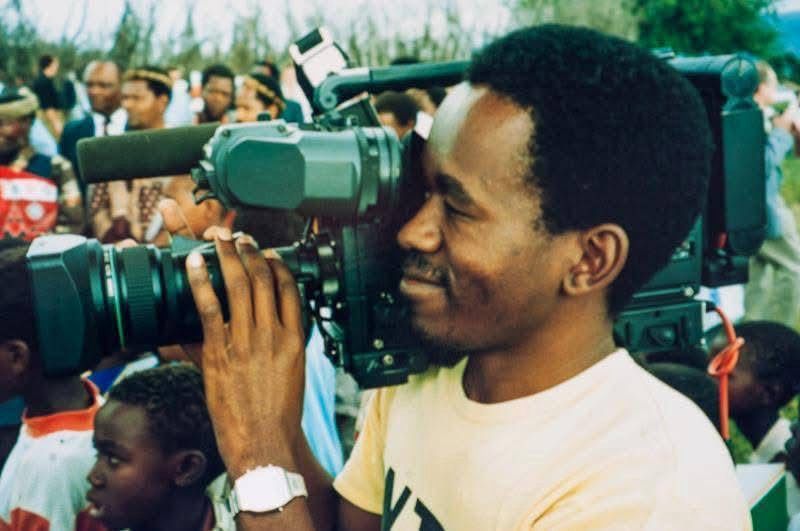
We buried Theophilus Sjuja Spokes Mashiyane. He was my childhood friend, a university mate and later a media colleague.
We buried the bones, flesh and blood. But his spirit lives in our memories, hearts and souls. Friends and family spoke about his life, his achievements and intentions. However, I am not too sure if the majority understand Spokes‘ role and responsibilities as an International News Cameraman. For that is what Spokes was.
Yes, he started out under Bantu Education from primary school right up to university. We were the generation that believed in making the best of the bad.
We knew it was poisonous. We would beat the apartheid system in its game, we vowed as youngsters. Thus, he qualified with a B.Com degree at Fort Hare University. It was not easy in those days.
Spokes was later to emerge as an International News Cameraman in 1985. This was at the height of Apartheid repression during the brutal reign of President PW Botha. It was also the terrible year during which the illegitimate regime imposed the State of Emergency, characterized by curfew, detention without trial and random disappearance of anti-apartheid activists.
Primarily, as his friend and colleague Winkie Mkhize said in 2-minutes speech, Spokes was in the heart of documenting our turbulent history.
This followed then-banned ANC President OR Tambo’s call to the children and youth to “make the country ungovernable.” As a result, all the devils left hell to join and fight in the struggle. There, too many unidentifiable com-tsotsis (criminals that masqueraded as political activists). This was in the mid-1980s, a few years after he had finished his B.Comm studies at University of Fort Hare.
Thus, between 1985-1995, Spokes pushed his way into the war zone, defying apartheid police, the com-tsotsis and death itself to capture and chronicle the turmoil. On a number of occasions, he was confronted and threatened by SADF soldiers and police for doing work.
![Theophilus Sjuja Spokes Mashiyane [Image: Gallo Music]](https://gsmn.co.za/wp-content/uploads/2026/02/Spokes-Mashiyane-1024x1024-2.png)
It was a historical turning point. The much-vaunted Struggle intensified. The Apartheid machinery was in full swing. The soldiers in the townships. The Mellow Yellows (yellow-coloured armoured vehicles). The army trucks and camouflaged child soldiers. The Police. The dogs. The brutality. Above all, the guns. The blood-letting. Worsened by the internecine political and ideological wars. And death that sprawled the streets.
Spokes was the eyes and ears of the world that was watching. Township upheavals were the stories of the decade. They had shaken the ANC out of slumber in exile. So, underground cadres suddenly came out of the woodwork.
And Spokes was one of the International News Cameramen that played a crucial role in capturing the raw emotions, protests, and violence that defined this era. He woke upvery early everyday and went to bed late at night to file his stories that were about a country that was divided against itself. A racist country.
The lines were clearer then. Everybody thought they knew who the “enemy” was. Nobody knew or believed the worst enemy was among the Struggle ranks.
Spokes had to do what he was committed to do, that is, capture compelling footage of events as they unfolded. For someone smart with a university degree, I think he was aware that he worked under pressure in high-risk environments. I know some young journalists of our generation who got sick and depressed with inhaling tear gas and the body counts. Some of us steeled our hearts and our souls became numb. Our attitude was to wrestle with the devil.
They say pictures are worth a million words. Spokes told a story through images, conveying the essence of the moment, of the torrid times. The apartheid regime was cornered and could no longer deny the horrendous events.
As writers, with veterans like Jon Qwelane, Themba Molefe, Mono Badela, Mudhini Maivha in the front lines, we attempted to provide context and objectivity in chaotic situations. Black journalists had chosen to take sides. They felt they could not be objective. They became “Black first”. They were more guerrillas than journalists. They chose to be on the side of the elusive justice, equality and democracy.

So, we went as a pack to the war zones. We collaborated with reporters and producers of international news like Spokes, Rapitse Montsho and Milton Nkosi, among others, to craft a narrative.
It must be made clear that during this period, cameramen like Spokes and Rapitse – together with the “Bang Bang Club” of photographers – risked their lives to document the struggle against apartheid. It is their footage that brought the brutal realities of apartheid to global audiences, influencing public opinion and contributing to the eventual dismantling of the regime.
It was Winkie Mkhize, again, who made the point, within two minutes, that “Spokes documented History.” A very important point to bring to the mourners and society in general. Thus, it is footage from this era that serves as a visual record of resistance and resilience and, sadly, the self-sabotage.
Spokes et al were in the forefront to provide firsthand accounts of pivotal moments, like the unbanning of political parties at the turn of the 1990’s, the 1985/6 upheavals, the Nelson Mandela’s release from prison and the ultimate ushering of democracy and freedom in April 1994.
Spokes contributed to the South African Historical Archive. In fact, he helped shape the narrative of South Africa‘s liberation struggle and the transition to democracy. His work reminds us of the power of journalism in shaping our understanding of history. The tragedy is that at the time of his death, Spokes was disillusioned. He felt betrayed. And he was angry for allegedly been cast aside. They say the revolution eats its own children
But he is gone now. His works are our heritage. His memory lives in our hearts. Some of us are glad that we walked the path with him. He told our stories and captured our history. Only fair that we do the same for him.
Lala Kahle, Mashiyane. Mnkandla. In your own way, uyiqhawe and may your spirit multiply.


![A grieving widow [Image: WIF]](https://gsmn.co.za/wp-content/uploads/2026/02/black-woman-crying-.jpg)