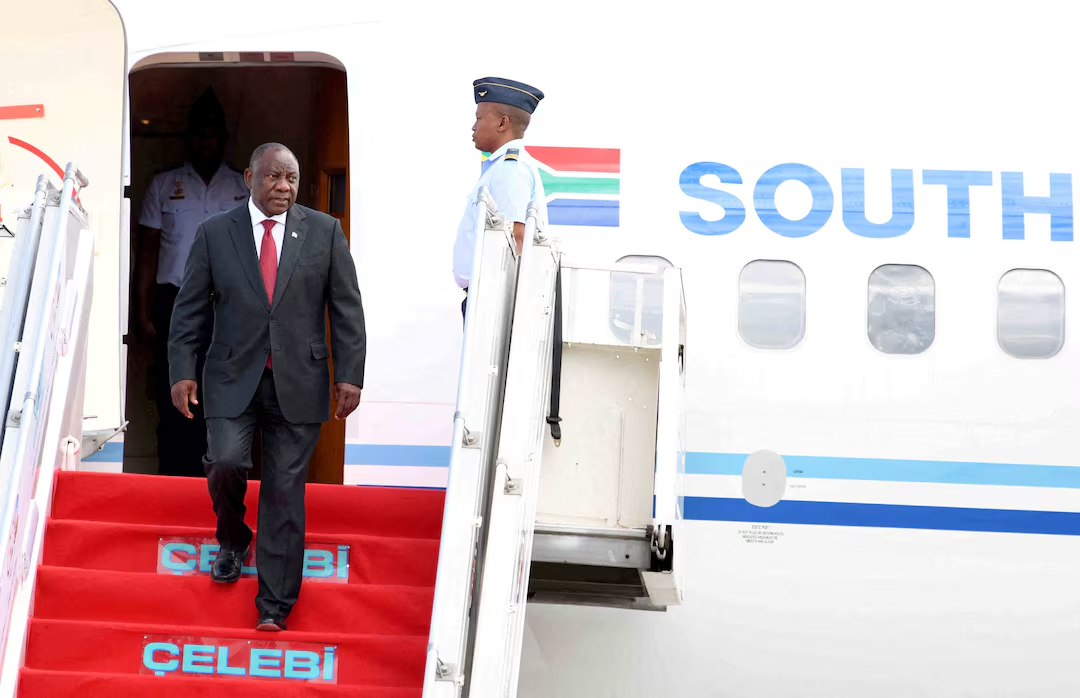
The Red Carpet was roll-out as South Africa’s President Cyril Ramaphosa arrived at the Joint Base Andrews Airport in Washington, US, for a high-stakes diplomatic visit.
This working visit is aimed at mending the increasingly strained relationship between South Africa and the United States. Once considered a stable partner on the African continent, South Africa now finds itself at odds with Washington over a series of contentious policy positions.

Central to these tensions are South Africa’s domestic land reform efforts, which have drawn harsh criticism from U.S. President Donald Trump, who has been disparagingly echoing a debunked conspiracy theory about “white genocide” in South Africa.
In addition to this, Pretoria’s increasingly non-Western-aligned stance on global conflicts – particularly its refusal to condemn Russia in the ongoing Ukraine War, and its irrevocable support for Palestinian statehood – has only fanned the flames of Washington’s rage.

This year, 2025, marks the advent of South Africa’s first uptake of leadership in the Group of 20 (G20), since its first inception into the group in 1999. In fact, South Africa is the only African country to have been a permanent G20 member since its formation. This would have been an opportune year for SA-US ties to flourish – after all, the US is SA’s second-biggest trading partner behind China – but reality has proven to be the complete opposite. Most recently, both President Trump and his Secretary of State, Marco Rubio, have threatened to boycott the G20 main event, and have banned all US agencies from any work on the G20 in South Africa.
In fact, a few months ago in mid-March, South Africa’s Ambassador to the US, Ebrahim Rasool, was unceremoniously booted out of the nation and declared a persona non grata by the Trump administration.

In addition to this, the future of the African Growth and Opportunity Act (AGOA), which provides duty-free access to the US market for some African products, hangs in the balance. With the perpetual stoning that has been dished out by the US President, it is unclear whether the AGOA agreement will be renewed upon its expiration this coming September 2025. This has propelled SA, and other African nations, to actively seek out healthcare partnerships and resources in other nations. SA’s partners in the rapidly-growing BRICS bloc have been especially key to establishing and fostering new economic ties in the larger global economy.
Besides the US President’s callous lambastation of SA’s geopolitical decisions, the nation was most-painfully struck by President Trump’s merciless decision to slash approximately $436 million in U.S. aid to South Africa under the President’s Emergency Plan for AIDS Relief (PEPFAR). SA, infamously contending with having the world’s highest number of HIV patients, is experiencing its biggest blow to its healthcare system since the early 2000’s. The cuts have reportedly led to the loss of over 8 000 healthcare worker positions, and the closure of over 12 specialized HIV/AIDS clinics, particularly affecting marginalized groups, underprivileged communities, and children.

In just a few months since these cuts, viral load testing declined by 21%, and early infant diagnostic testing has fallen nearly 20%, hindering the ability to monitor antiretroviral treatment (ARV) effectiveness and identify potentially infectious individuals. This has also arduously affected HIV/AIDS and Tuberculosis services, treatment, and critical research efforts. Healthcare experts such as Science Direct have warned of the catastrophic consequences of these disruptions, stating that they could lead to an estimated 150 000 to 295 000 additional HIV infections by 2028, and approximately 56 000 to 65 000 more HIV-related deaths during the same period, with a crippling projection of 700 000 deaths by 2045.
More recently, merely a week ago, a group of 59 white Afrikaner South Africans officially moved to the US to resettle, after President Trump granted them refugee status. Across the globe, experts and netizens alike have blasted President Trump’s revival of the dangerous and discredited myth of “white genocide” in SA as severely reckless, and a blatant affront to South Africa’s sovereignty and dignity. SA’s President Ramaphosa said in response, that those who wanted to leave were not happy with efforts to address the inequities of the apartheid past, observing their relocation a as cowardly, and an extremely “sad moment for them”.

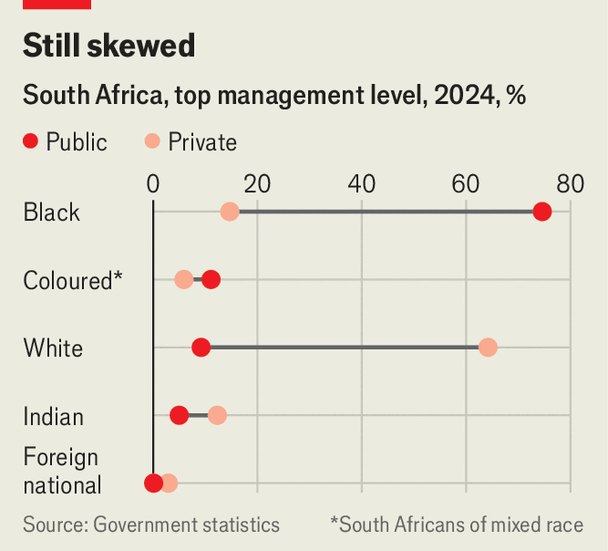
A flurry of South Africans – predominantly white – have also rubbished the claims of genocide and discrimination against Afrikaners, stating that this is a last-ditch effort to preserve the systemic white-privilege that is still deeply entrenched into post-democratic SA’s reality. In fact, notable Afrikaner farmer and SA’s richest man Johann Rupert, who is also in Washington at this time, has fervently expressed his frustration with Trump’s claims of a ‘white genocide‘ and the typecasting of disgruntled Afrikaners as ‘refugees‘. It remains unclear whether Rupert will form part of the delegation during the Trump-Ramaphosa meeting.
The SA and US Presidents will meet on Wednesday 21 May 2025 at Noon to discuss the way forward. SA’s Presidential Spokesperson Vincent Magwenya stated that President Ramaphosa will not address the alleged persecution of white people in South Africa during his meeting with US President Donald Trump, as it has been deemed a falsehood.
Magwenya elaborated that the meeting will focus on AGOA, high tariffs and trade relations, and that it will ‘focus specifically on reframing bilateral, economic and commercial relations.’

The President was and is received by Minister of Trade and Industry and Competition (DTIC), Mr Parks Tau, South African Embassy Chargè d ‘Affairs, Mr Stanley Makgohlo, Col Pumla Dlali, Assistant Defence Attache at the South African Embassy and Ms Abby Jones, Acting Chief of Protocol, and the State Department.
The President’s delegation comprises of the following ministers: Mr Lamola, Minister of International Relations and Cooperation; Ms Ntshavheni, Minister in The Presidency; Mr Parks Tau, Minister of Trade, Industry Competition; Mr Steenhuisen, Minister of Agriculture; Democratic Alliance (DA) leader John Steenhuisen; and Mr Jonas, Special Envoy to the United States of America.
Ultimately, they may be a strong symbolism emergent from the high-level meeting of the US and SA Presidents. Trump, the pioneer of the Make America Great Again (MAGA) movement, is a pro-white racial supremacist with a highly chauvinistic view of America and Capitalism above-all. This is the exact antithesis of Ramaphosa, a black, prominent anti-apartheid activist and trade union leader who was a prime actor in the CODESA negotiations for SA’s Democracy. Ultimately, their only commonality may be that they are both shrewed businessmen that believe in the autonomy of their nations.

In this particular instance, Ramaphosa not only represents everything that Trump seemingly stands against, he is also representative of an entire race and continent, that Trump may hate, but also desperately seeks to run to run the show.
This meeting will certainly be a rare showdown between two opposing global powers. There is no doubt that Trump will – in typical fashion – demonstrate a dramatic display of power‘, reiterating his claim as “the most powerful man on Earth”. However, Ramaphosa has not acquired his billions by falling into the rage-baiting traps that Trump will surely set-up. He is less-than-likely to end up in a heated rebuttal like the infamous Trump-Zelensky meeting. Rather, Ramaphosa is famously level-headed, and will likely lead with some ‘business talk’, seeking to alleviate any trade and economic stressors presented by the recent upheaval of SA-US foreign relations. Either way, the world will be watching in heightened anticipation.