

They stood shoulder to shoulder once, in boots and khakis, in underground cells and faraway capitals. They crossed borders at night, memorised ciphers, and whispered code names in the dark. They were comrades.
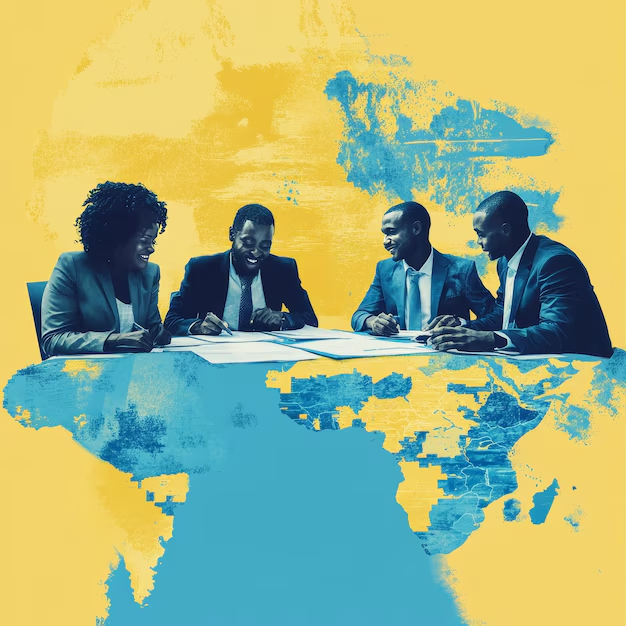
Now they meet awkwardly at business-class lounges or government banquets, offering half-smiles and evasive eyes. They sign off on tenders and patronage. One is a minister; the other, a CEO. One runs a foundation. The other keeps a quiet distance from public life. Both, once, were driven by something unspoken — an ache for liberation, and the fire of shared purpose.
This is not a story about betrayal. It is a story about contradictions.
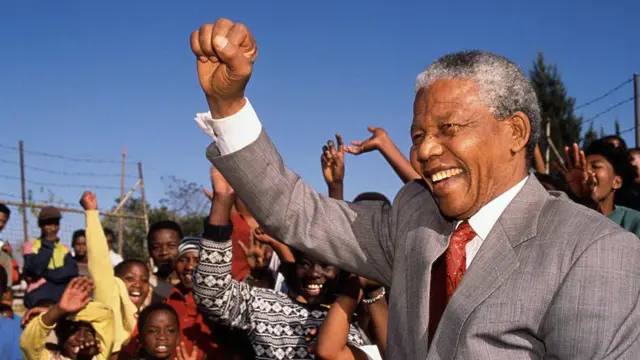
The Myth of Unity
We like to imagine that the liberation struggle was a united front, a choir singing one anthem, in tune and in rhythm. But anyone who lived it, or inherited its legacy, knows that unity was often performative, and that behind the clenched fists and slogans were rivalries, suspicions, and ideological battles.
There were the statists and the revolutionaries, the intellectuals and the soldiers, the religious and the secular, the loyalists and the critics, all of them part of a broad tent held together by urgency and the brutality of a common enemy.
But unity is easier when survival is at stake. What happens when the enemy retreats and power arrives?
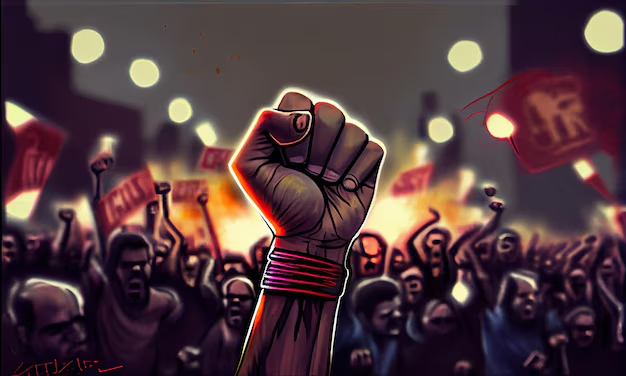
After the Arrival
Post-1994, South Africa had the impossible task of compressing centuries of dispossession, war, and struggle into a democratic miracle. The world applauded the handshake between jailer and jailed. And into the fragile architecture of democracy poured the exiles, the returnees, the home-grown organizers, and the newly mobilized youth.
Many former comrades were absorbed into the state, not just as bureaucrats but as ministers, diplomats, DGs, and presidents. Others went into business, with connections forged in Lusaka or London now becoming boardroom capital.
Some joined think tanks or NGOs. Some simply vanished, unable or unwilling to reconcile their beliefs with the emerging order. A few became the fiercest critics of the post-apartheid project, their letters bitter with disappointment.
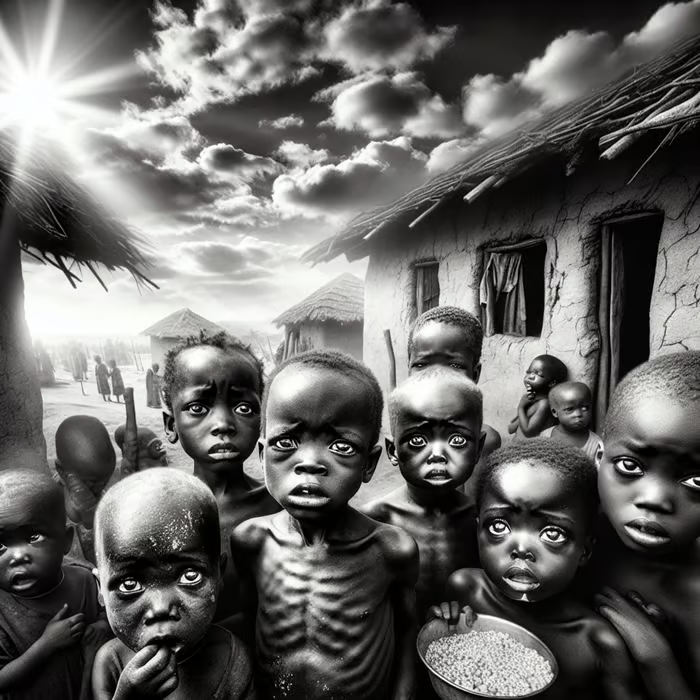
Loyalty, Then and Now
It’s difficult to speak about contradiction without touching on the sacred cow: loyalty. In the underground, loyalty was survival. To question, to dissent too loudly, was to risk the collective.
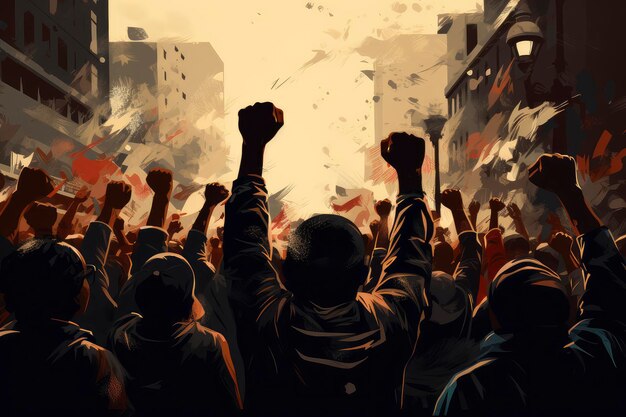
But in democracy, loyalty has been repurposed, often weaponised. It is invoked to protect the corrupt, to silence debate, to shame whistleblowers. “You’ve forgotten where we come from,” they say. As if remembering excuses everything that came after.
Some comrades now sit on opposite sides of commissions of inquiry. Others avoid eye contact at funerals. And still, a few toast each other at high tables, having turned their shared past into transactional capital.
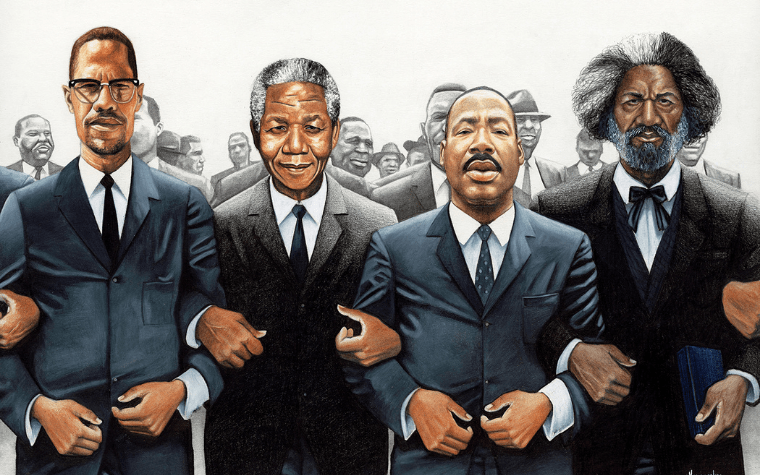
The Ghost of the Code
There is an unwritten code among former comrades, a code of knowing glances, unfinished sentences, and selective silences. It’s why certain stories are never told, why the archives are incomplete, and why so many memoirs feel like ghost-written obituaries.
Some carry secrets that would embarrass the living. Others protect reputations out of an old, perhaps misplaced, sense of duty. But this silence, too, is a contradiction. For a movement that promised truth, it sometimes deals too easily in omission.

When Revolution Became Procurement
There is a moment, spoken of only in private, when it became clear that struggle credentials could be monetised. Perhaps it was the first time a veteran was offered a seat on a board, or when a political funder insisted on meeting “someone who was really there.”
Procurement became politics. Deals were signed over old photos and worse whisky. Comradeship became a currency, the “struggle resume” now more valuable than a degree or work experience.
Some resisted this turn. Others dived in headfirst. The divide wasn’t always moral, sometimes it was generational, strategic, or just circumstantial. But the rupture remains. And it is in this fracture that many old friendships quietly died.
The Disillusioned Ones
Among the most tragic figures of the post-liberation era are the true believers. The ones who carried dog-eared pamphlets and quoted Sankara in conversation, who now walk with visible disappointment, unable to reconcile what was with what is.
They are neither bitter nor broken. But they are lost. They speak in past tense. “We used to…” “Back then…” They still attend the memorials and occasionally comment in newspapers. But their eyes betray them.
Some turned to academia. Others mentor younger activists. A few drink too much, caught in the purgatory between nostalgia and betrayal.
They are not to be pitied. But they must be remembered. They held the line, and when the line broke, they carried its memory.
A New Kind of Comradeship?
Perhaps the tragedy of contradiction is also its opportunity. We are, after all, not the first country to face the aftermath of revolution. Cuba, Algeria, Vietnam, they too, know the price of transition.
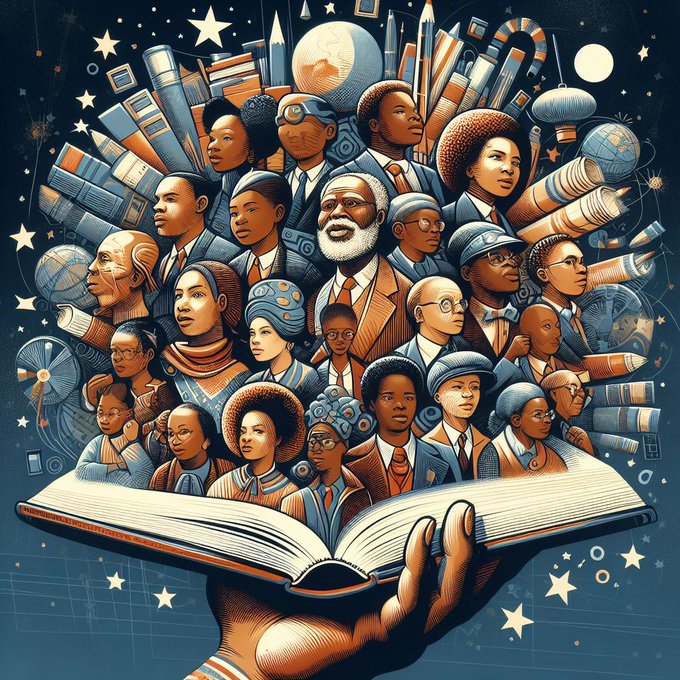
South Africa must find a new comradeship, one that isn’t built on secrecy and shared trauma, but on accountability, transparency, and renewal. One that can laugh at itself without losing its seriousness. One that acknowledges its failures without erasing its achievements.
There are glimmers: in younger activists refusing blind loyalty, in intergenerational conversations, in comrades who admit they were wrong.
The path forward is not purist, it never was. It is messy, imperfect, and human. But it nonetheless begins with honesty.
Final Reflections
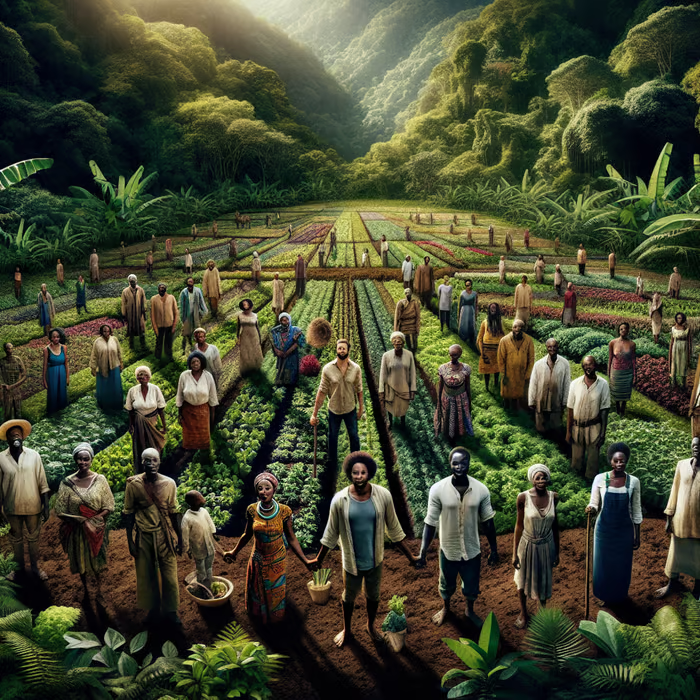
In the end, perhaps contradiction is not betrayal. Perhaps it is the price of being human in the face of history. The struggle was never just a linear path to freedom. It was and remains, a contested, complex terrain.
To walk with contradiction is not to walk with shame. But to deny it entirely is to do violence to memory.
So, here’s to the comrades, those who stood tall, those who fell short, those who vanished, and those who stayed. May we remember them honestly. Not as saints. Not as villains. But as people – flawed, courageous, compromised, hopeful.
As comrades. Only as comrades.


![Bra Hugh Masekela [Image: Wits Uni / Daily Maverick]](https://gsmn.co.za/wp-content/uploads/2026/04/WitsUni-Hugh-citation.jpg)
![DEPUTY PRESIDENT MASHATILE'S SPEECH DURING TITLE DEEDS HANDOVER CELEBRATIONS FOR SEBILONG RESTITUTION COMMUNITY [Image: SA Government via Linkedin]](https://gsmn.co.za/wp-content/uploads/2026/04/1775836079262.jpg)
![President Cyril Ramaphosa has appointed Justice Nambitha Christabel Dambuza-Mayosi and Justice Katharine Mary Savage as Judges of the Constitutional Court [Image : Instagram of News24]](https://gsmn.co.za/wp-content/uploads/2026/04/WhatsApp-Image-2026-04-15-at-22.38.18.jpeg)

![Indigenous knowledge systems integrated into modern curriculum - south africa history curriculum reform - school, education - image [linkedin]](https://gsmn.co.za/wp-content/uploads/2026/04/1742898386729.png)


![The Bolobedu PV Solar Plant in Limpopo, South Africa [Image: SOLA Group]](https://gsmn.co.za/wp-content/uploads/2026/04/image-39.png)
![AI image of Zimbabwe’s President holding the Constitutional Amendment No. 3 [Image: ZimNow]](https://gsmn.co.za/wp-content/uploads/2026/04/278b4a11-dfc4-4ff0-a394-806f97001410-1.jpg)

![DEP PRESIDENT MASHATILE ADDRESSES THE GAUTENG INVESTMENT CONFERENCE [Image: SABC]](https://gsmn.co.za/wp-content/uploads/2026/04/668556328_1359704256193042_8518102873825954691_n.jpg)

One Response
Well and succinctly articulated. A balanced analysis and observation of the developments after 1994. This is a trend in many countries where liberation comes with such unfortunate challenges and contradictions. The abandonment of the real struggle for freedom. People are not free yet