![AI image of Zimbabwe’s President holding the Constitutional Amendment No. 3 [Image: ZimNow]](https://gsmn.co.za/wp-content/uploads/2026/04/278b4a11-dfc4-4ff0-a394-806f97001410-1.jpg)
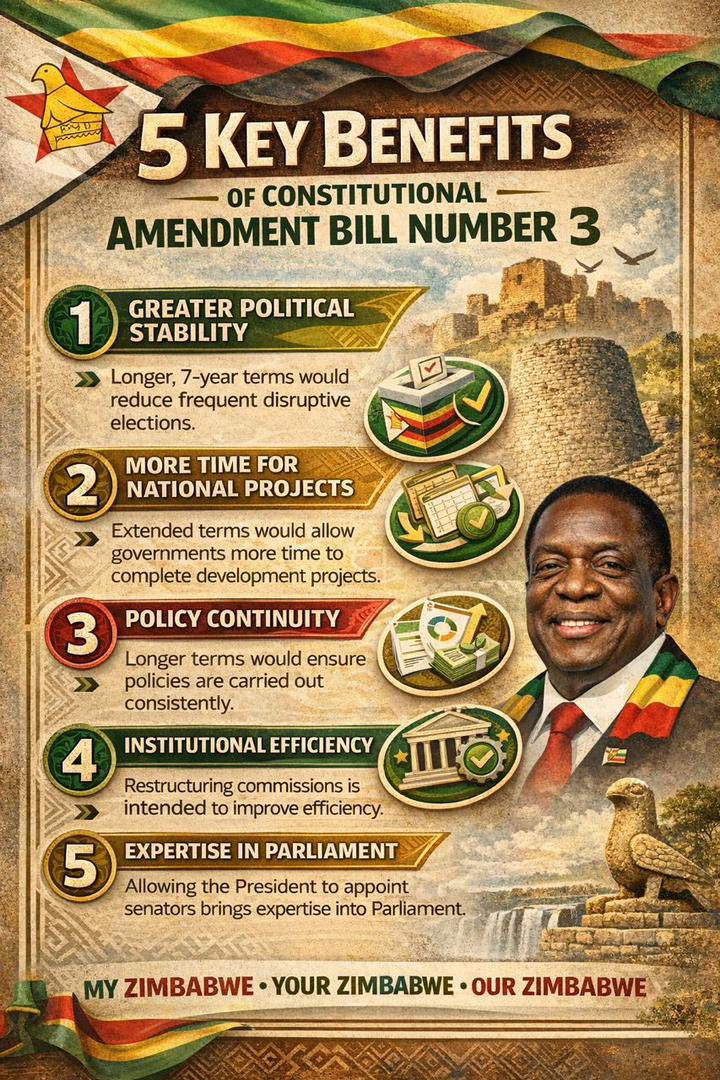
The persistent disconnect between grand infrastructure announcements and their eventual completion is a source of deep frustration shared across Zimbabwe‘s construction, energy, mining, and industrial sectors. The proposed seven-year presidential term, a central tenet of the Constitution of Zimbabwe Amendment (No. 3) Bill, 2026, is being positioned by industry leaders as a reform capable of shifting the national focus from electioneering to execution and ushering in a new era of project completion and tangible economic progress.
Industry experts point out that major infrastructure projects, from dam construction and power plant refurbishments to large-scale transport networks, mining developments, and industrial parks, simply do not fit within a five-year electoral cycle. The first year of a term is often lost to political transition, cabinet formation, and strategic reorientation, while the final year is consumed by the next election campaign, during which project approvals often stall and implementation slows. This leaves a narrow and unstable window of just three years for actual execution, encouraging a focus on ribbon-cutting ceremonies for small-scale, politically expedient projects rather than the sustained, multi-year effort required to deliver transformative national assets.
“Long-term projects require long-term thinking, consistent oversight, and uninterrupted funding streams,” said investment analyst Walter Mandeya. “A seven-year term provides the Government with adequate time to implement national programmes and complete long-term projects without the constant disruption of political cycles. It allows for proper planning, the retention of technical teams, and the phased allocation of budgets, all of which are essential for successful project delivery. When you have a stable horizon, you can undertake projects of genuine scale and complexity.”

The Bill’s rationale emphasises that this stability is not for its own sake, but to enable the successful and continuous execution of important infrastructure and development initiatives that form the foundation of economic growth.
Justice, Legal and Parliamentary Affairs Minister Ziyambi Ziyambi has in the past described the proposed constitutional reforms as a structural response to decades of institutional strain, arguing that repeated electoral disputes and prolonged cycles of political uncertainty have imposed a heavy economic toll on Zimbabwe.
Speaking during a media briefing in Harare recently, the Minister outlined the rationale behind the Bill, emphasising that its scope extends beyond partisan interests.
“The Constitution of Zimbabwe Amendment (No.3) Bill transcends narrow partisan considerations,” he said. “It constitutes a suite of institutional reforms that are robust, historically consequential and firmly oriented towards safeguarding national stability and long-term development.”
He argued that persistent election-related disputes have diverted national resources away from policy execution and infrastructure development, undermining the country’s economic potential.
“Zimbabwe has endured recurrent governance impediments arising from disputed electoral processes and perpetual electioneering,” he said. “These dynamics have contributed to corruption, inefficiency, and societal polarisation, with significant implications for economic growth.”
Clause 3.7 and 8 of the Bill amend sections 95, 143 and 158 of the Constitution to substitute the current five-year term of office for the President and Parliamentarians with a seven-year term. The objective of this reform is to reduce election-related disruptions, enhance policy continuity, allow sufficient time for the implementation of long-term national projects, and promote political and economic stability. By extending the parliamentary term to seven years as well, the reform ensures that the legislative and executive branches are aligned in a single, stable cycle. This alignment allows for coherent policy-making, enabling major projects to progress seamlessly from initial feasibility studies and environmental impact assessments to financing arrangements, construction, and final commissioning, without the risk of political discontinuity derailing progress mid-stream.
For the private sector, which is increasingly invited to partner with the government on major infrastructure through public-private partnerships and other collaborative models, this extended planning horizon is critical. Investors in such schemes require assurance that the political leadership and policy direction will remain consistent throughout the project’s lifecycle, which can often span a decade or more. A seven-year presidential term provides precisely that assurance, reducing the perceived risk of partnering with the state and potentially lowering the cost of capital for major national projects. The result, industry leaders hope, will be a fundamental transition from a culture of ambitious announcements to a culture of reliable completion, delivering the infrastructure that Zimbabwe desperately needs to compete in the modern global economy.



![AI image of exploitation in the workforce [Image: Linkedin]](https://gsmn.co.za/wp-content/uploads/2026/07/image-64.png)






![SAUDI ARABIA'S SIGNING "ABRAHAMS ACCORDS" SPELLS DOOM FOR PALESTINIANS [Image: ET]](https://gsmn.co.za/wp-content/uploads/2026/07/abraham-accords.avif)