
Recently, Ghana outrightly rejected a proposed United States-backed health agreement over concerns about privacy, oversight and foreign access to sensitive national health data. According to reports, the deal would have allowed multiple US entities broad access to Ghana’s health information systems as part of a wider funding arrangement tied to healthcare support.
Ghanaian authorities reportedly raised concerns about sovereignty, consent and the lack of sufficient control over how citizens’ data could be accessed and used.
These are not the only nations pushing back. Zimbabwe has reportedly rejected a similar arrangement recently, while Zambia has also raised objections linked to privacy and data governance concerns.
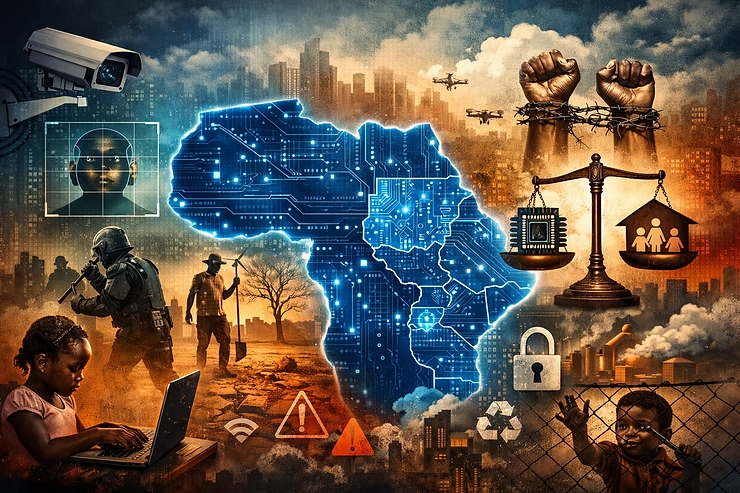
Across the continent, governments are beginning to confront a growing reality: thatin the modern world, power no longer only lies in minerals, land and labour, but also in data. And increasingly, Africa is being asked to surrender that data under the language of aid, partnership and development.
For centuries, this continent has been treated as a site of extraction. Gold was taken. Diamonds were taken. Oil, cobalt, land and labour were taken. Colonialism evolved into economic dependency, and economic dependency evolved into financial conditionalities disguised as cooperation.
Today, we are watching extraction enter a new phase — digital extraction. The resource of the future is not only beneath African soil. It is also inside African hospitals, databases, clinics and devices.
Health data has immense value. It reveals behavioural patterns, population vulnerabilities, disease trends, infrastructure weaknesses and deeply personal information about millions of people. In the hands of powerful states, institutions and corporations, that data becomes influence. It becomes leverage. It becomes power.
That is why Ghana’s rejection matters.
Because at the centre of this debate is a dangerous assumption that has shaped Africa’s relationship with powerful nations for decades: that poverty weakens our right to refuse. That if a country is economically strained enough, underfunded enough or desperate enough, then sovereignty becomes negotiable. That Africans should simply accept whatever conditions accompany aid because survival itself is treated as a privilege!
But healthcare assistance should not require surrendering democratic control over citizens’ personal information. Cooperation should not mean permanent access. And development cannot become a polite rebranding of blatant surveillance.
Predictably, there are those who will dismiss these concerns as paranoia or an anti-Western sentiment. They will argue that global health coordination requires cross-border data systems, that partnerships are essential for fighting disease outbreaks and improving healthcare delivery. And yes, international cooperation matters. Public health systems across the world rely on collaboration, research and shared expertise. But collaboration is simply not the same thing as unrestricted access.
There is a difference between ethical partnership and structural dependency. There is a difference between transparent data-sharing agreements and arrangements where powerful foreign entities gain disproportionate visibility into the internal systems of poorer nations. Most importantly, there is a difference between support that strengthens African institutions and support that quietly embeds foreign influence into the architecture of governance itself.
Because this issue is much bigger than one agreement. Across Africa, governments are rapidly digitising healthcare, banking, education, policing and identification systems, often with significant involvement from foreign governments and multinational technology companies. Yet in many cases, the regulatory protections surrounding these systems remain weak, underdeveloped or poorly enforced. Citizens are rarely informed about where their information goes, who accesses it or how long it is stored.
That creates the conditions for what many scholars and activists now describe as data colonialism — a system where African populations become sources of raw digital material for more powerful global actors. Not through military occupation, but through infrastructure, platforms, contracts and dependency.
A continent that does not control its data cannot fully control its future. And this is why the conversation around data sovereignty cannot remain trapped inside technical language reserved for policymakers and cybersecurity experts. This is a social justice issue. When privacy protections collapse, it is ordinary people who become exposed. It is vulnerable communities whose information becomes accessible. It is the citizens who lose agency over their own identities and bodies.
What governments such as the US need to understand is that: Poor people deserve privacy too. African citizens deserve protection too. And African governments deserve the right to define the limits of foreign access without being punished for it.
Ghana’s decision should therefore be understood as more than a diplomatic disagreement. It is part of a growing resistance against the idea that Africa must always trade away pieces of itself in exchange for support. It is a refusal to accept that sovereignty becomes optional whenever funding enters the room.
For far too long, this continent has been mined, monitored, measured and managed by egregious foreign powers claiming to know what is best for us. We should be deeply cautious of any future where our data becomes the next frontier of extraction — especially when that extraction arrives wrapped in the language of humanitarian concern. As countless prolific pan-African activists have reiterated: “The system does not fear the poor becoming rich. It fears the poor becoming conscious.”













One Response
Highly energetic blog, I loved that a lοt.
Will there be a part 2?
My web site fintechbase