For much of the past two decades, political debate in Zimbabwe has revolved around recurring electoral disputes, institutional mistrust and persistent economic uncertainty. While sanctions, policy choices and global economic pressures have all influenced the country’s trajectory, one issue sits quietly at the centre of national governance debates: the structure and durability of the country’s constitutional framework.
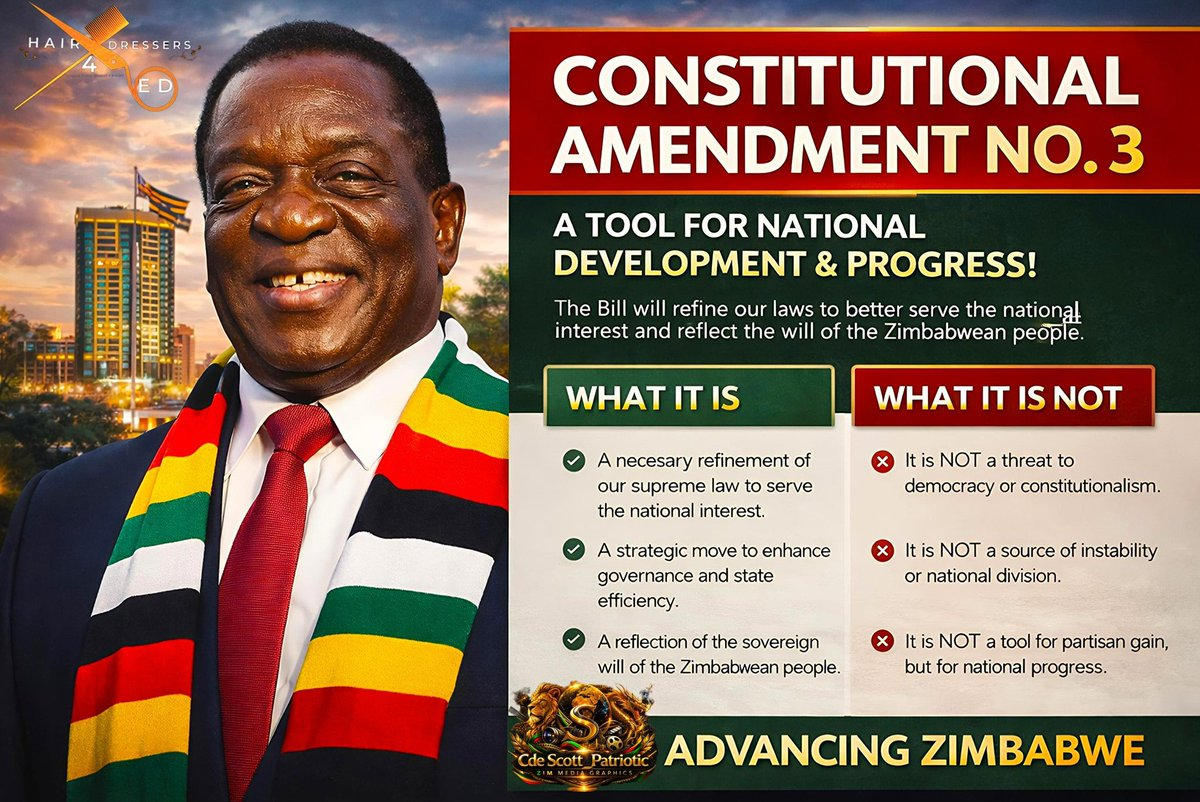
The proposed Constitutional Amendment (No.3) Bill of 2026 has rapidly become one of the most consequential governance debates in Zimbabwe’s recent political history. Critics have raised concerns about aspects of the reform, particularly around presidential tenure and election structures. Yet supporters argue that, when examined carefully, the proposed amendments offer an opportunity to modernise Zimbabwe’s governance architecture and lay the groundwork for long-term political and economic stability.
Around the world, constitutional reform has often marked a turning point in national recovery. Following the devastation of the 1994 genocide, Rwanda introduced sweeping institutional reforms that helped stabilise governance and rebuild state capacity. Similarly, governance reforms under Lee Kuan Yew helped transform Singapore into one of the world’s most competitive economic hubs.
Zimbabwe now faces its own moment of institutional recalibration.
Modernising Governance Structures
Legal scholars broadly agree that constitutions are not static documents. Instead, they evolve alongside political, economic and social realities.
Advocate Justice Khoza, a constitutional law lecturer at North-West University in South Africa, argues that reforms such as Amendment No.3 should be evaluated according to whether they strengthen governance institutions and improve democratic accountability.
“Constitutional reform can modernise governance by strengthening institutions, improving transparency and deepening public participation,” Khoza has noted.
Zimbabwe’s current constitutional framework was established under the Constitution of Zimbabwe (2013). At the time, it was widely viewed as a major democratic milestone. However, more than a decade later, supporters of the amendment argue that adjustments are necessary to align the system with evolving governance needs and long-term development planning.
Research from the Comparative Constitutions Project at the University of Chicago Law School notes that constitutional amendments are a normal feature of democratic systems. They allow societies to update institutional frameworks while maintaining the core principles of governance.
Several clauses in the proposed amendment illustrate how Zimbabwe’s political architecture could change.
Clauses 4, 9, 10: Extending the Presidential Term to strengthen Policy Continuity
One of the most debated provisions proposes a seven-year presidential term from five years. The move is a developmental mandate that allows time for the completion of Vision 2030 mega projects such as energy, damsand roads as opposed to the five-year term that is characterised by perpetual electioneering and personality clashes emerging from thee winner takes on mentality.
Critics argue that longer terms could reduce electoral accountability. Supporters, however, contend that the goal is to break the cycle of permanent campaigning that has shaped Zimbabwean politics for years. With a longer presidential term, there will be fewer distractions, such as mid-project polls, that will hinder the nation’s progress.
In many political systems, governments spend their early years consolidating authority and their final years preparing for elections. This often leaves limited time for implementing long-term policy programmes.
Historically, several democracies experimented with longer presidential mandates. France operated under a seven-year presidential term known as the septennat until 2000, when it was shortened to five years to strengthen electoral accountability. Meanwhile, Mexico uses a single six-year presidential term, known as the sexenio, designed to balance political continuity with limits on executive power.
For Zimbabwe, supporters argue that a seven-year mandate could provide governments with more time to implement long-term development programmes in sectors such as energy, infrastructure and agriculture.
On average, large government infrastructure projects can take several years to complete, with many facing significant delays that extend timelines to 5 years or longer. A study of 239 large dam projects found an average delay of 2.3 years, while municipal infrastructure projects frequently experience average delays of 22 months.
Transportation projects like roads can take 3 years or more, while major rail or metro projects often span 3 to 6 years. Projects exceeding 2 years are typically categorized as long-term, often ranging from 3 to 15+ years for completion. Procurement activities for complex projects take a median of 152 days to over 300 days to reach contract signing, with high-complexity projects often taking years to pass this stage. In some contexts, up to 79% of infrastructure projects experience delays, with some stalled for over 25 years.
The phase from proposal to approval can take several years due to statutory requirements, funding hurdles, and complex planning processes. Changes to project requirements after work has commenced (scope creep) often cause significant delays.

Clarifying the Difference between Term Length and Term Limits
Much of the public debate around the amendment has blurred the distinction between two important constitutional concepts: term length and term limits.
Term length refers to the duration of a single period in office, while term limits determine how many terms an individual may serve overall.
Khoza emphasises that term limits remain a crucial safeguard in most constitutional systems to prevent the concentration of executive power.
Maintaining limits on how long a leader may remain in office while adjusting the duration of individual terms is one way constitutional designers attempt to balance stability with democratic oversight.
Clause 3: Reforming the Presidential Election Process
Another key aspect of the amendment concerns the method used to elect the president.
Globally, two broad models exist: direct elections by the electorate and indirect elections through parliament or an electoral college.
Direct elections are common in presidential systems such as Brazil and Kenya, where the president exercises significant executive authority and derives legitimacy directly from voters.
Indirect elections, by contrast, are typical in parliamentary systems. In South Africa, for example, the president is elected by members of the National Assembly of South Africa rather than through a nationwide vote.
Advocates of the Zimbabwean reform argue that parliamentary election models can encourage institutional politics and strengthen legislative oversight.
Strengthening Checks and Balances
Another objective of the amendment is to refine the relationship between the executive branch and parliament.
Governance research by the International Institute for Democracy and Electoral Assistance suggests that countries with clearly defined institutional roles and checks on executive authority are more likely to achieve political stability and effective governance.
Clarifying these institutional boundaries could strengthen accountability mechanisms within Zimbabwe’s political system.
Reducing the Cost and Intensity of Elections
Zimbabwe’s national elections have historically been high-stakes contests that require extensive financial and logistical resources.
Nationwide presidential campaigns demand significant security deployments, political mobilisation and public expenditure. They can also intensify political tensions in already polarised environments.
Supporters of the amendment argue that elements of parliamentary election models could reduce the intensity and cost of presidential campaigns while preserving democratic representation through elected legislators.
Countries such as Germany and India use indirect presidential election models partly to maintain institutional balance and reduce the politicisation of executive leadership contests.
Clause 8: Encouraging Institutional rather than Personality Politics
Direct presidential elections often centre political competition around individuals rather than institutions.
Campaigns become personality-driven contests, while policy debates receive less attention.
Strengthening parliamentary processes could shift political discourse toward policy platforms, legislative oversight and institutional accountability.
Political analysts frequently note that systems dominated by institutional politics tend to produce more predictable governance environments, which in turn supports investor confidence and economic stability.
Creating Space for Long-term Economic Planning
Perhaps the most significant potential benefit of the amendment lies in its implications for long-term policy planning.
Large-scale development programmes often require sustained implementation over many years. Infrastructure expansion, energy reforms and industrialisation strategies rarely produce results within a single electoral cycle.
Countries that achieved rapid economic transformation frequently benefited from stable governance frameworks that allowed leaders to pursue long-term development agendas.
Examples often cited include South Korea and Singapore, both of which implemented governance systems capable of sustaining long-term development strategies.
Supporters argue that Zimbabwe’s proposed constitutional adjustments could create similar conditions for policy continuity.
A Step in Constitutional Evolution
Research from the Comparative Constitutions Project shows that most modern constitutions undergo periodic amendments as societies adapt governance frameworks to new realities.
Zimbabwe itself has amended its constitution multiple times since independence. Viewed in this context, Amendment No.3 represents part of the natural evolution of a living constitutional system rather than a departure from democratic principles.
Rebuilding Trust in the State
Ultimately, Zimbabwe’s most pressing challenge is not only economic recovery but also restoring confidence in public institutions.
Investors, citizens and international partners all look for governance systems that are stable, predictable and capable of sustaining long-term policy commitments.
The proposed amendment offers an opportunity to rethink how Zimbabwe’s political system functions, how leadership transitions occur and how institutions balance democratic accountability with the need for development-focused governance.
If implemented carefully and accompanied by strong institutional safeguards, Constitutional Amendment No.3 could become an important step toward rebuilding trust in the state and laying the foundation for Zimbabwe’s next phase of national renewal.