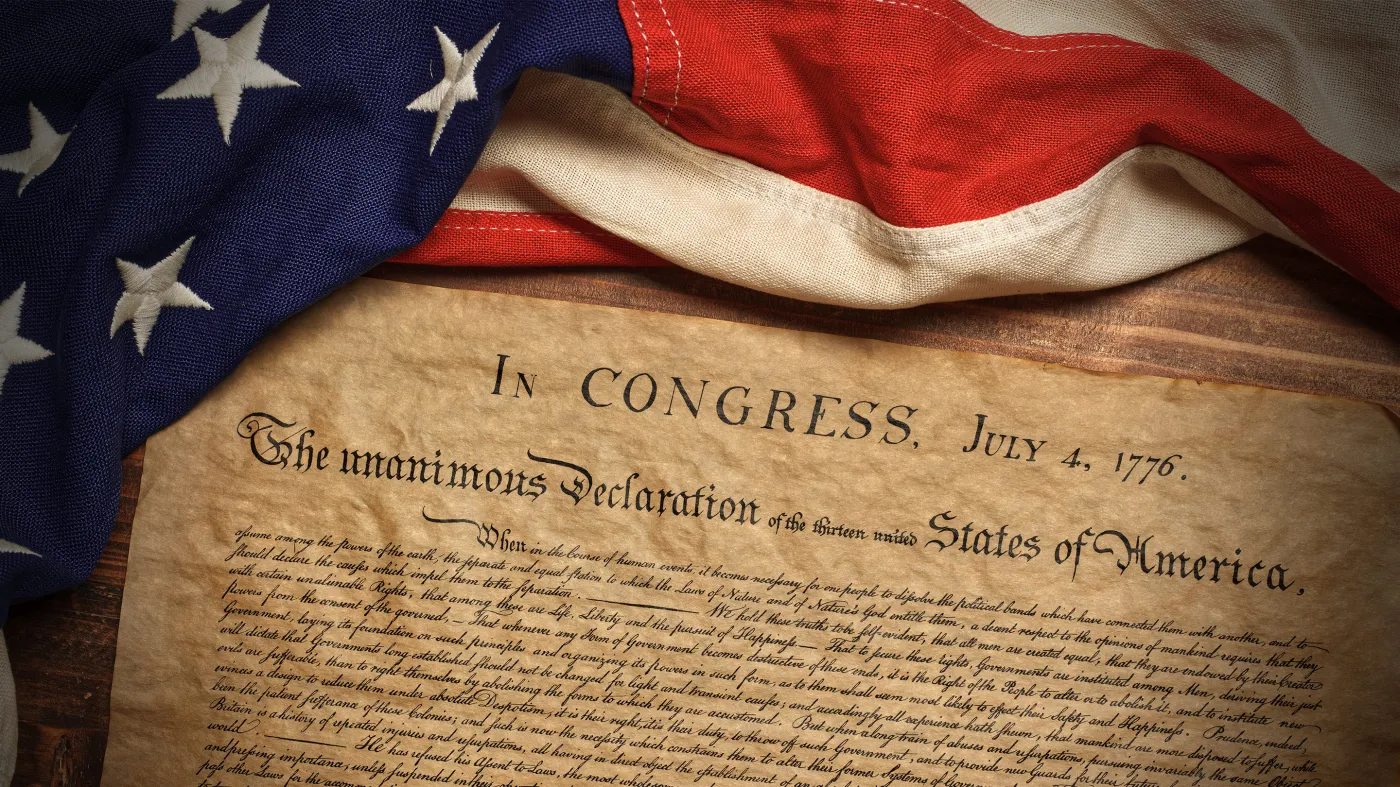
Two hundred fifty years ago today, on June 11, 1776, the Continental Congress did something that should puzzle every cynic about politics. The day before, it had postponed until July 1 the vote on Richard Henry Lee’s resolution for independence—the delegates of the middle colonies were not yet ready to decide. And then, the decision not yet taken, Congress appointed a committee of five—John Adams, Benjamin Franklin, Thomas Jefferson, Roger Sherman, and Robert Livingston—to draft a declaration of an independence that had not yet been declared. They understood that a war fought without stated reasons is merely a war, and that what a free people owes, in the Declaration’s own words, is “a decent respect to the opinions of mankind”—reasons given to the whole world. Seventeen days later, the draft was done.
Measure current history against that standard. The President of the United States announced on his social platform that the United States will, “at some point in the not too distant future,” be “taking Kharg Island, and other oil infrastructure points,” to “assume total control of their Oil and Gas Markets, much like we have with Venezuela.” No reasons addressed to mankind; the seizure of another nation’s patrimony was announced as a simple fact. Iran’s deputy foreign minister pronounced the April 8 ceasefire a dead letter, observing that “the aggressor does not evade the consequences of its actions by changing the title,” referring to U.S. claims of “self-defense.” And then in the evening of June 11, Trump reversed course, announcing that a deal was nigh and the strikes would not occur.
The Strait of Hormuz, through which a fifth of the world’s oil passed before the war, is declared closed; three Indian seafarers are dead from an American strike on a tanker; the cooling systems of the Zaporozhzhia nuclear plant are running on diesel generators after the nineteenth total loss of outside power of the war. And in Congress, Sections 224 and 622 of the pending defense and intelligence bills would weld American technology and intelligence to Israel beyond any president’s power to manage—of which Helga Zepp-LaRouche said in her webcast yesterday: “If you put this bill through, you would have no difference between the British Empire, Israel, and the United States.” John Quincy Adams gave the condition its name in 1821: “dictatress of the world … no longer the ruler of her own spirit.”
But deliberation continues. In the Senate, four Republicans have now voted to discharge the Iran war powers resolution, and its sponsor believes a fifth is close—Congress attempting to restore the Constitutional mandate that the decision of war belongs to deliberation and not to proclamation. In Tehran, the Qatari mediators who arrived June 10 did not leave when the bombing resumed; they are still there, and so, therefore, is the potential for negotiation. Russian negotiator Kirill Dmitriev will meet his American counterparts later this month, and Zelensky’s call with both was, in his word, “very positive,” showing that the channel that bypasses the war’s European sponsors is still open. In Washington, KMT Chairwoman Cheng Li-wun told representatives and senators, think tanks, and anyone who would listen that the United States can still avoid “an avoidable war” in the Taiwan Strait. Yet, the same U.S. government credibly accused of bombing reservoirs in Iran published, this week, a national roadmap for fusion energy and named the crew that will carry four astronauts for the next stage of tests as we return to the Moon—the country’s better self continues to radiate.
Which self prevails is not a matter of prediction but of decision. Zepp-LaRouche located the obstacle precisely: to end the wars, a president “would have to declare independence, not from the British… but from the moneybags, the people who supported his campaign.” As Trump does not seem prepared to do that, the people must be prepared instead. “I hope we can revive America, which used to be a beacon of hope and a temple of liberty 250 years ago,” she said. “We have to revive the American Revolution spirit as a republic.” That is the substance of The LaRouche Organization’s June 9 call: not to let the semiquincentennial be reduced to the cage-match spectacle planned for the White House lawn this Sunday, but to answer it as Marian Anderson’s 75,000 answered exclusion in 1939—with readings of the Declaration of Independence in every town and city in the coming weeks, and a Trans-Continental Congress on the Inalienable Rights of Man worthy of the original. Pope Leo XIV, in his encyclical Magnifica Humanitas, states the operating principle: “history can also change when individuals truly take the dignity of everyone seriously”—and gives as evidence Martin Luther King Jr. and Nelson Mandela, who declined “to surrender the future to hatred.”
The occasions are already on the calendar. July 3: The Pope, by telecast from the Vatican, receives the Liberty Medal in Philadelphia, where the drafting was done. July 5: Diane Sare’s “America 250: A Rededication” event in Philadelphia. In 1776, the Committee of Five was handed a war already begun and a question not yet decided, and answered with a document that has, so far, endured. Scarcely more than three weeks separate us from July. If we take up the “equal station to which the Laws of Nature and of Nature’s God entitle” us, what ideas shall we submit to a candid world?
The June 12 meeting of the International Peace Coalition is a forum for answering that question.