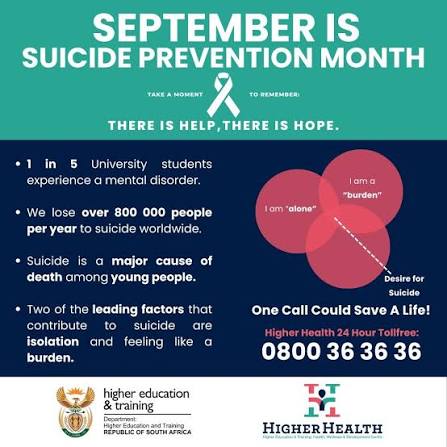
September is our National Suicide Prevention Awareness Month in South Africa. Yet, it seems all we do is telling people to “speak up” and “take care of themselves”, and that’s exactly where we have missed the point. Because people cannot literally breathe their way out of poverty. They cannot meditate their way out of unemployment. They cannot positive-think their way out of violence, grief, hunger, discrimination, substance abuse or a society that demands resilience from people it has repeatedly failed.
We cannot keep breaking people and then handing them the responsibility of fixing themselves. If poverty, violence, unemployment, inequality and hopelessness are shaping people’s mental health, then our response cannot begin and end with telling individuals to cope. Some of what is making South Africans sick is structural — and structural pain requires structural change.
The numbers should force us to confront the scale of what we are dealing with. The National Department of Health has cited a 12-month prevalence of mental disorders of 15.9% in South Africa — with depression, anxiety and alcohol and other drug-use disorders among the most common. It has also warned that child and adolescent mental health services remain dreadfully lacking.
More recently, the World Health Organization’s 2025 assessment reported that South Africa has a mental-health treatment gap exceeding 70%. That figure is nothing to scoff at. It emphasises the millions of people being told, effectively, to suffer without support. In fact, it indicates the magnitude of sheer neglect of our human rights in post-apartheid SA.
Behind every horrific statistic is a person. It is the young person sitting in a university bathroom, on the verge of a breakdown because academic pressure has become unbearable. It is the man taught from childhood that admitting he is struggling makes him weak. It is the child growing up around violence and learning to call dysfunction normal.
We have become far too comfortable celebrating resilience. We praise people for surviving circumstances they should never have endured.
South Africans are expected to be strong through homelessness, unemployment, rampant crime, gender-based violence and femicide (GBVF), poverty, inequality, family breakdown, substance abuse, failing public services, and so much more. We tell people to be resilient as though resilience is an unlimited resource. It is not. There comes a point when “being strong” becomes another way of telling people to suffer quietly.
This is why our Suicide Prevention Awareness Month matters. Not because South Africans need a calendar reminder to care about themselves, but because we need a conversation about what is crippling our society — and whether the systems meant to support us are even functioning.
The government acknowledges that mental health remains severely under-resourced. In 2025, the Department of Health said 5% of the national healthcare budget was allocated to mental health, contributing to infrastructure and staff shortages. It has set a target for 75% of Community Health Centres to have at least one mental-health provider by 2029. That target matters. But so does the distance between where we are and where we need to be.
Mental healthcare cannot remain something people access after they have reached their breaking point. It must exist in schools, universities, workplaces, clinics, communities centres and beyond. It must reach rural areas, townships and people who cannot afford private psychologists. It must tackle children before trauma shapes their adulthood. It must recognise the relationship between mental health, poverty, substance abuse, poverty, violence and social isolation.
More importantly, we need to destroy the shame surrounding asking for help. There is nothing weak about saying, “I am not okay.” There is nothing shameful about needing therapy, counselling, medication or someone willing to listen. The shame should belong to a society that sees people drowning and tells them to swim harder. September must therefore be more than suicide awareness. It must be about serious action and meaningful accountability.
The consensus is clear: mental healthcare is inaccessible, unaffordable and inadequately funded. This means millions of people are forced to wait for a crisis before seeking or receiving support. We need to consider the long-term impact of this on children, young people, vulnerable communities, and beyond — and truly interrogate the countless ways our society drives this distress in the first place.
We need to be clear: mental healthcare is not a luxury for people who can afford private healthcare. It is not a motivational quote. It is not a hashtag. It is a human right — enshrined in our national constitution.
At some point, resilience stops being a virtue and becomes evidence of how much a society has failed its people. South Africans do not need to be taught how to survive another crisis. We need to stop existing in a country where survival is the price of simply trying to live. We deserve a country that does not wait until we are beyond repair to finally give a damn.
*Tswelopele Makoe is a China-based gender and social justice activist and editor at Global South Media Network. She is a researcher, columnist, and an Andrew W Mellon scholar at the Desmond Tutu Centre for Religion and Social Justice, UWC. The views expressed are her own.