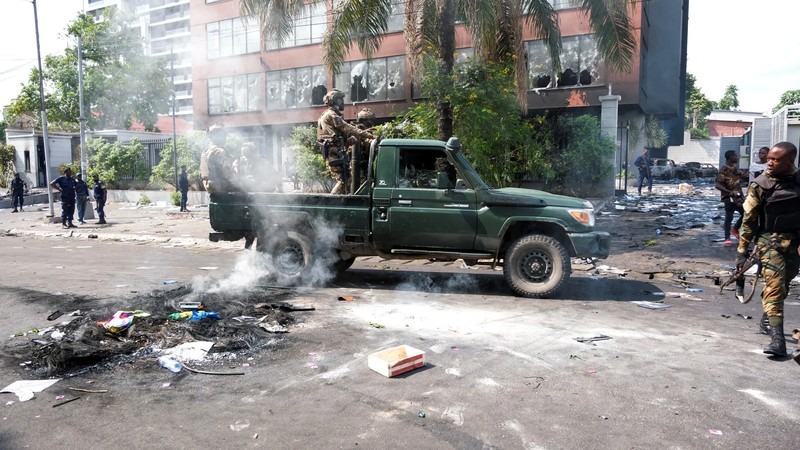
The grave situation that continues to unravel in the eastern Democratic Republic of Congo (DRC) lays bare Africa’s distorted faults of progress since the defeat of colonialism and the dawn of independent governance and freedom.
Despite the continent’s vast wealth in natural resources, Africa remains the least developed of all the world’s continents and is often described in disparaging terms such as the “dark continent”.
Yet the darkness that wreaks havoc across all the corners of Africa – from Cape to Cairo, Morocco to Madagascar, are not entirely of Africa’s doing. Through stealth and deceit, Africa’s erstwhile Western colonizers continue to apply underhanded evil methodologies steal in the dark the minerals they used to whisk away to their rarefied capitals in their so-called First World.
Despite the official demise of colonialism on our continent, Africa’s enormous wealth from a diversity of minerals is still the oxygen behind the lavish lifestyles of the Europeans the West at large.
At the tail-end of the 19th century, a horribly dark period engulfed Africa and it is better-known in the history books as the Scramble for Africa. Great Britain, Belgium, France, Italy, Germany, The Netherlands, Spain and Portugal, among others, were behind an evil scheme of diving our continent, and its people, according to Westphalian borders. They also used ethnicity and tribalism as tools for the division of Mother Africa. The legacy of this heinous period still reverberate across the continent, felt through various forms and ways such as fueling of civil wars, unending feuds and perennial under-development.
To this day, most of Africa’s educational systems are yet to be de-colonized. Based on dubious and debilitating forms of Western civilizations that trump Africa’s indigenous knowledge production systems, education is the number one tool the Africa’s modern-day enslavement.
Our history is distorted, our lands chopped into borders that repels each other and the continent’s 1.4 billion remain disabled by circumstances to not appreciate their numeral advantage.
It is a sad, sad situation. The DRC, Africa’s uppermost producer of tons of different minerals, is in my book the microcosm and epicentre of Western manifestation of greed, and inhumanity.
It is perhaps easy to lambaste the West collectively for the evidence of their long tentacles in Africa’s affairs. But if truth be told, African political elites are as guilty. Guilty for letting Western education transform them into European wannabe’s, abandoning their culture and frowning upon African epistemology without any iota of shame.
The ordinary people of our continent rightfully often feels bewitched cursed by forces of darkness from far and near. The penchant of African leaders to be effortlessly assimilated into alien philosophies of life is a constant cancer that eats away our identity and sense of being. We’ve become strangers even to ourselves!
In 1963 the founding fathers and mothers of the Organization for African Unity (OAU), the predecessor to the present-day African Union, dreamt of a united continent united by ethos of Ubuntu/Botho, ruling their nations on the critical values of Batho-Pele (People First).
Former South African President Thabo Mbeki sought to steer Africa in that direction when he spearheaded the African Renaissance, seeking to help play the role of a mid-wife in Africa’s rebirth.
It is a source of great pain and anguish that Mbeki’s efforts seem to have come to naught, not least helped by the ignominious manner in which he was kicked out of office by his own comrades in Johannesburg.
Elsewhere in the continent, from East Africa to the Francophone parts of our continent, Mbeki was held in the highest esteem and revered to this day by many who still mourn his unceremonial departure from his role as the continent’s modern hope to renewed emancipation.
Addis Ababa, home to the HQ of the AU in Ethiopia and shouting distance from where the OAU was formed in 1963, has gradually lost its impact and effect as the seat of Africa’s political leadership.
Too many conflicts have afflicted Africa in recent memory, and the silence from Addis Ababa has been deafening, and that’s putting it mildly.
The Sahel region remains in relative stability following a series of coups that threatened to disintegrate the Economic Community of West African States (ECOWAS). It is a miracle that ECOWAS remains intact, although it is clear that the regional body is on tenterhooks.
Sudan remains in the grip of a menacing civil war, triggered during Ramadan on April 15, 2023 by competing selfish political interests between the Sudanese Armed Forces and the Rapid Armed Forces.
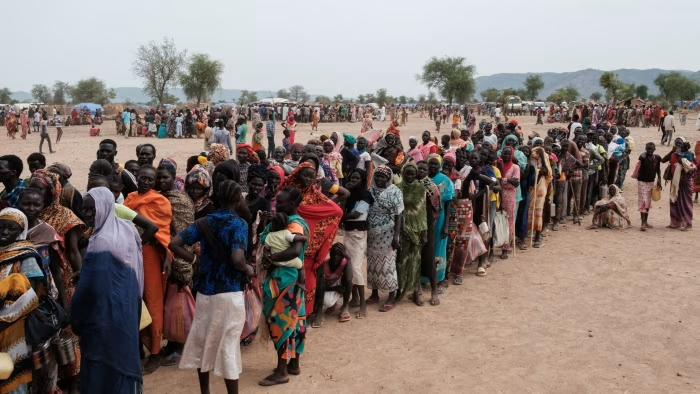
More than 150,000 have been killed in the civil war and a whopping 11 million forced from their homes in one of the most ferocious mass displacement of the modern era.
I can go on a long run listing conflicts – past and present – that have befallen our unfortunate continent. But it is the conflict of the moment – the DRC, in my view, that requires in-depth look as a case study of Africa’s failed collective political leadership and guidance.
Since 1996, conflict in the eastern DRC has led to approximately six million deaths. The fatality rate is more than the total population of many countries around the world.
But it is the elephant in the room that must be addressed if peace should be attained in the DRC, and that is the neighbouring Rwanda. In 1996, I visited Rwanda with the then foreign affairs minister of SA, Dr Nkosazana Dlamini-Zuma.
Whilst Dr Dlamini-Zuma was engaged in a series of closed-door meetings, the Rwandan government official took me and a few journalists on a tour of the museum of the victims of the 1994 genocide. The Rwanda genocide was carried out by Hutu extremists, who killed an estimated one million minority ethnic Tutsis and moderate Hutus with the active support of some Belgian nationals.
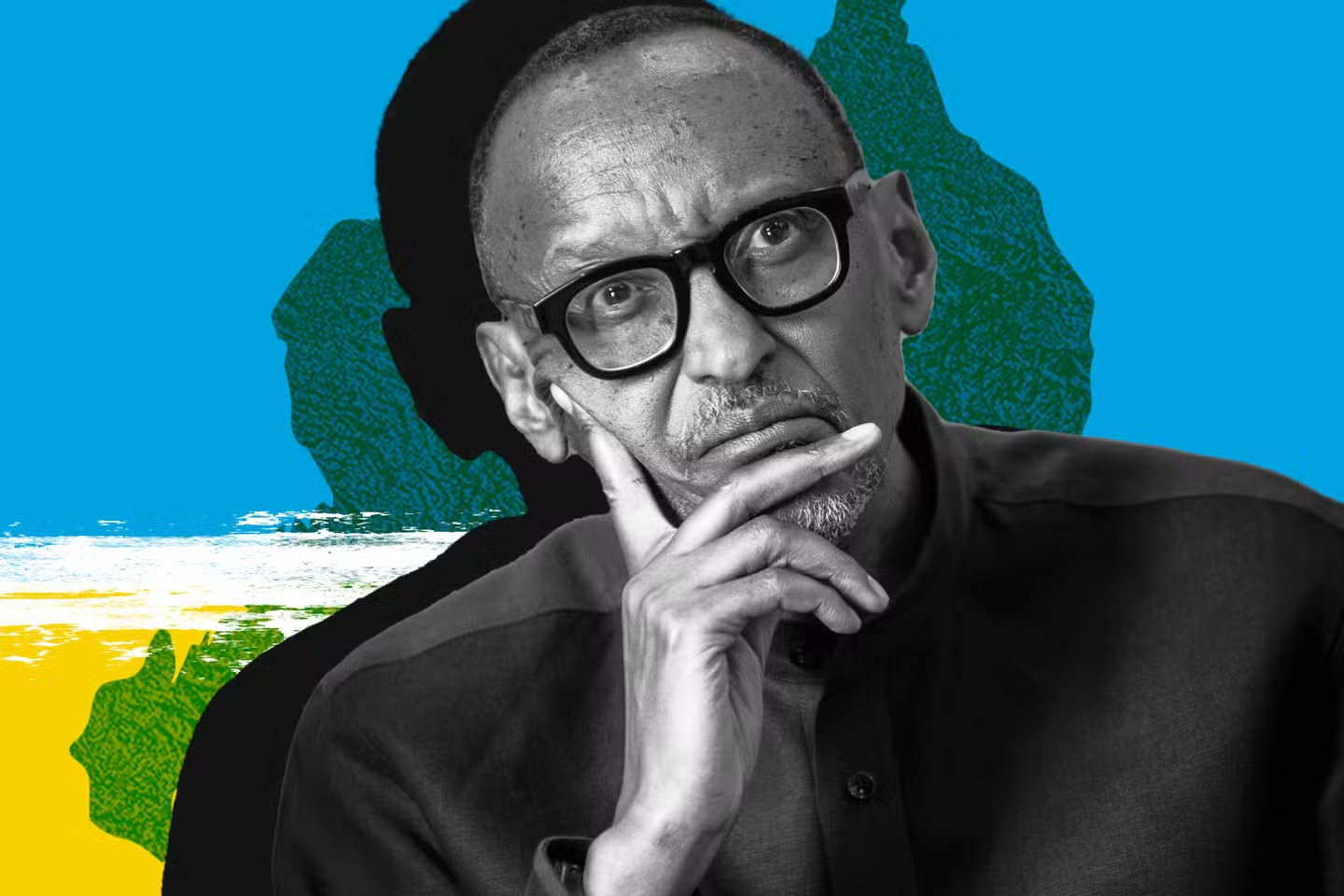
Later that day, a Rwandan army official took us on a boat ride in Lake Kivu, a short distance to the DRC town north Kivu. On arrival, the town was deserted, and only Rwandan troops in uniforms were roaming around, brandishing machine guns. The town has been under Rwandan occupation since Paul Kagame came to power. President Kagame, a dictatorial figure whose grip on to power is unshakeable, has repeatedly argued that the some of the Hutus who fled to the DRC following his Rwandan Patriotic Front ascended to power remain a threat to Kigali’s stability. He claims that the DRC-based Hutus plan to attack Rwanda, and by invading the DRC` he is dealing with the challenge at the source.
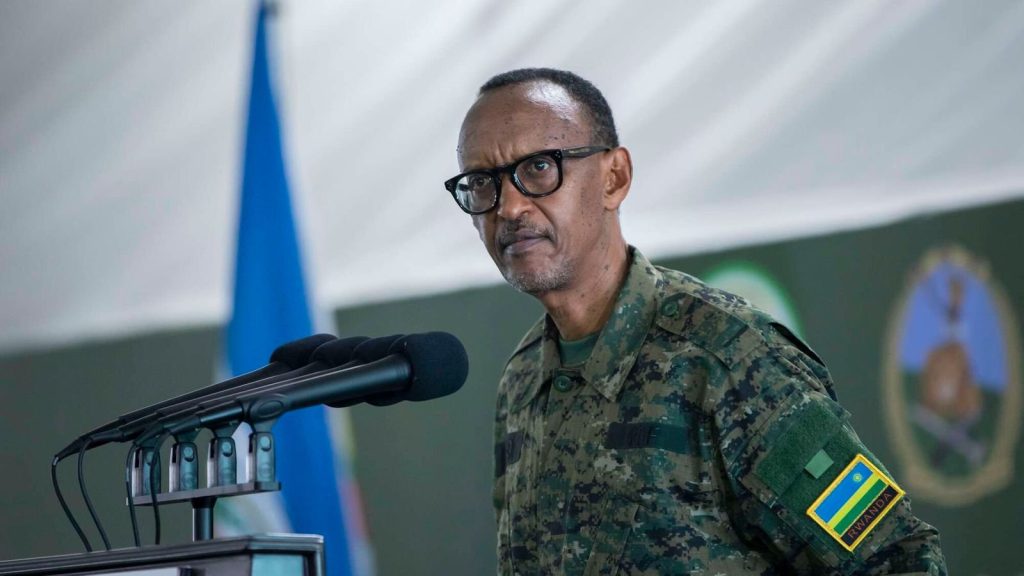
Through it all, the AU has failed to intervene meaningfully. Systematic DRC governments have accused Rwanda’s strongman Kagame of being after the DRC’s minerals.
Now, the DRC ranks among the richest nations in the world in terms of mineral wealth that is estimated at 24 Trillion US dollars.
The DRC hosts numerous major deposits of diamonds, gold, copper, tin, tantalum and lithium, which is critical in the manufacturing of electric vehicles batteries. These are mined mainly in places like Rubaya mines in the eastern part of the DRC, where the M23 rebels allegedly supported by Rwanda have taken over.
The DRC is also the world’s second largest producer of coltan, a key mineral in making mobile phones and laptops.
Other minerals found in the DRC include zinc, cassiterite (the chief source of metallic tin), manganese, coal, silver, platinum, uranium, cadmium, germanium (a brittle element used as a semiconductor) and palladium (a metallic element used as a catalyst and in alloys.
Now, it is plausible that Rwanda is using its military power to take advantage of the DRC, as alleged by the government in Kinshasa. Rwanda’s claims of existential threat to itself posed by fugitive Hutus who have settled in the DRC should have long been put to the test by the relevant regional bloc, the SADC and the East African Community.
Surely, both the governments of Rwanda and the DRC could be made to sit around the table and iron out their fears, threats and identify opportunities for economic development?
The conflict in the DRC has been allowed to simmer for far too long, letting President Kagame to act with impunity.
There are strong claims that countries such as France, Israel, the US and UK have vested interest in the Rwandan project in the DRC. As untoward things are done, President Kagame and his backers will continue to operate in a clandestine manner.
After all, it is in Rwanda’s interest to be surreptitious. But the mountain of evidence – partly seen during the killing this week of 13 SANDF soldiers in the eastern DRC that was part of a peace-keeping mission – points a finger at Kigali. Mbeki’s moribund Peer Review Mechanism would have found Kagame wanting.