
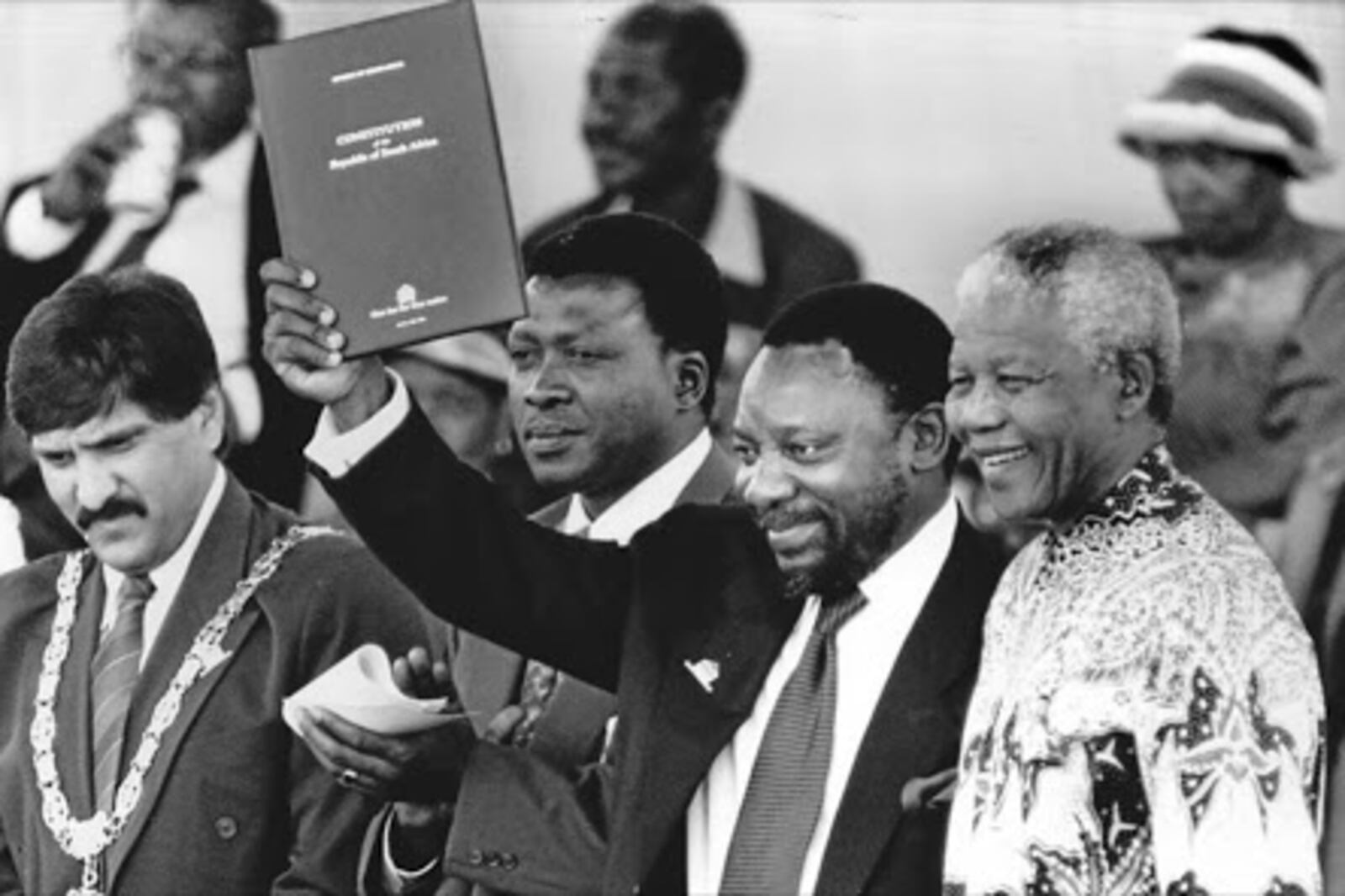
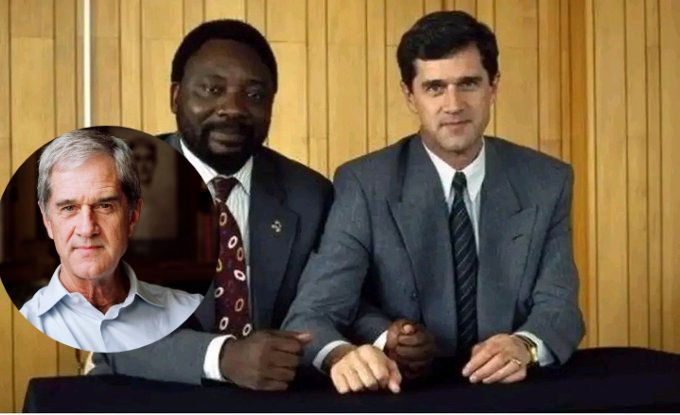
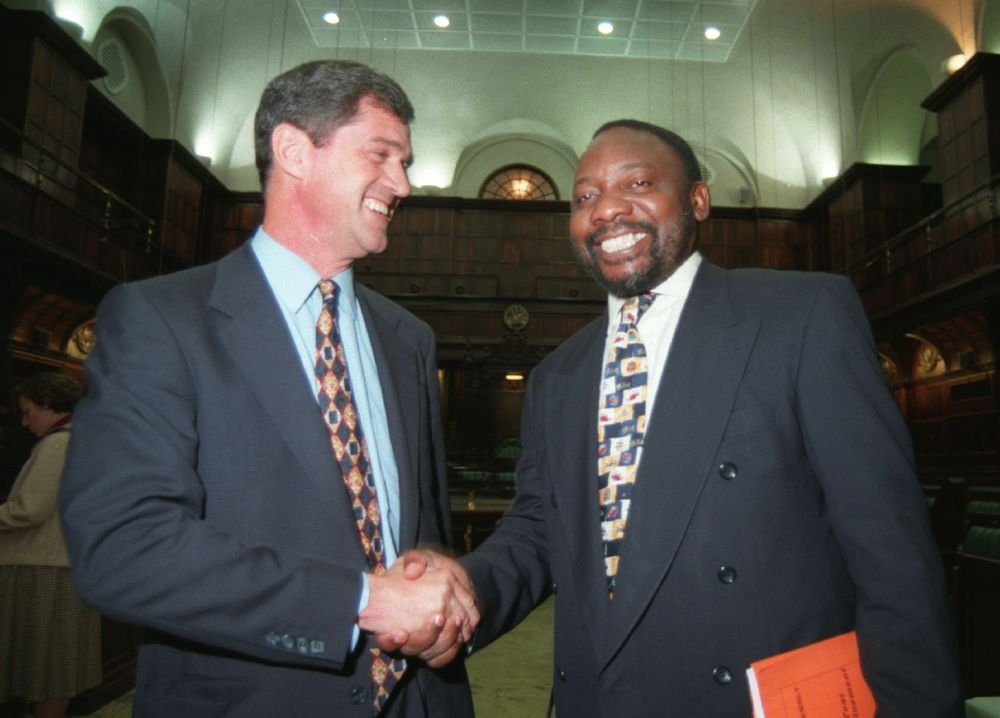
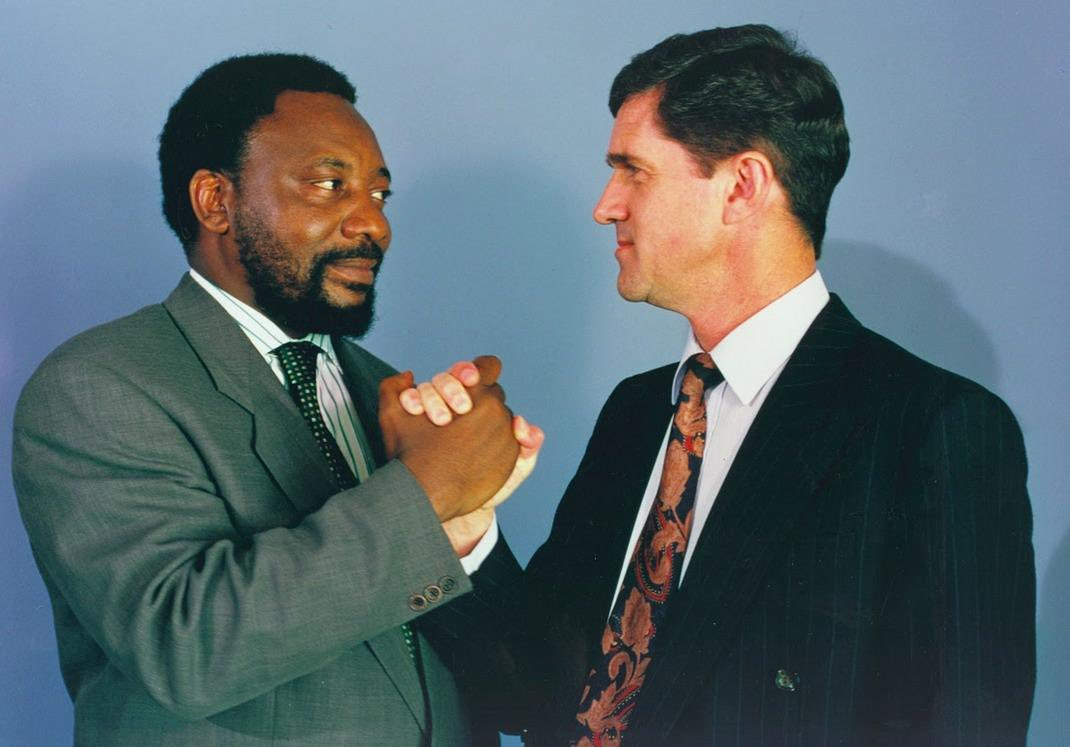
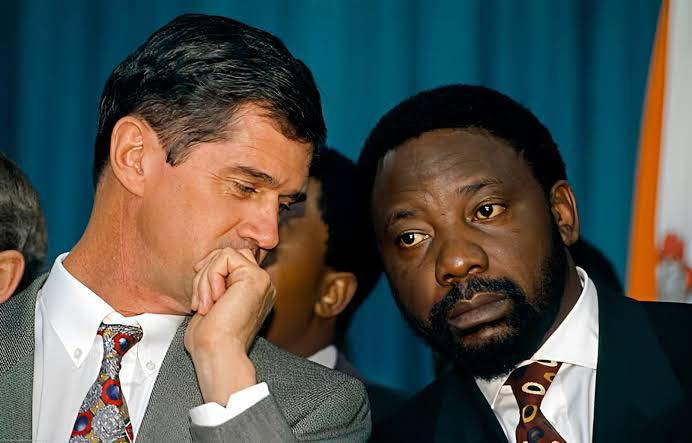
![President Cyril Ramaphosa that he has appointed former apartheid-era government kingpin Roelf Meyer as South Africa’s ambassador to the US [Image: Luke Daniel | News24]](https://gsmn.co.za/wp-content/uploads/2026/04/roelf_meyer_and_cyril-1.jpeg)
The announcement by President Cyril Ramaphosa that he has appointed former apartheid-era government kingpin Roelf Meyer as South Africa’s ambassador to the US is a hard pill to swallow.
Our President: a gentle soul, whose love for our country is beyond reproach. A lawyer by profession and former trade unionist whose stature rose like a phoenix at the height of apartheid when he led the formation of the National Union of Mine Workers (NUM), his leadership credentials have long beena cut above the rest. He is both erudite and affable. Oftentimes he stands accused of dilly-dallying, an accusation he recently laughed off publically.
President Ramaphosa’s Struggle credentials are also impeccable. They date back to his involvement in Steve Biko’s Black Consciousness Movement through his service in the iconic South African Students Organisation (SASO) whilst a student at Turfloop University, now known as the University of Limpopo.
Ramaphosa is also known to be God-fearing. He was a prominent leader of the Students Christian Movement (SCM) at university.
A skillful political operator, he has managed through his illustrious career to navigate clashes of ideology, particularly in the so-called “broad-based church” that is the ANC – home to nationalists, communists, traditionalists, royalties and commoners, the hoi polloi.
His art of negotiation is credited with enormous contribution to the CODESA talks at the turn of the 1990’s that led to the breakthrough of April 1994 when Mandela became SA’s first democratically elected president.
Now, let me nail my colours to the mast: I am a great admirer of President Ramaphosa for reasons expressed above and a lot more that are too many to mention. In the same vein, I also delight in critiquing the President, particularly his performance in public office as our first citizen.
Granted, leadership is no child’s play. It requires men and women of steel. Great leaders make decisions that leave some people leaping for joy, and others wailing and weeping. In the case of a sitting head of state, such as President Ramaphosa, the pursuit of public good and national interest are some in the long list of priorities that are sacrosanct.
The announcement this week that President Ramaphosa has appointed his friend, “Roelfie” Meyer, as our new ambassador to the US left me with a jaw dropped.
For the uninitiated, thirty years into our democracy, SA continues to be described as the most unequal society in the world.
Transformative legislation such as Black Economic Empowerment (BEE), which is aimed at redressing the past socio-economic imbalances, continue to be met with increasing resistance and outright scorn on the home front and afar, notably in the US.
Our so-called born-frees, children who were born following the advent of democracy, have become the unhappiest generation that constantly takes their parents to task about the outcomes of CODESA.
They might have been born into Model C schools, or born in the formerly whites-only residential areas, but they are at the coalface of subtle inequities and discrimination that hardens their worldview.
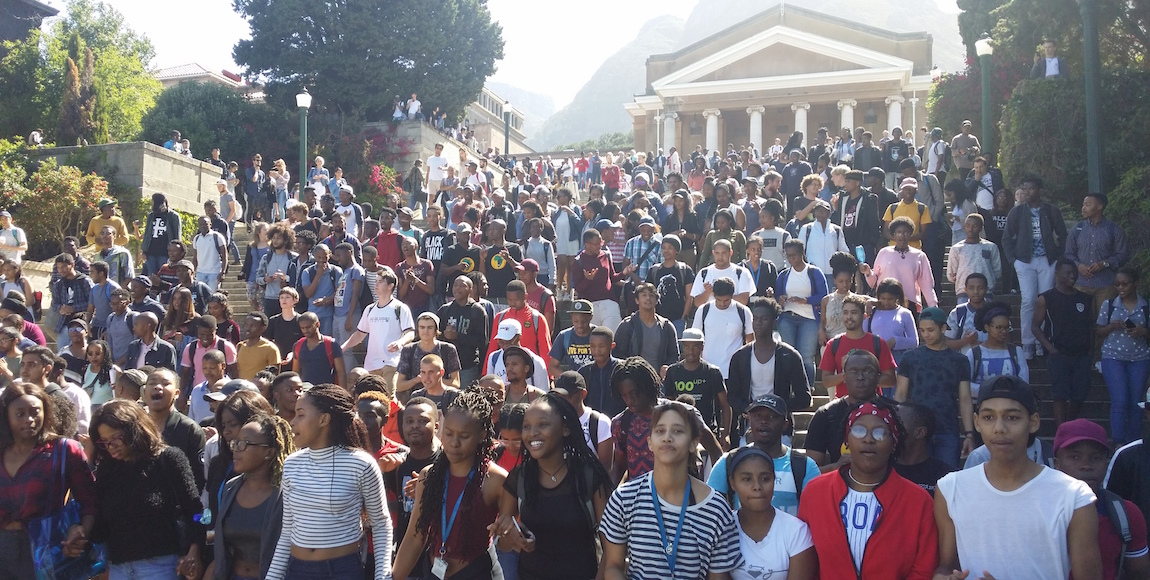
The eruption of #FessMustFall eleven years ago, when the born-frees demanded free and “de-colonised education”, remains one of the most prominent examples of what social sciences describe as the “disordered faults of progress” in the New South Africa.
The government succeeded to put a plaster over those cracks, and hyped up the NSFAS as a freely available service for students loan – to be paid after completion of studies. But then again, most of our children are sitting on their tertiary certificates, many for years, unable to find jobs in an economy that former President Thabo Mbeki once described as divided along racial lines. I move that President Ramaphosa continues to preside over a country of two economies, as Mbeki contended, one white and affluent and the other black and bleak.
President Ramaphosa can nonetheless not be single-handedly faulted for our glaring examples of lack of transformation, or its snail’s pace, particularly in the economy. Many handicaps are structural, a consequence of a compromise that was CODESA. However, as a collective of the so-called formerly disadvantaged, we look up to President Ramaphosa to take decisions that are geared towards ameliorating our lot. He must have been seen to stand for change, for transformation, in a country where Blacks were discriminated purely on the basis of their skin colour for over three hundred years until recently.
I am not opposed to our government’s multi-cultural and multi-racial inclusive programs. That is the foundation the founders of our democracy had laid for all of us to nurture. On paper, it looks oh so wonderful. Yet in practice, it leaves so much to be desired.
Like many South Africans who survived institutionalized racism, I’d like to see tangible effort aimed at bringing about a better life for all.
Implementation of equal opportunity programmes must also bear in mind that the starting point for a black child cannot be set at the same spot as that of the white child. This is why we have BEE. And in addition, gender parity legislation that has seen the ANC lead by example when insisting that organizational leadership ought to reflect 50-50 ratio, meaning equal number of males and females in leadership positions.
When our nation grapples with such complex and divisive issues of transformation whose implementation can easily be countered by a litany of sections of our Constitution – written largely by President Ramaphosa and Roelf Meyer – we need stoic leadership to lead us to Canaan.
It is therefore in this light that I feel the appointment of Meyer, at the pensioner age of 78, as our new envoy to the US does not reflect well on President Ramaphosa’s judgement.
We need to affirm our people, indeed without discrimination, yet mindful of our transformation agenda that President Ramaphosa has correctly argued that it remains non-negotiable.
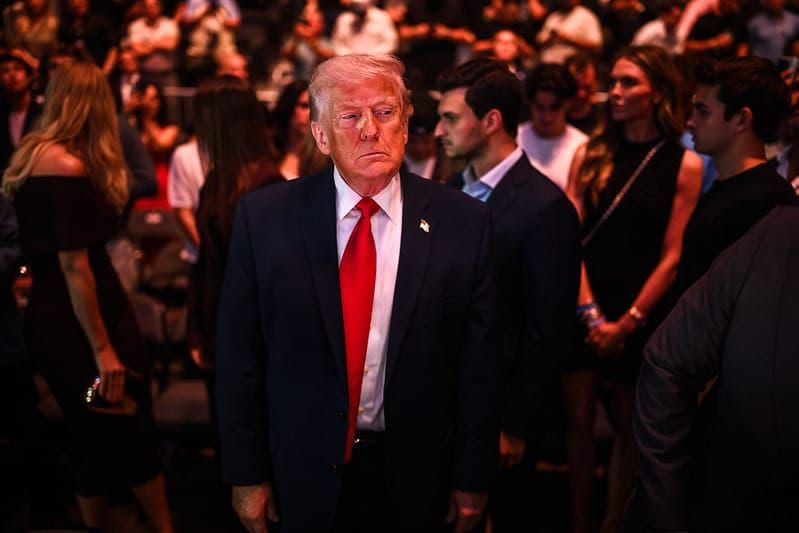
Furthermore, this appointment reveals uncomfortable factors in our bilateral relations with the US. Just over a year ago the US chased away SA ambassador in Washington, Ebrahim Rasool, labelling him a persona-non-grata following his criticism of President Donald Trump and the MAGA movement in a webinar.
President Ramaphosa later indicated that he was intending to deploy SA’s former Deputy Minister of Finance, Mcebisi Jonas, as Rasool’s replacement. That move fell flat after it emerged that the US held a dim view of Jonas in relation to his position as a top executive at MTN, a tele-company in the bad books of the US authorities.
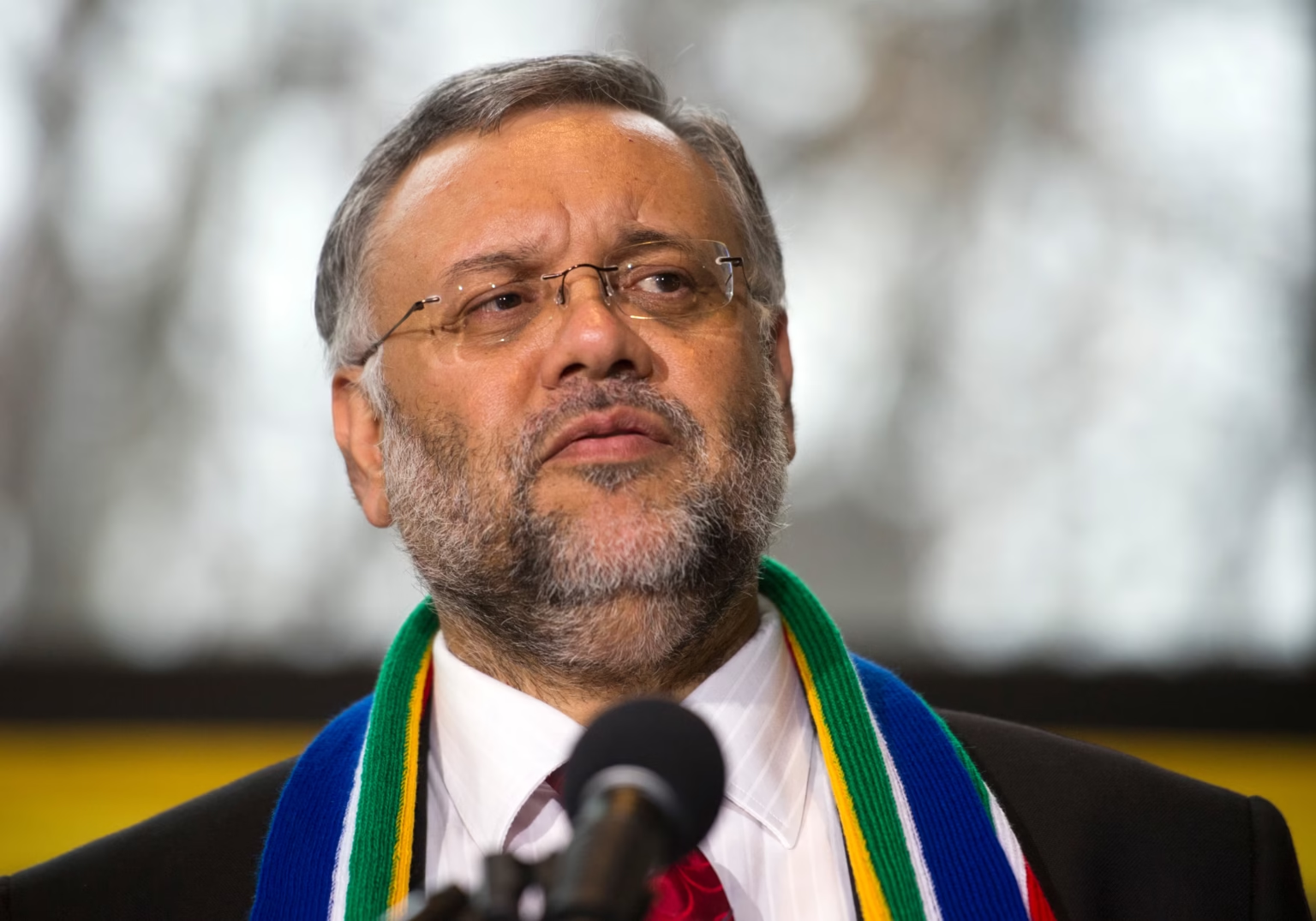
It is now over a year that SA has had no ambassador in Washington, yet during that time the US had Ambassador Reuben Brigety in Pretoria who was notorious for breaking every rule in diplomacy until his welcome departure in January 2025.
And now, President Ramaphosa recently accepted papers of credence of the new US ambassador, Brent Bozell III, who has already been hauled before the disciplinary desk of the Department of International Relations and Cooperation (DIRCO) in a very public act of “demarching”. It seems like the US is all too happy to lay down the rules of engagement for Pretoria, and in return the Ramaphosa administration is too careful to appease Washington seemingly at all costs.
The appointment of Meyer can also be read in the context of him being an Afrikaner, and thereby hopefully will counter the Elon Must-led false narrative that Afrikaners in SA are subjected to genocide.
Looked at face value, Meyer’s deployment can be regarded as a master stroke, and typical of the Ramaphosa magic wand. However, at 78, methinks our President should have gone for someone much younger – Afrikaner or not – and without any iota of apartheid baggage that is vexatious to the spirit of the majority of South Africans.
![AI IMAGE OF IRAN WAR W USA AND ISRAEL - IMAGE: WIO NEWS]](https://gsmn.co.za/wp-content/uploads/2026/04/image-1768397582204.webp)
![PRESIDENT RAMAPHOSA'S KEYNOTE ADDRESS AT THE INTERNATIONAL PANEL ON INEQUALITY [Image: SA Gov]](https://gsmn.co.za/wp-content/uploads/2026/04/678926814_1431297252369404_2450149361202771917_n.jpg)
![12 students who are set to depart for The Education, Training and Development Practices Sector Education and Training Authority (ETDP SETA)-Chinese Bursary Programme - [Image: ETDP SETA via X]](https://gsmn.co.za/wp-content/uploads/2026/04/HGkfZIJXIAADiBf.jpg)

![Bra Hugh Masekela [Image: Wits Uni / Daily Maverick]](https://gsmn.co.za/wp-content/uploads/2026/04/WitsUni-Hugh-citation.jpg)
![DEPUTY PRESIDENT MASHATILE'S SPEECH DURING TITLE DEEDS HANDOVER CELEBRATIONS FOR SEBILONG RESTITUTION COMMUNITY [Image: SA Government via Linkedin]](https://gsmn.co.za/wp-content/uploads/2026/04/1775836079262.jpg)
![President Cyril Ramaphosa has appointed Justice Nambitha Christabel Dambuza-Mayosi and Justice Katharine Mary Savage as Judges of the Constitutional Court [Image : Instagram of News24]](https://gsmn.co.za/wp-content/uploads/2026/04/WhatsApp-Image-2026-04-15-at-22.38.18.jpeg)

![Indigenous knowledge systems integrated into modern curriculum - south africa history curriculum reform - school, education - image [linkedin]](https://gsmn.co.za/wp-content/uploads/2026/04/1742898386729.png)


![The Bolobedu PV Solar Plant in Limpopo, South Africa [Image: SOLA Group]](https://gsmn.co.za/wp-content/uploads/2026/04/image-39.png)