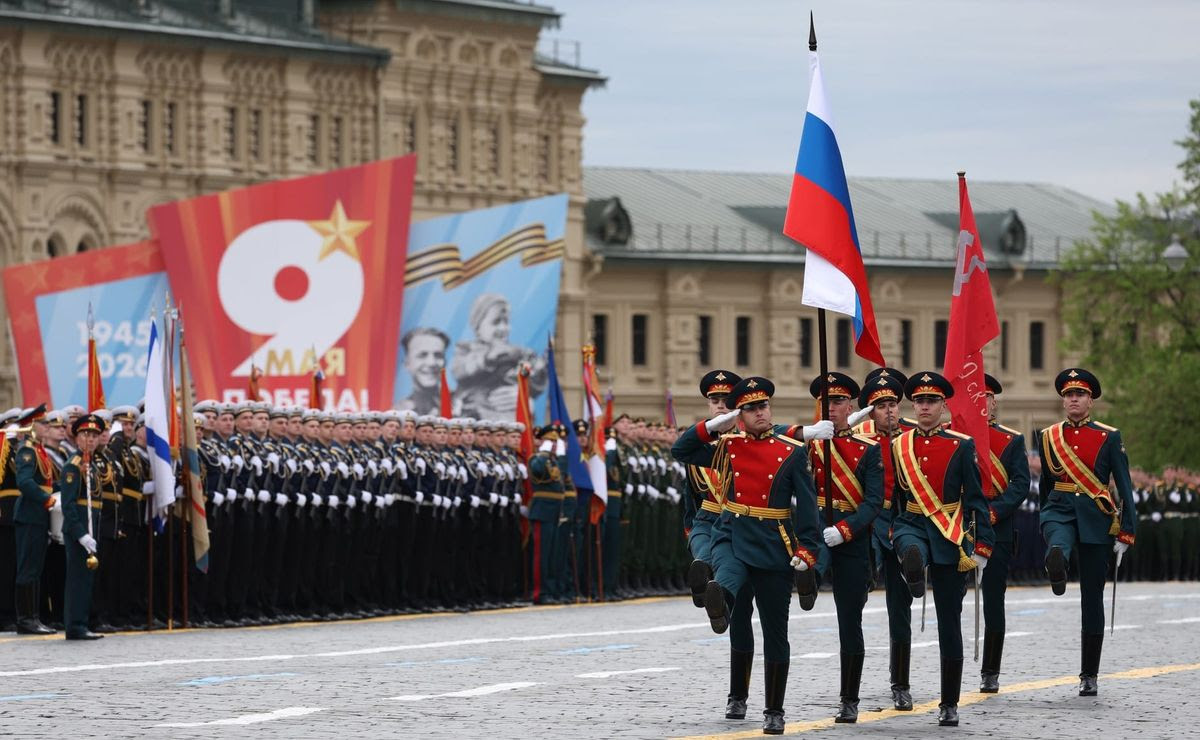
Russian Presidential Aide Yuri Ushakov told reporters on May 9 that “intensified” contact between Washington and Moscow over the recent days had led to the ceasefire agreement brokered by U.S. President Donald Trump the day before. Clearly, the danger represented by Kiev’s threat to attack Moscow’s May 9 Victory Day parade and Russia’s promise of a massive retaliation was taken notice of—and the power of diplomacy was shown to exist.
Nonetheless, the events of May 9 saw an exceptionally blunt Russian President Vladimir Putin, who addressed the commemoration by noting the significance the sacrifices of those 27 million citizens have for Russians today: “The great feat of the victorious generation inspires the soldiers carrying out the tasks of the special military operation today. They are confronting an aggressive force armed and supported by the entire NATO bloc.”
In other words, Russia sees its fight against an increasingly aggressive NATO as a continuation of that war 81 years ago.
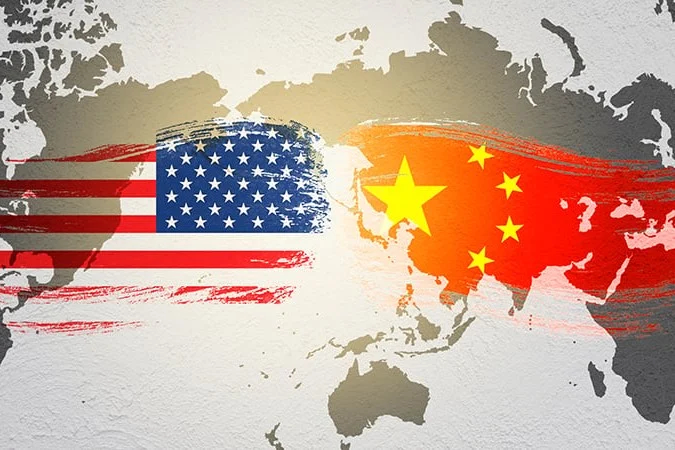
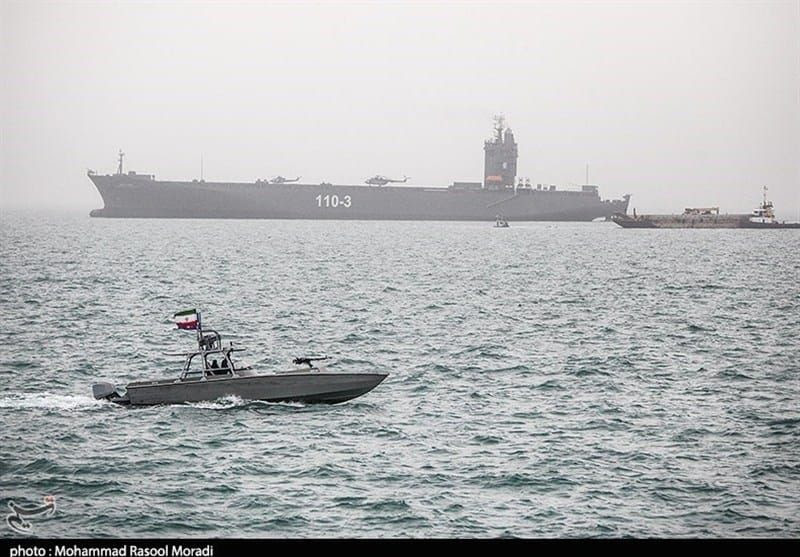
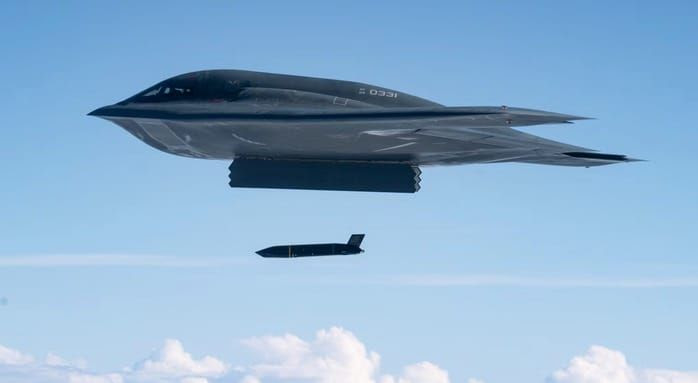
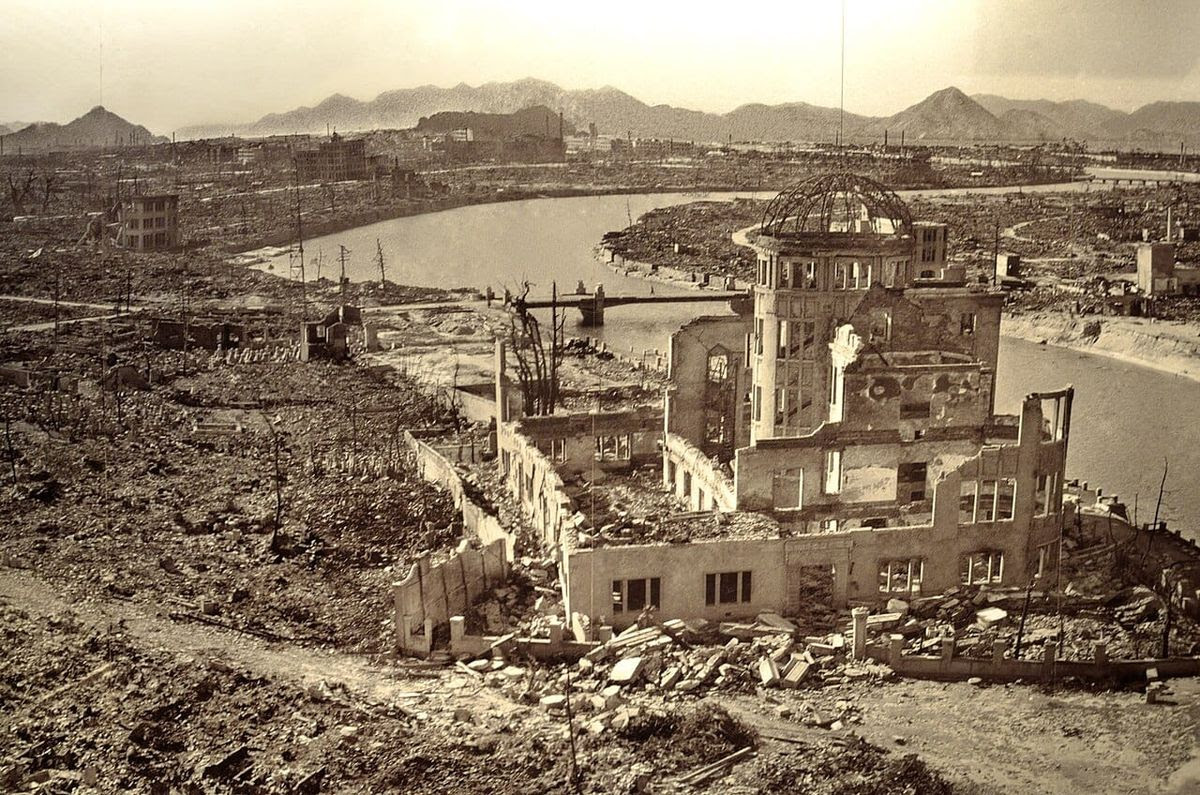
It is undeniable that we are currently living through the most dangerous period in world history. At any moment, one small mistake or misunderstanding could precipitate a spiral of events leading to global war. This is made even worse by the irrationality of leading Western nations, which insist on upholding a dying unipolar world view and are increasingly using smaller “proxy wars” to target their leading adversaries—Russia and China. Indeed, the Trump administration’s new round of sanctions against Chinese companies, allegedly for aiding Iran, is a case in point.
However, despite this deadly serious reality, true global statesmen and stateswomen are approaching this situation from the standpoint of potential—even the potential of those highly irrational Western nations like the United States. Speaking at the Russian embassy’s May 7 Victory Day celebration in Washington, D.C., Ambassador Alexander Darchiev said: “the high point of our relations during the Great Patriotic War serves as an example and a positive event that undoubtedly contributes to the normalization of our bilateral relations. Again, the process is slow, and world events also have tragic implications, but if Russia and the United States stand together, and if China joins us, I believe we will resolve all issues.”
The concept of potential was repeatedly emphasized by Lyndon LaRouche, who knew that, contrary to stale classroom textbooks, the world doesn’t operate based on the fixed laws of physics. The ancient Greeks promoted the principle of dynamis—a self-developing, creative potential—while Aristotle and his followers emphasized that of energeia, the mere actualization of already-existing things. Aristotle falsely believed that actuality is always prior to potential, meaning that anything new can only be produced by something already fully realized, whereas Plato and his followers insisted that the real world is actually an open field of generative power, in which unseen creative principles drive the universe toward forms that have never yet existed.
This principle of dynamis is why the world can exist perched simultaneously between the absolute disasters of a new militarism, religious warfare, amoral cultural depravity, and global superpower confrontation, and at the same time be on the cusp of a qualitatively new era of human history that puts these evils away like a childhood toy. The challenge implicitly posed to those willing to see it, is: What will we do to act on this potential and seize the moment of opportunity now before us?