This past Wednesday, the Tshwane Metro Police Department stated that multiple vehicles had been impounded belonging to the new e-hailing service, Wanatu, after its drivers were found operating their vehicles illegally. The new app, launched at the end of 2024, has generated widespread contempt due to its strict Afrikaans-only policy for all of their employees. Following this, the ride-hailing services announced that it was temporarily suspending its services.
Across the nation, netizens and experts alike have been engulfed in impassioned discourses and debates about the new ride-hailing service, with some arguing for its preservation of the Afrikaans language, and others critical of its blatantly exclusionary employment practices.
Launched in October 2024 and currently servicing Centurion and Pretoria, Wanatu is branded as the first Afrikaans transportation service, which has self-proclaimed itself as a tool for advancing the Afrikaans language and its speakers.
In South Africa, even thirty years after the advent of democracy, we are still contending with a plethora of social issues, which are deeply rooted in racial and political relations. Although we are a multicultural, multilingual, multi-ethnic society, our ‘rainbow nation’ has oftentimes been critiqued for being inauthentic, still riddled with tensions and hostilities that derive from our heinous history of the apartheid regime.
Even in today’s increasingly globalised world, language remains a powerful tool of connection for some, and simultaneously, a discriminatory barrier for many others. Exclusion based on language – whether in education, workplaces, or society at large – has been at the forefront of our national challenges. In fact, it remains deeply rooted in various systems and institutions throughout our society and continues to reflect the challenges that people of colour faced during apartheid in our post-independence society.

Our history has shown the rampant implications of the domination of a singular language or culture in our society, yet thirty years after democracy, certain organisations still uphold the dangerous sentiments of an authoritarian language and culture within an employment market. This is absolutely deplorable, and ‘tone-deaf,’ when you consider the issues that are contended with in SA’s society today. From rampant unemployment, to unequal access to quality education and economic opportunities, the acknowledgement of and adherence to serving our multilingual society is critical to equal and just empowerment.
Nevertheless, the question remains, how was this type of business policy launched into action? How did this type of business burgeon so swiftly before becoming a point of contention? Are our systems simply so poorly regulated that businesses are able to disregard the laws and rights enshrined by our Constitution?
The South African Constitution of 1996 – Section 9, on the Right to Equality, clearly speaks to the values of equality that must be upheld by every private and public body and individual in our nation. It stipulates that the “government must take active steps to change the inequalities of the past … taking positive action to protect or help a person or group who has been prejudiced or disadvantaged in the past, to help undo the imbalances and disadvantages that were caused by discrimination and oppression in the past.” The exclusive use of the Afrikaans language prior to democracy is a major signifier of the importance of this law.
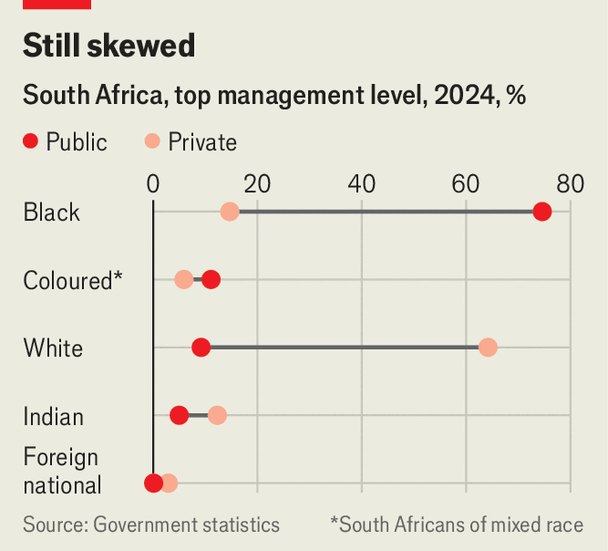
Additionally, page 213 of the Employment Equity Act places emphasis on practicing the right to equality in the workplace, stating that: “People from designated groups (black people – including African, Coloured and Indian – women and people with disabilities) must be given equal employment opportunities and they must be equitably represented in all work categories and levels.”
The Public Service Act’s subsection 3 also covers equity in employment, stating that “neither the state nor any person can unfairly discriminate against someone, either directly or indirectly … on the basis of race and colour, language, culture, sexual orientation,” and countless others.

What is clear here is that there is a serious oversight of the policies of businesses in aligning with the values of our national laws and Constitution. We are revered for having the greatest Constitution in the entire world. It is therefore not our laws that are at the centre of criticism, but rather the failures of government and provincial leadership in effectively implementing these laws. To neglect to uphold the values of the Constitution physically and institutionally, which was forged for the betterment and reconstruction of our society after the harrowing apartheid era, is truly a reckless mistake.
Although the City of Tshwane has expressed disapproval for the Afrikaans-only e-hailing transport service Wanatu, which has been operating in the Centurion and Pretoria areas, we cannot overlook the creation of jobs that seek to exclusively promote the Afrikaans language, Afrikaans speaking people, and their communities alone. In 2025, there are approximately 65 million citizens in SA. Only 10-13% of the entire nation is Afrikaans speaking at a proficient level. This does less than a disservice to the 33.2% unemployment rate that will be contended with this year, according to the PWC’s Strategy& South Africa Economic Outlook report for 2025.
This business has highlighted a serious lack of effective screening and assessments where the laws and regulations of new businesses are concerned. Who knows how many other businesses operate similarly, exclusively hiring staff based on their lingual ability, cultural categorisation, skin colour, gender, or other distinctive features.
Speaking to television channel Newzroom AfriKa, Tshwane Transport MMC Tlangi Mogale stated that the language policy at Wanatu is a ‘total no-no’. Mogale added: “I think for us that is blatant racism, and it is the last thing that we should be discussing in this day and age, as a constitutional democracy. For me, personally and in my capacity as an MMC, it is one thing we have said to the province – what are you doing about this?”

MMC Mogale also emphasised that there is no malicious intent in the targeting of Wanatu, however, that the Afrikaans e-hailing service will not operate in Tshwane, and that the City has escalated the matter to the Human Rights Commission. Mogale underscored that “there is no way we will be able to support anything that seeks to take us 100 years back in terms of segregation.”
We need to ensure that businesses like Wanatu do not worsen toxic racial tensions, and are forced to comply by our national laws and regulations, that not only uphold fairness and equality, but also manage the many institutional and systemic impediments that are faced by the vast majority of the national demographic.
We are revered across the globe for boasting the greatest Constitution, however, what does it say about our society, systems, and leadership, if we neglect to uphold its incredible values? What does it say about our future, if we cannot respect the values that were so arduously fought for in our recent history? It is crucial that our leaders address the inequalities in our society with more swiftness and seriousness. We need to head former President Nelson Mandela’s words: “As long as the nation refuses to acknowledge the equal role of more than half of itself, it is doomed to failure.”