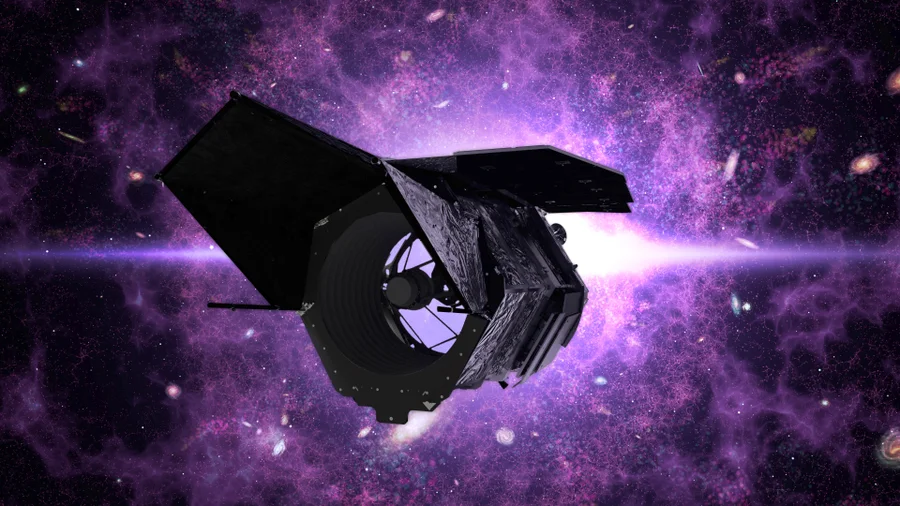
The Nancy Grace Roman Space Telescope is a NASA Observatory that is scheduled to launch on August 30, 2026. It will lift off from NASA’s Kennedy Space Center in Florida, launching eight months ahead of its original May 2027 launch date.
Nancy Grace Roman (1925–2018) was a pioneering American astronomer widely celebrated as the “Mother of Hubble” for her instrumental role in making the Hubble Space Telescope a reality. As NASA’s first Chief of Astronomy Programs, she was the first woman to hold an executive position at the agency.
The Roman Telescope is designed to answer some fundamental questions about the nature of our Universe, and will investigate dark energy, study dark matter, discover thousands of new exoplanets, and perform infrared astrophysics. The video on the NASA site notes that although we currently have “an exquisite model of how our Universe works,” the Roman telescope “is designed to tell us if we’re wrong,” with the implication that to be proven wrong by science is a good thing.
“More than a thousand technicians and engineers assembled Roman from millions of individual components. Many parts were built and tested simultaneously to save time. Now that the observatory is assembled, it will undergo a spate of testing prior to shipping to NASA’s Kennedy Space Center in Florida in summer 2026,” reported the NASA website.
It is scheduled to be shipped from the Goddard Space Flight Center in Maryland to the Kennedy Space Center in Florida in mid-to-late June, where it will undergo additional testing and preparations for launch. The $4 billion observatory will make the journey aboard the agency’s Pegasus barge.
“Roman will peer through dust and across vast stretches of space and time to study the universe using infrared light, which human eyes can’t see. The amount of detail these observations will reveal is directly related to the size of the telescope’s mirror, since a larger surface gathers more light and measures finer features. Roman’s primary mirror is 7.9 feet (2.4 meters) across, the same size as the Hubble Space Telescope’s main mirror but less than one-fourth the weight (410 pounds, or 186 kilograms) thanks to major improvements in technology, “ said NASA.
The primary mirror, working with the rest of the optics, directs light to Roman’s two science instruments: the Wide Field Instrument and the Coronagraph Instrument. When light enters Roman’s 7.9 foot (2.4 meter) aperture, the curved primary mirror reflects and focuses it, and the secondary mirror refines the focus again. From there, light from different regions of the sky is routed to each instrument, allowing Roman to operate both simultaneously. This will provide an extraordinary capability of the telescope to maintain the clarity of Hubble’s observations, and a field of view 100 times greater.
The telescope will operate in a quasi-halo orbit around the second Sun-Earth Lagrange point (L2), located about 1,000,000 miles (1.5 million kilometers) away from Earth in the direction away from the Sun. This is the same general area in which the James Webb Space Telescope is operating, and since the two devices both have infrared observation capabilities, they will frequently team up, providing a truly extraordinary and exciting capability to learn more about our Universe.