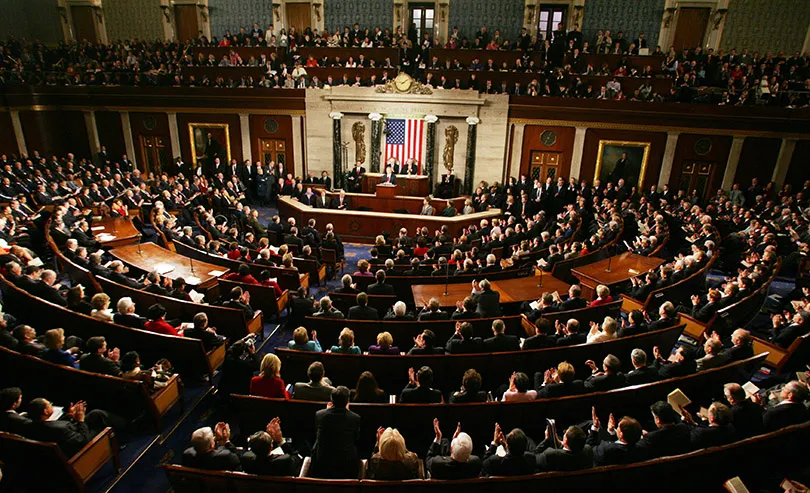
The July 15 House vote was considered mostly symbolic and in the end the effort failed, but 103 House Democrats and one Republican, Thomas Massie (R-KY), voted for an amendment to cut off all aid to Israel. This was a one-sentence amendment written by Rep. Massie to cut $3.3 billion from the Foreign Military Financing Program, which is the amount currently allocated to Israel in the form of grants and loans to purchase American weapons and related defense services.
It would also prohibit any funding in the annual spending bill for the U.S. State Department programs for Israel. There were 98 Democrats who voted to keep the aid flowing, and 10 Democrats who simply voted “present.” All other voting House Republicans also voted to fully support Israel.
This vote is a reflection of the growing rebellion within the United States against the failed war policies of the two-party establishment—and its subservience to Israel—a reality which is even spilling into the Congress. House Minority Leader Hakeem Jeffries (D-NY) sent an email to all House Democrats arguing against the amendment, though saying he was not going to “whip the votes” to oppose it.
Rep. Jeffries admitted that a major “reset” is needed in U.S.-Israel relations and attacked the “far-right Netanyahu government,” but wrote that the measure was “overly broad” and argued that in addition to cutting off military aid, this amendment would also eliminate humanitarian aid, defund diplomatic efforts, and even cut out funds for basic operations in the U.S. Embassy.
There were some Democratic leaders who also split with Minority Leader Jeffries, such as Democratic Whip Katherine Clark of Massachusetts who said that “the status quo is not tenable.”
Rep. Clark wrote in a statement, “I will be voting yes, not because I agree with the entirety of the amendment, or the GOP’s cynical motivations for its consideration, but because I believe we must change course.”
Also supporting the amendment was the chairman of the Congressional Progressive Caucus, Rep. Greg Casar (D-TX), who posted on X, “I am aware that the amendment as written may cut off both military weapons (~$3.3 billion) and some diplomatic funding (~$50 million). While I would prefer to vote on an amendment that stripped just military funding, I think opposing the billions in military funding is what’s most important here.”
Congressman Casar added, “The Israeli government committed war crimes in Gaza and helped drag America into war with Iran. Americans should not be financing more weapons for Netanyahu.”
This is the same Congress that gave nearly 50 standing ovations for an address in a joint session of Congress by Israeli Prime Minister Benjamin Netanyahu on July 24, 2024.
While this vote is a notable shift, it’s important to note that the far more serious issue—that of the proposed U.S.-Israel military and intelligence mergers in this year’s NDAA, in Sections 219 in the House version and 1217 in the Senate version—still looms large and has received far less attention.
In fact, Rep. Jeffries even gave a nod to this merger in his July 14 letter, where he called for a “new security arrangement” to “undergird the maintenance of Israel’s qualitative military edge against Iran,” one in which “[m]utually beneficial joint technology, innovation, research and further development of defensive programs… should be prioritized.”