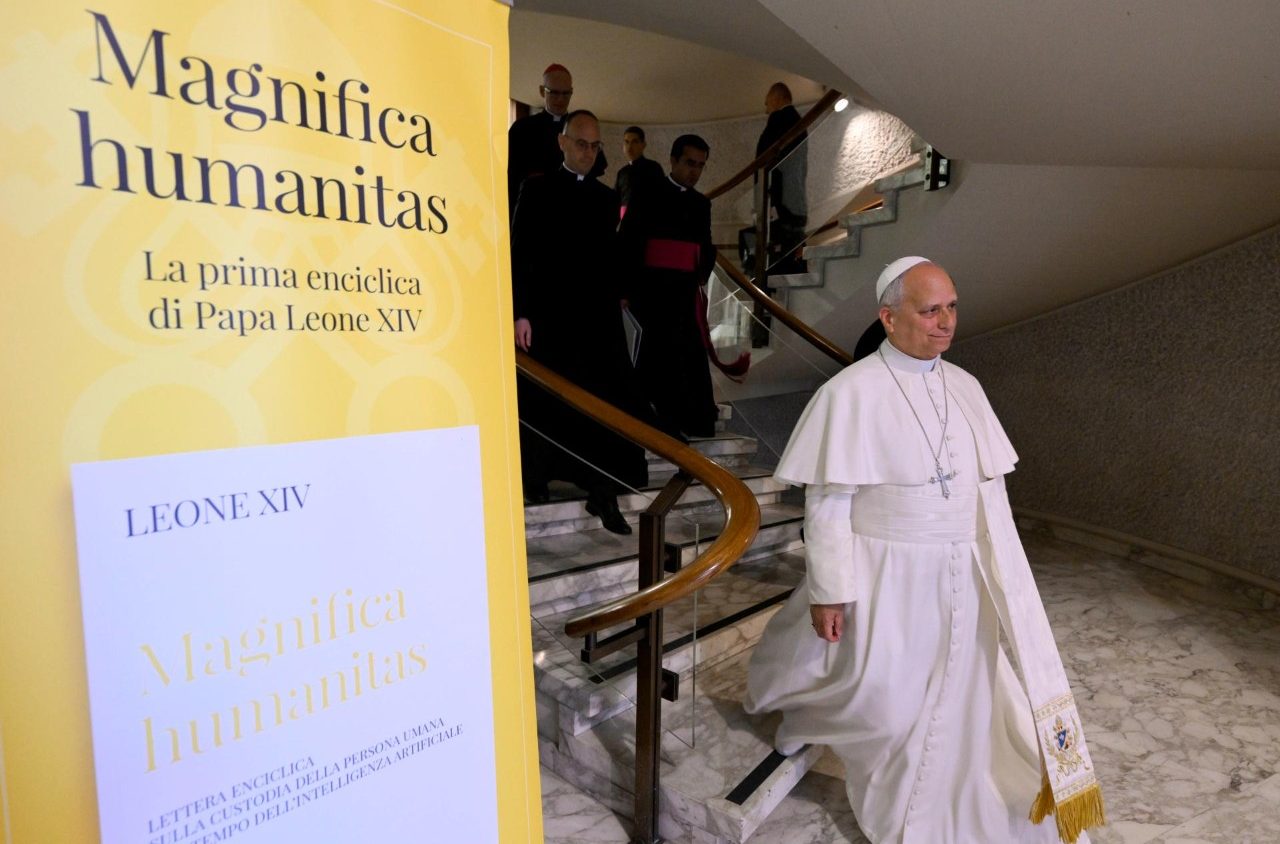
The 200-person gathering of Nobel Prize winners and other notables at Castel Gandolfo began with a presentation of the encyclical Magnifica Humanitas by Cardinal Angel Fernández Artime, the Pro-prefect for the Dicastery for Institutes of the Consecrated Life. This was followed by a presentation by Cardinal Fabio Baggio.
“We gather at a moment in history,” he said, “marked by increasingly profound geopolitical tensions, the fragmentation of the international order, and intensifying technological competition.” “At a time when the pace of innovation often exceeds that of reflection,” he warned, “the world stands in need of shared principles capable of guiding progress toward authentically human ends.”
Cardinal Silvano Maria Tomasi, the president of Domus Communis Foundation, expressed his view of the event’s aims. “May future generations be able to say that, at a moment when humanity possessed unprecedented power over its own destiny, women and men of conscience chose cooperation over confrontation, dialogue over fear, and hope over resignation.”
While the event has succeeded in gathering an impressive group of people around the concepts elaborated by Pope Leo in his encyclical, it is a very mixed group of people, including Muhammad Yunus, an adherent of the “small is beautiful” perspective; Filipino democracy activist Maria Ressa; and Karen Hallberg, Secretary of Pugwash Conferences.
The conference also heard an address from Juan Manuel Santos, the former president of Colombia. Topics for discussion include “the fragility of the human family in the nuclear age,” “technology in the service of humanity,” and “the moral challenges of AI and war.” Representatives of AI companies Anthropic and DeepMind also gave presentations.
Three days after Rome adjourns, Shanghai opens the World Artificial Intelligence Conference and its High-Level Meeting on Global AI Governance (July 17–20), China’s own bid to help write the rules for AI.
Within one week the two great counterweights to an unregulated, war-driven tech oligarchy—the moral authority of the Church and the development drive of the world’s rising power—are each placing the governance of artificial intelligence, and its subordination to human ends, at the center of the table.