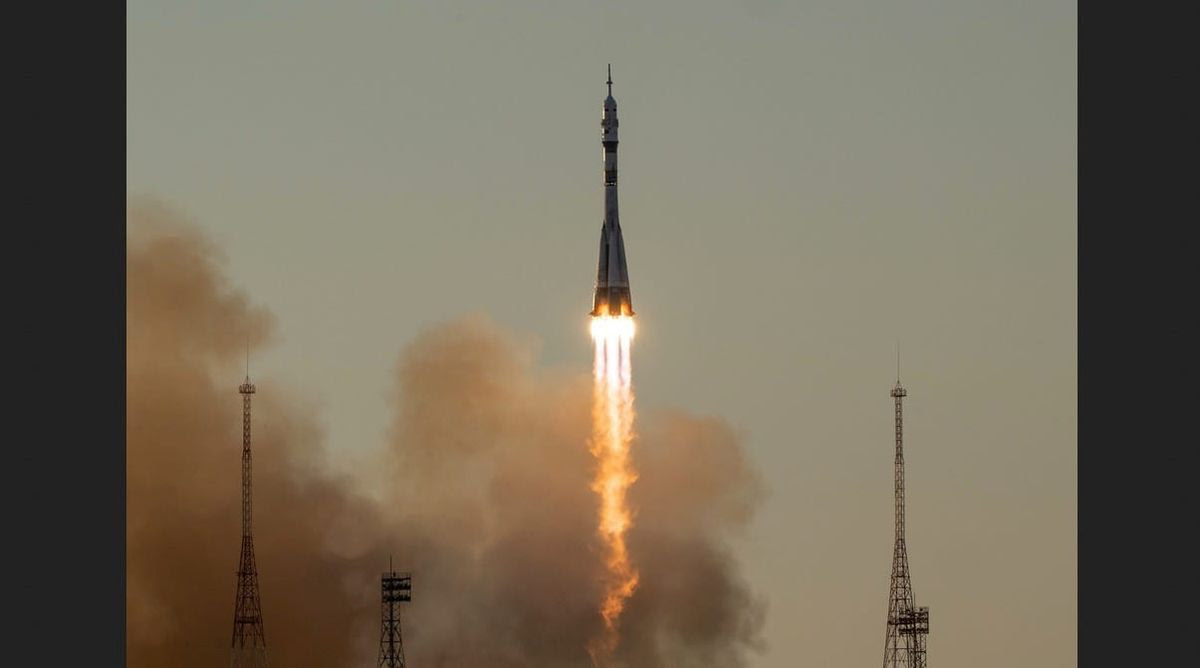
On July 14 at Baikonur, the heads of the American and Russian space agencies stood side by side—the first such meeting on that soil in nearly eight years—and launched a crew, two Russians and an American, toward the one outpost where their nations have never stopped cooperating.
That same morning in the Strait of Hormuz, a sailor was killed and eight of his crewmates wounded when missiles struck their tankers in a war over who may pass through a channel twenty-one miles wide. One day, two images of mankind. Which is the human future?
Vladimir Vernadsky spent a lifetime demonstrating that this is not an open question. Across two billion years of the fossil record he traced an arrow that runs against the physicists’ “arrow of time”: it points up—the irreversible perfecting of the nervous system, what the American geologist James Dwight Dana named cephalization, for “the brain, which has once achieved a certain level in the process of evolution, is not subject to retrogression, but only can progress further”—and he named its destination the noösphere, the epoch in which “man becomes a large-scale geological force,” the first creature to remake the planet knowingly, on purpose.
Lyndon LaRouche gave that arrow its economic measure: the anti-entropic rise of energy-flux density, the power of a species that does not merely occupy the biosphere but willfully raises its own carrying capacity. Man’s vocation is not to submit to the world as found, but to build the world he lives in. And two hundred fifty years ago this month, a republic was founded as the political form of that arrow: “We the People,” a light to all mankind.
Now measure the present. The arrow is being reversed—deliberately, by elites who, as Helga Zepp-LaRouche warns, have let insanity take hold in the corridors of power. That reversal is why the President threatens to “take out” Pickaxe Mountain, a nuclear site buried so deep that experts say no conventional weapon can reach it—leaving unspoken the only instrument that could, the first nuclear weapon used in war since 1945.
It is why missiles were fired at the home base of the Fifth Fleet, why the blockade of Iran’s ports is back in force, and why the first seafarers have now died in a strait the world’s oil must pass through. It is why the Congress is asked to dissolve itself into the war machine—Sections 219 and 1217 of the NDAA would fuse the U.S. military permanently with Israel’s, Netanyahu’s own “plan,” as he wrote to a congressman—and why the Senate Democrats who blocked the defense bill this week did so to posture against an unpopular war while leaving the merger untouched, to pass once the theater subsides.
And it is why Europe liquidates its physical economy to pay for the guns—Germany borrowing €838 billion, with debt service soon four times its health budget, down the Schachtian road that once financed the march to world war—while a single week of June heat killed more than ten thousand Europeans, nine thousand of them elderly, in homes their civilization will not cool.
A civilization that forgets that its purpose is to build a growing world will, inevitably, begin fighting over a shrinking one.
But the arrow has not stopped. China and India—more than a third of mankind—are choosing to reconnect. And at Castel Gandolfo, in the gardens of the Pope’s summer residence, thirty Nobel laureates and the leading scientists of the AI age convened in the spirit of Leo XIV’s encyclical Magnifica Humanitas—”magnificent humanity.” There, the opening session heard the demand that no nuclear weapon ever be loosed by a process without a human being in the loop, on the way to a “Rome Declaration for a Disarmed and Disarming Peace” to be proclaimed at the Capitoline on July 16.
Two days ago, at his Sunday Angelus, the Pope had already said it plainly: “The winds of war are unfortunately blowing again in the Middle East, in Ukraine and in many other parts of the world,” and he prayed for the seafarers “fearful of the conflicts crossing the sea lanes”—words an Iranian missile made literal within forty-eight hours. His answer, and ours, is not the management of a shrinking world but the development of a growing one: the right of every human being to stay, to build, and to flourish in a developed homeland.
That is the case EIR will put before the world at its July 31 roundtable, “Solve the Immigration Crisis with Development,” and the case Diane Sare is carrying into the presidential race with a single question: what will America, and the world, look like in 2076? Vernadsky’s arrow carried life from the sea onto the land, and formed a republic out of a wilderness.
Writing in the darkest hour of the last world war, he did not flinch: “our democratic ideals are in tune with the elemental geological processes, with the law of nature, and with the noösphere. Therefore we may face the future with confidence. It is in our hands. We will not let it go.” Let that be our work.