Not long after the ANC was unbanned, and with most of its former exiled leaders back in the country, a delegation which included Pallo Jordan went for a walkthrough visit to the JSE. When asked about his impressions by a journalist – I guess the hidden question was his impressions of Capitalism at work – Jordan did not mince his words. He responded that whilst the experience was impressive, it was all a paper chase. I could not agree more with Jordan. Share ownership on the JSE through empowerment deals does not necessarily translate into economic transformation.
The JSE is one of the most reputable Stock Exchanges in the world. At a market capitalisation of R 24 trillion (January 2026 figures), It is by far the biggest Stock exchange on the continent by market capitalisation and ranks among the top twenty stock exchanges in the world. Yet, lack of readily available and credible financial data on ownership by Black shareholders on JSE-listed companies and stocks, gives an eerie feeling of lack of transparency and a sense that there is something wrong in the reporting on economic transformation. Notwithstanding, available data on Black shareholding and B-BBEE scorecards indicates that BEE is ineffective in the realisation of real economic transformation.
Challenges with varied reporting
In 2017, The National Treasury published a research report titled “Ownership of JSE listed companies” by independent researcher Lynne Thomas. The report on equity ownership covered 816 traded instruments and 379 listed companies. These made up the total equity market of the JSE, then valued at 13 trillion rands. The report indicated that the top 25 listed companies accounted for a total market capitalisation of 3,8 trillion and also accounted for two thirds of companies deemed major shareholders with significant influence. South African BEE companies and trusts accounted for R44,7 billion and a mere 1% of the top 25 listed companies N.B. Not 1% of the total listed companies.
The National Treasury Report also cited a 2013 study conducted on behalf of the JSE on the top 100 JSE-listed companies by research company Alternative Prosperity. The Alternative Prosperity report estimated BEE ownership of the total top 100 JSE-listed companies at 10%. The approach by Alternative Prosperity was to also include empowerment transactions facilitated by JSE-listed companies through the sale of assets to black owners at the subsidiary level including direct retail holdings. Thus, the Alternative Prosperity report did not only limit Black ownership to direct listed holdings.
In July of 2022, the Broad Based Black Economic Empowerment Commission issued its annual report labelled ‘The National Trends and Status on B-BBEE Commission Transformation Report 2022. The B-BBEE Commission is a body mandated to track compliance with the B-BBEE Act. Unlike the 2017 National Treasury Report, the B-BBEE report was not only focused on black ownership of the JSE- listed companies but tracked Broad Based Black Economic Empowerment and Transformation across various sectors of the economy. The report was based on B-BBEE compliance share certificates uploaded on the share certificates portal by B-BBEE verification agencies as well as compliance reports by JSE-listed companies and public entities.
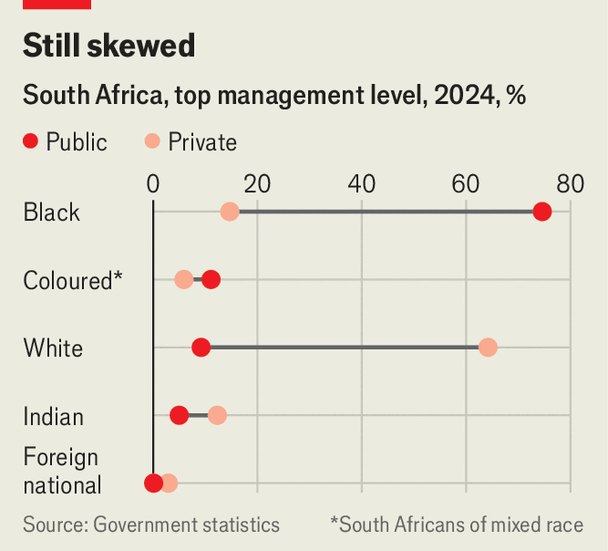
The B-BBEE Report indicated a 1,5 % decline in overall B-BBEE ownership from 31% in 2020 to 29,5% in 2021. The report also indicated that in the same period, black management control had declined from 57% to 51,6%, however, against the trends, board control of JSE- listed companies by black stewards had increased to 39 % from 29 % in 2020. The fact that the report tracks certificates loaded on the verification portal underscores the point that BEE transactions and B-BBEE scores are nothing more than a paper chase exercise. They do not measure the real value of a demonstrable foray by blacks in meaningful economic transactions, but shareholder value based on stacks of share certificates.
Whilst the report notes that no less than 500 B-BBEE ownership deals worth R600 billion had exchanged hands between 2017 and 2020 in transaction value (read this as paper value), it also suggested that there was a need for less expensive and unencumbered funding for the deals to ensure that real value exchanged hands to previously disadvantaged communities. What sticks out like a sore thumb amid all the empowerment deals is that by 2020, there was no single 100% black owned company on the JSE listing. Ironically, the report data indicated declining trends as it shows 1% of the total JSE-listed companies were 100 % black owned in 2017, 1% in 2018, 3% in 2019 and none in both 2020 and 2021. This is a clear indication that if anything, B-BBEE has not only declined but has also stagnated.

Challenges with BEE transaction structures
Most BEE deals have a period during which the empowered beneficiaries are locked in for a defined period for the transfer of shares. When the window period expires, beneficiaries may opt out and sell their shareholding, effectively diluting Black ownership. The 2017 National Treasury report suggests that this should not be seen as failure of transformation as the empowered beneficiaries who sell are able to use their net worth to pursue new investments. This line of reasoning clearly does not hold water. And I would argue, this is also the reason the empowerment transactions have shown a decline and even stagnation as per the B-BBEE Commission data.
Instead of admitting to the glaring failures of share certificate based economic empowerment where the empowerment beneficiaries ride out the empowerment window period before they cash in and bolt before the share price dips, the powers that be have opted to conjure up a clause ‘once empowered always empowered’ , under the refined B-BBEE Codes. This implies that even if there is no empowered component in reality, the empowerment component continues to be recognised in the company scorecards. The big question Is who is fooling who?
Fast-forward to 8th June 2026, the Black Management Forum released a research report by economist Duma Gqubule titled “Black Ownership on the JSE during the first three decades of democracy.’ The research report was conducted in collaboration with Transformation Lens on behalf of the Black Management Forum. In comparison to the National Treasury report of 2017, the report was more comprehensive as it covered the top 60 JSE-listed companies in comparison to the 25 covered by the National Treasury report. N.B The significant influence threshold qualification it the 2017 National Treasury report.
The report placed direct black- ownership of the top 60 JSE-listed companies at R255 billion. This represented 6,9% of their South African assets and 1,5 % of their total market capitalisation at around R17,1 trillion. This was more in line with the 1% as per the 2017 National Treasury Report, however, way out of sync with the 2022 B-BBEE Commission Report which placed black shareholding in JSE-listed companies at 39%. Clearly there are huge challenges in official reporting on BEE and economic transformation data.
Duma Gqubule attributed the discrepancies to contradictory information between actual empowerment transactions and the inflated compliance percentages as depicted on companies’ BEE Certificates. He did not pull punches when lamenting that reporting on black ownership on the JSE had lost credibility. His report was very critical of the conceptualisation of the B-BBEE Codes. He sighted the recognition of indirect empowerment as well as recognition of passive pension holdings as a policy failure which rewarded companies with full compliance points for doing nothing. He slammed such practices as a back door to compliance. The BMF report by Gqubule was also very critical of the ‘once empowered always empowered’ principle and strongly advocated for replacement contracts.
Transformation of our political economy must happen organically and not through share certificates. Empowerment deals – in whatever form – through share certificates are nothing but just a paper chase. They serve nothing but to enrich the chosen few and coopt the masses for no other reason but for purposes of beefing up B-BBEE scorecards. That is not economic transformation but compliance and box ticking. Government must have a clear vision and a clear path for the development of small to medium enterprises in commerce and industry.
Development Funding Institutions must facilitate funding for real economic transactions and not just fund paper deals. Empowerment funded transactions – irrespective of the funding model – must translate into bricks and mortar and economic transactions that can be measured in haulage and railage. There must be a deliberate effort and a clear focus on the upliftment of small to medium enterprises. Empowerment transactions must create real actors in the economy and not glorified employees of white established businesses masquerading as businessmen and women who have no real say in the running of the companies beyond their fancy offices. No matter the huge monetary rewards for the beneficiaries, it is not economic transformation, it is scorecard authenticated fronting.
Real transformation of our political economy cannot be achieved through a paper chase. It cannot be measured by stacks of share certificates and can certainly not be truly measured against the billions or rands in value created for a handpicked few or categories of women and youth and people with disabilities who form part of compliance scores. This is the reason why transformation has not moved and has actually stagnated in the last three decades of democracy.
Real economic transformation must be measured against the frequency of haulage and railage, and the amount of tonnage as well as the independent black hands and black heads involved in the facilitation, running and directing of related economic transactions. Until we get this right, we shall continue to waste resources on reports that may be useful for scorecard purposes but not very helpful for economic transformation.
With 30 years of data on Black Economic Empowerment, it is clear that bureaucrats cannot champion economic transformation. What South Africa needs is not more compliance but more entrepreneurship. There is a big question to ask. Are the current custodians ready to lead the charge for real change towards a truly transformed society?