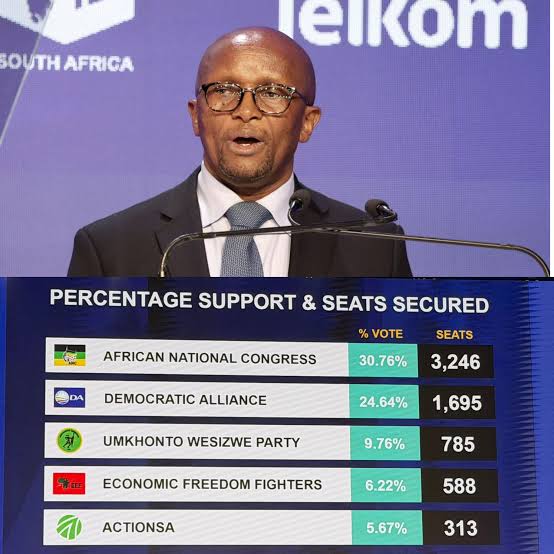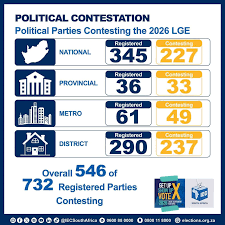
Earlier this month, on November the 4th, South Africans came out in their numbers to cast their votes in the local government elections (LGE 2026). The sensational story of LGE – 2026 was Action SA, which emerged as king maker in Gauteng’s three big metros of Tshwane, Ekurhuleni and Johannesburg, even surpassing the ANC in Tshwane. As per indications from the last few national and local government elections, the ANC has been on a steady decline, however, its spectacular collapse in LGE-2026 is not just an indictment of the ANC but spells a setback for black politics in general.
With the results of LGE-2026 declared by the IEC, and with various parties engaged in frantic negotiations to form coalition governments in the major metros, and in many of the hung municipalities across the country, it is worth taking stock on the reasons for the unravelling of the once colossal ANC and what it actually means for the future of black politics in South Africa and beyond. For some time, the post liberation bourgeois leadership of the former liberation movement of the revered Tambo, Mandela and Sisulu, has been showing signs that it was losing popularity with the masses at the voting stations, but nothing could have prepared us that things could unravel so badly, and so fast, for the oldest liberation movement on the continent.
At the height of its popularity, the ANC registered 69,69 % of the votes during the 2004 national elections under Thabo Mbeki. Since the bruising factional battles of Polokwane in 2007 – that continue to haunt the party even today – the ANC has been on a downward spiral sinking to hitherto unthinkable lows in LGE-2026 where it amassed only a paralysing and sobering 30,8 % of the consolidated votes; a far cry from the two-thirds majority of 2004. Anyone who argues against reading any meaning into this, is just an unrepentant denialist.
Alienation and failure to marshal the motive forces
There is no single factor, but a multiplicity of co-existing endogenous and exogenous factors that continue to eat away at the once monolithic ANC; in the main the reasons for the ANC’s rapid decline in the last fifteen years is attributable to its alienation and failure to marshal what it defines as the motive forces of the National Democratic Revolution (NDR). According to the ANC’s Strategy and Tactics document, the motive forces of the NDR are defined as classes and components of society that are critical to the transformation of South African society and the building of a new democratic order. The NDR stratifies components of the motive forces as the working class and the poor (urban and rural), the middle strata – made up of black professionals and the emergent small business owners, as well as intellectuals and lastly, the progressive members of white society as another key component.
For its manifest self-serving acts, and far from harnessing and marshalling the motive forces into coherent and strategic pillars of the NDR, the bourgeois leadership of the ANC has overtime only succeeded in alienating these critical components of the motive forces. It is this alienation of the motive forces that has precipitated the ANC’s decline in popularity, undeniably registered in LGE-2026. The working class is the core of the motive forces; however, overtime, there has been simmering tensions in the tripartite alliance between COSATU and the SACP on the one hand, and the ANC on the other, largely stemming from the ANC government’s steadfast commitment to neoliberal policies and austerity measures which have not augured well for government spending necessary for job creation, thus reducing the unemployed in suburbia to grant dependents and mere voting fodder for the ANC.
With unemployment levels at record highs, and no policy coherence between the ANC and its tripartite alliance partners, a split is imminent. In the recent LGE-2026 elections, the SACP opted to come out of the shadow of the ANC and contest elections on its own. These are no small fractions. There is no coming back from this, and no amount of political equivocal speak or spin can save the alliance from this. A fracturing of the tripartite alliance is a lost opportunity for the ANC to marshal the leadership of what the NDR identifies as the most critical pillar of the motive forces, the working class.
The Bourgeois leadership of the ANC has failed to lift the rural people out of poverty. They have failed to implement robust and transformative agrarian reforms to develop and uplift subsistence farmers to the status equivalent or near equivalent to successful small scale commercial farmers. Whereas the ANC government has issued loan farms and has been running programmes for the issuing of loans to small scale farmers, the black farmer has to see everything to finish; from soil preparation, to the planting of crops, to paying farm labour costs, to paying for implements, and seeking markets for their produce on top of saying prayers that their crops do not fail due to any natural disaster.
In comparison, the small scale ‘boere’ of old needed to worry about the business of farming and got paid for their crops by the local ‘boere korporasies’ under the various farming boards – which have since been disestablished. The old style boere korporasies were integral to the sustenance and success of the small-scale farmers as they meant farmers had a guaranteed market for their produce. Whilst government owns the major fresh produce markets, it is the white market agents that decide whose produce to buy for their customers, and not the state. Aside from the general challenges of access to farming land and implements, black farmers struggle for access to markets as old style boere networks still dictate the farming value chains.
One is not lost to the reasons for the ANC’s attempts at developing black entrepreneurs, however, BBBEE has failed to transform black entrepreneurs into a fully-fledged national bourgeoisie. Black Economic Empowerment has only served to enrich those in the ranks of the bourgeois leadership and a few politically connected individuals but, in the main, it has dismally failed in the creation of a proper bourgeoisie class necessary for the transformation of South Africa’s political economy. With all the billions worth of BEE transactions and share certificates that define black business today, blacks are virtually a no show in the country’s economic value chains. The economy remains emphatically white.
For all their share certificates and their billions, the BBBEE beneficiaries have not reached the lofty heights attained by the old-style township businesses which lifted themselves by their bootstraps to establish the likes of NAFCOC under the leadership of the able Ntate Sam Motsuenyane and his cohort. It was during the height of Apartheid in the repressive seventies that NAFCOC established African Bank as a fully licensed commercial bank – black owned and black directed. This is a feat worth emulating by the existing business chambers. I hope that in our lifetime, we shall get the reasons why the ANC government under a democratic dispensation has still not been able to establish a black bank despite a resolution to do so at its 54th national conference in 2017. This is a serious indictment of the ANC.
It is an open secret why the democratic government propped up a middle class of professionals referred to as the middle strata. They are not a real class in a classical capitalist boss and worker sense, and thus, make for a pseudo class. The middle strata serve as an important cog in the totality of the motive forces as they do not destroy state property or burn tires when they are disgruntled with the state. They contribute positively towards the maintenance of a stable democracy through their relative predictability. Also, they are not loyal to the bourgeois leadership or to the ANC as nationalist party – for they lack national consciousness – and thus, their voting patterns are not always predictable.
The middle class is first and foremost loyal to those who secure their employment – whether in government or in the private sector – and are very conscious of their overall well-being. Their voting patterns are highly elastic to job security and their ability to service their bonds and are very sensitive to any perceived threat to their jobs and their general well-being. The ANC post liberation bourgeois leadership has been slowly losing the trust of this pseudo class, and it is this class that has been loud by way of shifting votes away from the ANC as can be extrapolated from the voting patterns in the major metros during LGE-2026.
Failure to translate national liberation into national consciousness
South Africa is still grappling with the challenges of divisions instilled by a history of colonialism and artefacts of Apartheid segregation, such as the Bantustans, which in the democratic order have been morphed into provinces. It would be a huge mountain to climb for the ANC to argue that it has succeeded in building national consciousness, let alone political consciousness, among the masses and sections of white society. Whites have not fully embraced the idea of a single nationhood and have retreated to the laager despite some sections of white society calling themselves Afrikaners. They will commit to be South Africans for as long as the status quo on land remains. As for the progressive elements of white society, there is no evidence that the ANC has been able to mobilise this component of the motive forces in any meaningful and positive way to bolster its popularity and promote national cohesion let alone national consciousness.
Increasingly, the bourgeois leadership has put party interest before national interest. Decisions have often been taken to defend the party leader or even government officials over the national interest. Those who stray have often been shifted around to quell any registration of outrage from the public and to shield the party from public embarrassment. Overtime, this erodes the trust of the people and eventually chips away national cohesion; this ultimately threatens national integrity and national sovereignty.
Without taking away from the maturity of the South African voter, loudly demonstrated in LGE-2026, on close scrutiny of voting patterns, one can detect a semblance of protest voting and a recoil to the ethnic laager as evidenced by the shedding of votes by the ANC and the rather inexplicable voting fortunes of primarily ethnic based parties such as the IFP and the UDM, and to some extent, the MKP. In fairness to the IFP, the UDM and the MKP, and in affirming the maturity of the South African voter, the DA and Action SA – with no evidence of national consciousness – have also been beneficiaries of the protest votes against the ANC. Whilst there is a general acceptance of an amorphous South African Identity among the people themselves, there is no real evidence that the ANC has succeeded in translating national liberation into political consciousness and national consciousness.
Implications of the ANC’s decline for black politics
The spectacular failure of the ANC in LGE-2026 has reverberations that spell a political and psychological disaster for black politics, irrespective of their location on the political spectrum. It also poses a huge dilemma for the black voter in the future. South Africa still has to define what it means to be South African in concrete terms beyond the map, the flag and the compromise national anthem. We are a country built on a fragile nationhood.
The ANC is the oldest liberation movement on the continent. The failure and dramatic decline of the monolithic ANC that once commanded a two thirds majority sends a wrong message about black politics. It reinforces the stereotypes of predictable failures of African governments post national liberation – irrespective of the reasons. These are the pitfalls that Fanon eloquently warned us about in his Wretched of the earth. The ANC’s collapse says to the world with a megaphone that Africans are incapable of running modern states. Despite misgivings one may hold with the ANC, its failure in LGE-2026 reverberates beyond South Africa’s borders and beyond the continental shores. It puts black politics on the continent and the diaspora on an existential precipice. It shuttles us more than 2OO years back to the unknown future of the Haitian revolution.
On the home front, It sends a subtle, yet politically damaging message to the young voters; those who do not know the history of our political struggle, those who have no memory of the jackboot brutality of Apartheid, those who know nothing about the Sharpeville massacre and the Sobukwe clause, those to whom the message of Biko and the Black Consciousness Movement in the sixties and seventies sounds nothing more than just another Tik Tok video, those who think being South African is shouting the slogan ‘No DNA Just RSA’ without regard to the fact that they remain dispossessed of the land after 32 years of national liberation. In all fairness, it is not their fault, the finger points right back at those among us who facilitated, and sold to the masses, the betrayal at CODESA.
The ANC’s collapse sends a chilling message from which I fear black politics may find it near impossible to recover; a blanket message that all black political parties are the same and that all black politicians on the continent and in the diaspora are the same. It is for this reason that the Gen-Z and the various segments of the motive forces – who after 32 years of ANC governance still lack national consciousness and political consciousness – who have lost faith and hope in the ANC, will vote for ethnic based parties, or parties which lack political consciousness and national consciousness, and for that matter, anti-transformation parties such as the DA, as they have done in LGE-2026. Before shouting Traitor! to the voter, let us pause and think again, let us pause and think hard about our contribution, through our actions and our inaction.