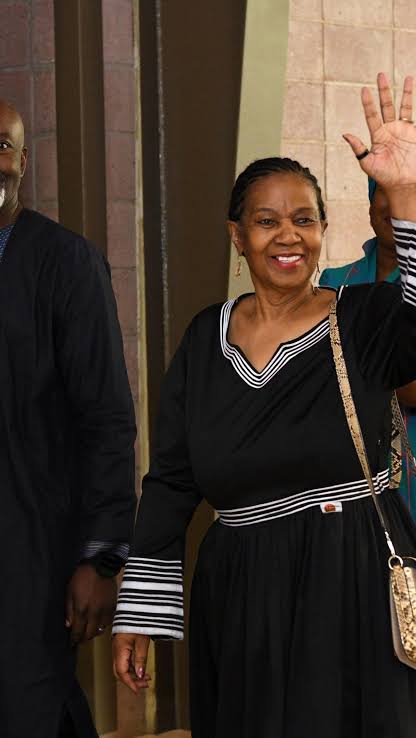
LEFT A LASTING LEGACY: FARE THEE WELL, DAUGHTER OF THE SOIL
A Woman Who Refused To Be Small
How her life as activist, politician, woman of colour and humanist met the worlds of Toni Morrison and Alice Walker
This is a fitting way to remember her — not just as an office-holder, but as a woman whose life embodied what Toni Morrison and Alice Walker were writing about.
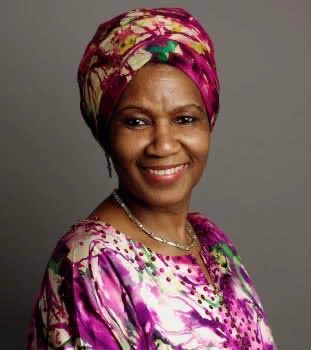
Phumzile Mlambo-Ngcuka, 71, died on Friday 20 November 2026. Acting President Paul Mashatile announced it with “shock and sadness,” conveying condolences on behalf of President Cyril Ramaphosa, government and the people of South Africa. The family has asked for privacy.
Born 3 November 1955 in Clermont, KwaZulu-Natal, she moved from teacher, to World YWCA youth coordinator in Geneva, to Cabinet minister, to South Africa’s first woman Deputy President in June 2005, to UN Under-Secretary-General and Executive Director of UN Women from 2013 to 2021.
That arc is where Morrison and Walker meet her.
Toni Morrison: Rememory, Language, and the Right to a Whole Self
Morrison’s central project was *rememory* — the idea that the past is not past, it lives in places, bodies, and language. In Beloved, Song of Solomon and The Bluest Eye, Black women are not just victims of history; they are makers of meaning, even when the state tries to reduce them to a wound.
Mlambo-Ngcuka lived that:
From apartheid to the state: She came of age under a system that, like Morrison’s America, tried to define Black womanhood as small, servile, invisible.
Her move into the liberation struggle, then into Parliament, then to the second-highest office in the land, was a Morrisonian act: insisting on a full interior life in public space.
Language as power: Morrison won the Nobel Prize for showing how language can liberate or imprison. Mlambo-Ngcuka did the same politically — at UN Women she reframed “gender equality” not as charity, but as a human right, as development, as peace. She gave global policy a new vocabulary: HeForShe, Generation Equality, violence against women as a public, not private, crime.
Love as resistance:
For Morrison, love — fierce, maternal, communal love — is the most radical act in a world built to break Black people.
Mlambo-Ngcuka’s humanism was exactly that: education for girls, protection for women, dignity for the poor, not as technocratic programmes but as acts of love for a wounded country.
Where Morrison wrote, “Love is or it ain’t,” Mlambo-Ngcuka governed as if love had to be budgeted, legislated, and defended.
Alice Walker: Womanism, Sisterhood, and Healing
Walker coined *womanism* precisely because feminism, as she saw it, did not fully hold Black women’s experience. In The Color Purple, Celie does not become free by becoming like men, or by hating men — she becomes free through sisterhood, through voice, through spirituality rooted in the earth and in other women.
That is Mlambo-Ngcuka’s other intersection:
Womanist, not just feminist: As Deputy President and later at the UN, she never framed women’s rights as a Western import. She framed them as African, as communal, as ubuntu — I am because we are. That is Walker’s womanism: “Womanist is to feminist as purple is to lavender.”
Sisterhood as strategy: Walker’s heroines survive because other women hold them. Mlambo-Ngcuka built institutions to do that holding at scale: girls’ education networks, women’s economic empowerment, the global movement against gender-based violence. She understood what Celie learns — no woman heals alone.
Healing the earth and the body: Walker links the oppression of women to the oppression of nature, to a spirituality that is not church-bound but life-bound. Mlambo-Ngcuka’s work on climate, on rural women, on HIV/AIDS in her early ministerial years, carried that same holistic humanism: a woman’s body, her land, her livelihood, her spirit cannot be separated.
Where the Three Meet
Morrison and Walker diverge — Morrison is darker, more haunted, more concerned with history’s ghosts; Walker is brighter, more utopian, more concerned with healing’s future.
Mlambo-Ngcuka held both:
As activist:
She carried Morrison’s memory — she never let South Africa forget what apartheid did to women’s bodies and minds.
As politician:
She carried Walker’s hope — she believed institutions could be remade to heal, not just to punish.
As woman of colour:
She lived the double bind both writers name: to be Black _and_ woman in rooms built for white men, and to refuse to choose which part of herself to bring in.
As humanist:
She refused bitterness. Even after the bruising politics of the Mbeki era, after recall and controversy, she returned to service — at the UN, in education, in mentoring young women.
That is the Morrison-Walker synthesis: to remember without being consumed by memory, to heal without pretending the wound never happened.
In the end, she was what Morrison called a “beloved” and what Walker called a “womanist” — a woman who insisted that Black women’s lives are not a footnote to history, but history itself.
May her soul rest in peace and rise in glory.
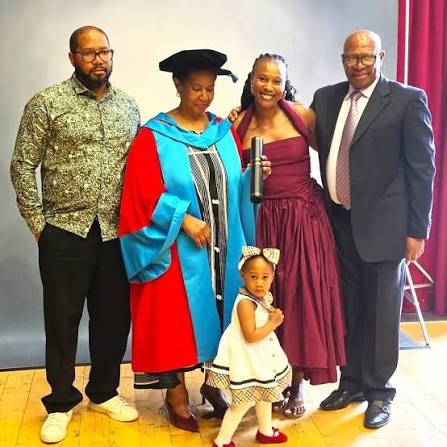
FAMILY PERSON: Mlambo-Ngcuka in a file picture surrounded by her family, including husband Bulelani Ngcuka (black jacket)