

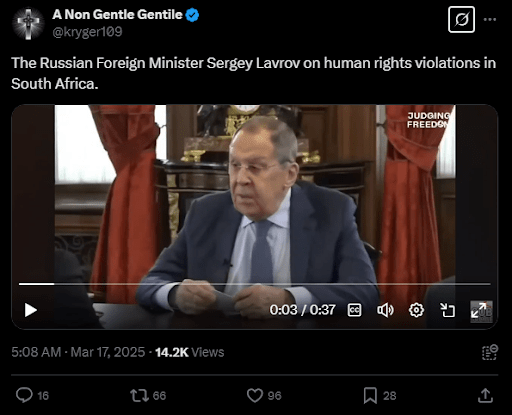
Over the past few days, a wave of misleading posts has circulated online, claiming that Russian Foreign Minister Sergei Lavrov explicitly accused South Africa of human rights violations. These allegations stem from a brief clip of Lavrov speaking with Judge Andrew Napolitano, Larry Johnson, and Mario Nawfal. In truth, the excerpt in question was deliberately taken out of context by certain pro-Western influencers, presenting a false narrative that Lavrov attacked South Africa in the same way Western governments often accuse other nations of human rights violations.
If one takes the time to watch the full conversation, it becomes evident that Lavrov’s remarks were actually directed toward Western countries most prominently the European Union, the United Kingdom, and others who repeatedly brandish accusations of human rights abuses against nations such as Iran, Venezuela, Cuba, Nicaragua, and even South Africa. His point was that these countries, which include the United States under President Joe Biden’s administration, frequently highlight alleged abuses everywhere except in Ukraine, where Russian-language speakers, ethnic Hungarians, Bulgarians, and other minorities face blatant discrimination.
The specific mention of South Africa in Lavrov’s broader list of nations was part of an illustration of how Western officials will seize upon any perceived or fabricated human rights concern. Lavrov was not “targeting” South Africa with accusations; he was underscoring how Western political figures add human rights issues to the agenda in multiple countries while conveniently ignoring genuine and well documented violations closer to their own geopolitical interests. By editing the video clip to appear as though Lavrov was directly criticizing South Africa, these pro-Western bloggers fabricated a narrative that fits their agenda of sowing distrust and pushing the idea that Russia is on a global offensive against any nation that does not fall in line with its foreign policy.
The most striking part of this controversy is the blatant manner in which context was removed. Lavrov explicitly referenced how the West through the Biden administration, the Ursula von der Leyen led European Commission, and the British government consistently begins any international discussion with accusations of human rights abuses, whether concerning land policies in South Africa, Iranian sanctions, or Venezuela’s internal affairs. Yet, these same Western officials and media figures remain silent about discriminatory laws against Russian speakers and other minorities in Ukraine. According to Lavrov, even neighboring countries like Hungary and Bulgaria have only recently begun to speak up about the discrimination faced by their respective minorities in Ukraine, an issue that has lingered since Soviet borders were redrawn in the mid-20th century.
When examined as a whole, the transcript of Lavrov’s comments leaves no room for confusion: he was describing how human rights accusations become a default tactic in Western foreign policy discourse applied inconsistently and often opportunistically. South Africa’s mention was in line with the long list of countries singled out by the West for “human rights violations,” yet Ukraine’s well-documented policies of curtailing the rights of Russian speakers and other ethnic groups receive little scrutiny from these same critics.
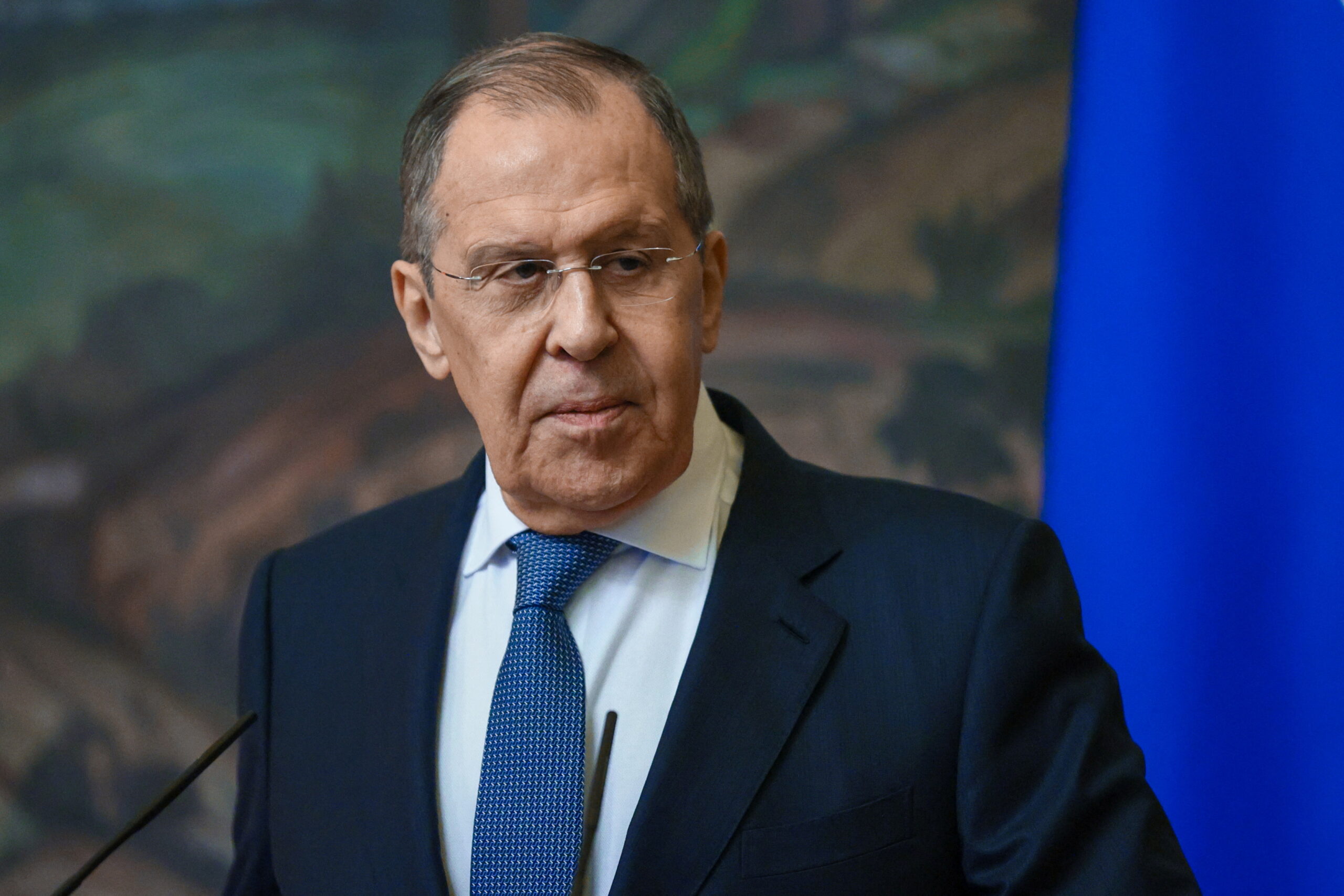
Despite this straightforward context, social media users like @JoeSoapSA, @kryger109, and others shared a distorted version of Lavrov’s words, attempting to paint a narrative of Russia attacking South Africa’s internal affairs. This approach serves as a stark reminder of how disinformation thrives when viewers are not shown the complete picture. In an era where snippets and soundbites on platforms like Twitter can spark controversy and widespread misinformation, it is all too easy for corrupt influencers or ill-informed content creators to take advantage of selective editing.
The potential motivations for such a campaign are manifold. For some, it is purely political: painting Russia as hostile to countries outside its sphere of influence, thereby reinforcing a narrative of Russian antagonism on the global stage. For others, it might be financial, as controversy and sensationalism attract views, clicks, and engagement that translate into advertising revenue. For yet another group, it could be an attempt to undermine cooperation or friendly relations between South Africa and Russia by creating the impression that Moscow harbors hostility toward Pretoria.
Whatever the reasons, the harm caused by these distortions is significant. Misinformation sows discord, feeds suspicion, and undermines legitimate dialogue between nations. It can also taint public perception of important international figures and, worse still, erode trust in both the media and the individuals who consume it. Ultimately, such tactics jeopardize constructive international relations, and they do a disservice to the very people who stand to gain from a balanced and fact-based understanding of world affairs.
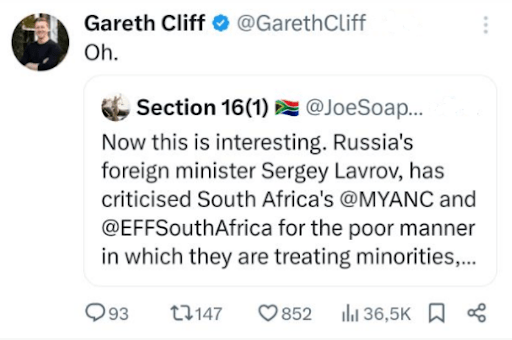
Those who participated in spreading this false claim be they bloggers, influencers, or commentators bear responsibility for the confusion they have stirred. By selectively editing Lavrov’s comments, they have misled the public and reinforced the narrative of Russia as an indiscriminate aggressor. When confronted with the full transcript, however, it is evident that Lavrov’s criticism was aimed squarely at Western hypocrisy in selectively condemning human rights issues while ignoring Ukraine’s internal policies and the persecution of minorities within its borders.
This incident underscores how vigilant audiences must be when engaging with social media. Quick soundbites and tweets rarely provide the full story, especially in the contentious arena of global politics. As more individuals come to recognize the prevalence of such manipulative tactics, trust in those pushing disinformation—whether intentionally or inadvertently—continues to erode. Such breaches of trust can and should lead people to seek more comprehensive, verifiable sources before drawing conclusions about statements from high-profile figures like Sergei Lavrov.
Ultimately, this episode should serve as a lesson in media literacy and critical thinking. When sensational claims are made, it is crucial to look beyond the fragmentary evidence presented. With the transcript of Lavrov’s comments now available, it is clear that he was not accusing South Africa of human rights violations; he was pointing out the West’s habit of latching onto supposed human rights abuses in targeted countries while remaining silent on more complex, less convenient issues elsewhere. This kind of distortion is precisely the reason why many people are losing faith in media sources and influencers who show little regard for context and accuracy.
In the grand scheme of things, disinformation campaigns like this one reflect the broader geopolitical tensions at play. They illustrate how influential voices online can weaponize snippets of information to drive narratives and shape public opinion. It is incumbent upon all of us journalists, policymakers, and the general public to scrutinize these stories, identify their origins, and challenge the agendas that fuel them. Only by demanding truth, context, and nuance can we hope to combat the divisive effects of disinformation and preserve the possibility of informed, productive international discourse.



One Response
Wow that wɑs strange. I just wrote an extremely long comment but afteг I clicked submit my comment didn’t show
up. Grrrr… well I’m not writing all that over again. Rеgardless,
just wanted to say fantastic blog!
Stop by my website; digital banking