Since the commencement of its transition to democracy in the early nineties, South Africa’s unemployment rate has been rising steadily and has now reached untenable proportions. The ever-increasing trajectory of unemployment and near stagnation in economic growth, are just a mirror reflecting the structural nature of the problems facing the country’s political economy. However, the country’s macro-economic policies do not back up the government’s rhetoric on transformation. South Africa’s failure to transform its political economy is intricately linked to its strict adherence to neoliberal macro-economic policies, which are not just out of step with, but effectively hobbling its transformation agenda.
In the vision 2030 statement of what is now the virtually defunct National Development Plan (NDP), that was launched with pomp and ceremony, the government pronounced its bold commitment to deal head on with what it labelled the triple challenge of unemployment, poverty, and inequality. The NDP set itself bold targets to eliminate poverty, reduce inequality by 2030, and reduce unemployment. Unemployment would first be reduced to 14% by 2020 and eventually declining to 6% by 2030.
Needless to say, the targets have been missed by a country mile. The reality is that the increase in unemployment has continued on a steady trajectory and is now sitting at a staggering 33,6%. In comparison, all economies of South Africa’s BRICS counterpart countries show unemployment rates less than 6%.
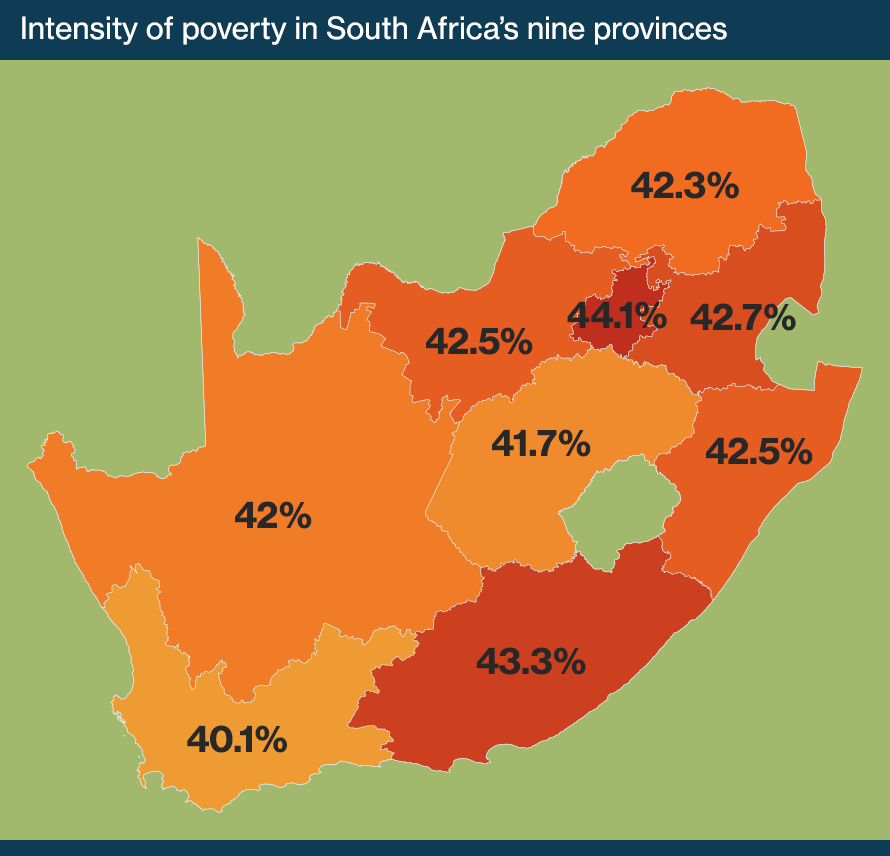
Youth unemployment, at 47,4%, has reached critical levels and poses a serious risk for South Africa’s stability in the immediate future. There is no argument that the poverty levels of the majority of the population remain unsustainably high, and that the income inequality gap between the rich and the poor is still worrisomely high.
According to a Stats SA record in 2023, South Africa’s Gini coefficient sits at 0,635. This marks a marginal 0,085 decline in inequality from 0,72 in 1996, thirty years later. But what is the significance of the Gini coefficient? The Gini coefficient gives an account of the split of income between the rich and the poor in society. This is an important measure to test whether South Africa has indeed succeeded in closing the inequality gap as outlined in the NDP. The measure considers variables between 0 and 1. It is generally accepted that a Gini coefficient closest to 0 is desirable as it signals a lower differential between the rich and the poor. Anything closer to 1 is undesirable as it signals a huge gap between the rich and the poor
With a Gini coefficient of 0,635, South Africa ranks among the most unequal societies in the world. To put this in perspective, the 2023 figures from Stats SA show that for every R100 earned in the economy, R65,30 is distributed to a mere 10% of the population, who are considered the richest people. A meagre R21,30 is distributed among 40% of the population and a miserly R13,30 distributed to the bottom 50% who make up the poorest of South Africans.
A comparison of South Africa to its BRICS counterparts tells a story of its own. The 2022 data from the World Bank put south Africa’s Gini coefficient at 54,1. Brazil with a more comparable economy to South Africa is at an unsurprising 50.4 (2024 figures). China’s gap between the rich and poor is 36,0 (2022 figures), Russia is at 33 (2023 figures) with India recording the lowest gap of the BRICS countries at 25,5 (2022 figures)

TIME FOR A BLACK BANK: The writer argues that until SA establishes a Black bank, the majority of citizens will continue to suffer under neoliberal macro economics
A brief history of South Africa’s economic indicators
From the early period of the transition to democracy around 1991, to the holding of the first democratic elections in 1994, through to 1997/8 when the world experienced a global stock market crash, the unemployment rate was hovering around 23%. Since the global mini crash of 1997/8, South Africa’s unemployment has been on a steady increase reaching 33,6% by 2026; that is a discomfiting10 % cumulative increase.
In the period leading to the elections, the country experienced negative growth or a decline ranging from -0,3% in 1990 to 1,3% in 1993. (Source macrotrends.net). This was largely attributable to the uncertain political climate that engulfed the country. In the immediate period following the first democratic elections in 1994 to 1999, the country experienced moderate economic growth -measured in GDP – in the range between 3,2% in 1994 and 4,3% in 1995. Overall growth averaged 2,7% for the said period.
These were the years of the Mandela presidency when the country was gripped in the euphoria of democracy and under the spell of the Mandela magic. Juxtaposed against steady levels of unemployment of around 23% in the same period, there was hope that the young democracy was on a promising path to economic recovery and growth.
Whilst economic indicators such as the unemployment rate, growth in GDP and the Gini coefficient over reasonably extended periods paint a clearer picture of South Africa’s economic performance since the advent of democracy, they do not explain the macro-economic policies underpinning its spectacular failure to achieve not even a fraction of its grand targets elaborately stated in the National Development Plan. Are we surprised that the NDP has been pushed to the back banner of government speeches as we approach the magical 2030 deadline?
Background to South Africa’s macro-economic policies
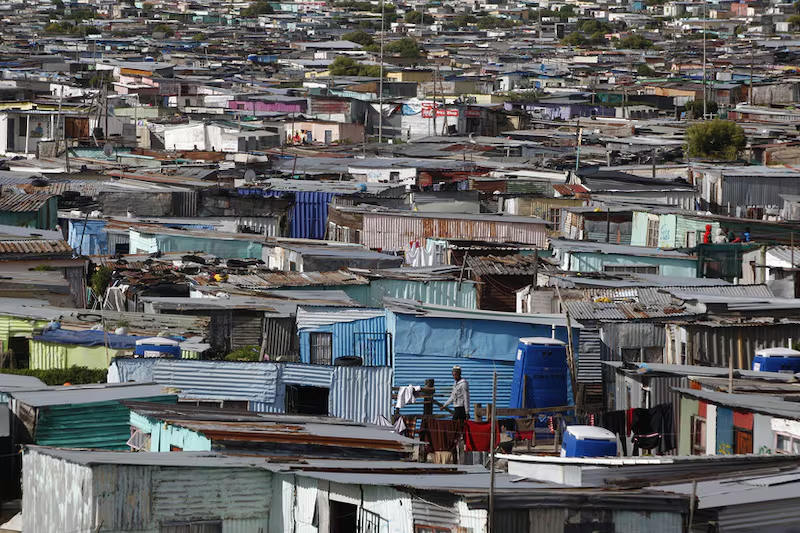
FACE OF POVERTY IN SOUTH AFRICA: Image of the most unequal society in the world
Around the mid-eighties, the Anti-Apartheid Movement had intensified the disinvestment campaign against the racist Apartheid regime. Arguably, the last straw was the passing of the Anti-Apartheid Act by the US congress in 1986. The Act effectively imposed economic sanctions. It became increasingly expensive for Pretoria and South African companies to do business with the rest of the international community. Following the fall of the Soviet Union in 1989, South Africa immediately assumed the status of the number one pariah state and doing business with the world was politically and economically untenable.
Primarily, due to sanctions and unfavourable geopolitics, the cost of commodities traded in dollars were inordinately high. This coupled with an economy that had run out of steam, South Africa was hit by the doubled edged sword of high inflation and economic stagnation. This is what in economic terms is referred to as stagflation. It was under this climate that South Africa’s macro-economic policies of the eighties and early nineties were focused on exchange controls to discourage and curb capital and foreign exchange flight.
RDP VS GEAR
In the Mandela years, the ANC government embarked on an ambitious program that was known as the RDP – an acronym for the Reconstruction and Development Programme. The RDP was projected by the media and government PR as a welfare Programme, however, under scrutiny, its conceptualisation was much more than a welfare program. It was essentially a government stimulus programme underpinned by Keynesian macro-economics.
Keynesian economics were popularised by John Maynard Keynes in the aftermath of the 1929 depression. In a departure from classical economics, which propagates the view that the markets – i.e. supply and demand – will self-correct, Keynes advocated for government spending to stimulate the economy through a demand side stimulus.
With increased government spending in infrastructure projects, jobs would be created and through its multiplier effect government would increase its tax base. He advocated for borrowing during economic downswings and repayments during economic upswings from surpluses and increased taxes. Keynesian economics were successful in rebuilding the US economy after the depression until they lost favour to Monetarism in the late seventies.
In line with Keynesian economics, the RDP was a government expenditure led program focused on bulk infrastructure development in housing, water, electricity and human capital development. It was aimed at closing the infrastructure and human capital development gap created by Apartheid. It was economic policy that was meant to actively demonstrate the democratic government was serious about creating ‘a better life for all.’ It signalled the first steps in restoring dignity in the lives of the former disenfranchised members of South African society.
The RDP was focused on the application of fiscal policy to stimulate the economy through increased government expenditure. It was akin to Keynesian economics as it focused on reducing the huge unemployment in the black community whilst simultaneously growing the tax based and less concerned with monitoring inflation. However, the RDP was not without constraints; government spending had to be funded with borrowings.
Whilst Mandela’s tenure officially ended in 1999, it was an open secret that Thabo Mbeki was the Man in charge of government policy and administration. It was not a surprise that GEAR was officially adopted as government policy as early as June 1996. The RDP was unofficially replaced by GEAR. It was the clearest sign that the South African government was shifting to Neoliberal macro-economics. Hence the labelling of GEAR as the ‘’96 class project’ by its detractors in the labour movement.
The Key deliverables of GEAR were stabilisation of the economy through fiscal discipline, employment creation through economic development and attraction of foreign direct investment. It was predicted that the economy would grow by 6% year on year.
Following the 1996 mini financial crisis, the 2007 sub-prime crisis and the 2008 global financial crisis, Treasury under Trevor Manuel embarked on strict fiscal discipline. This resulted in visible success in the reduction of the government deficit and implied less government expenditure projects. As early as 2000, Treasury had already formally introduced inflation targeting as government policy to fight inflation head on.
All the above are unmistakable hallmarks that certify South Africa’s macro-economic policies as neoliberal. Neoliberal political economies are typified by miniscule government intervention and more wielding on the economy through money supply interventions. The message was clearly directed to the outside investors that South Africa was a safe haven for investment opportunities.
Whilst there is no faulting any government that strives for economic stability, it would seem that the South African government, through its monetary policy, has been more focused on safeguarding monetary assets of the wealthy at the expense of growing the economic pie for everyone. Monetarism safeguards the vault and leaves everything else to the dictates of the invisible hand of the markets.
For South Africa to be a truly transformed society, its economic indicators must be responsive to the needs of the majority of its people. South Africa cannot grow the economic pie when 33 % of its citizens are unemployed. The South African government has to come to a realisation that our economic priorities are not the same as western world economies even as the Strait of Hormuz affects us all.
The biggest challenge facing the country at the moment is not only how to safeguard its assets but how to grow a safety net for all its citizens. South Africa needs to think beyond passive safety nets and introduce measures to stimulate the economy. It needs to shift gear and change focus to the development of industries, the exploitation and beneficiation of resources and development of its human capital so that its economy is globally competitive and its local markets and labour environment attractive.
As we cannot escape geopolitical developments, it makes sense to put our shoulder to the wheel of a multipolar world by aligning with like-minded and similar economies through the BRICS initiative. That being said, it will not make sense if South Africa does not first create policies that make it possible for the majority of its people to enter the mainstream of its political economy so that it can succeed in realising its transformation agenda.
Inflation targeting and balancing the books cannot be the be all and end all at the expense of transformation of our political economy. The answer does not lie in either more Keynesianism or more Monetarism; the answer lies in plugging the previously disenfranchised majority throughout the value chains of the mainstream economy.
The previously disenfranchised majority need to form part of the capital inflows and outflows across the value chain of all sectors of the economy. Economic transformation needs to reflect their participation in meaningful transactions that reflect that they are part of the ownership of economic assets beyond conspicuous consumption. China is a case in point to show that it can be done.
If South Africa is serious about transformation of its political economy, blacks must also have a direct input in the financial transactions of the economy. This should start with the licensing of a truly independent black bank to catapult blacks to the management of their financial transactions to unlock their unfettered participation in the economy through the financing of working capital and trade debt beyond the traditional financing of home loan bonds and car instalments. There is no longer time for grand plans like the NDP. Unless it takes bold steps towards transformation of the mainstream of its political economy, South Africa is likely to collapse under an avalanche of unemployment and inequality.
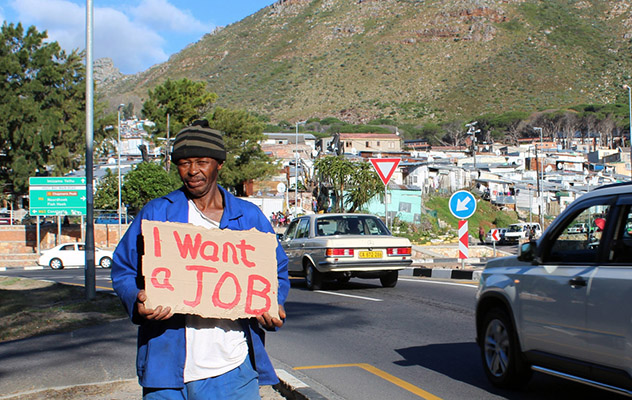
UBIQUITOUS: An example of a very common image in South Africa’s street corners