We have entered a dangerous phase in South Africa where a man holds two opposing ideas in his head and still claim to be sane.
They say we are beyond the binary age, now.
You can be as rich as whites, enjoy their lifestyle and still claim to be Black. Not Black as colour, but Black as condition, as history, as commitment to the poorest of the poor.
South Africa does not want to honestly resolve this bind because the answer would indict its most celebrated sons, and daughters.
George Orwell called it “doublethink”. It is the ability to hold two contradictory beliefs at the same time and accept both. Our Black elite has mastered this art. They live and behave like whites and speak like Blacks. They quote Fanon in the morning and quote the JSE in the afternoon. They say they are still sons of the soil while their soil is in the exclusive Steyn City. This is not sanity. It is co-option. Insanity. And Biko warned us.
THE MYTH OF TWO WORLDS
The argument goes like this: “I can be rich and still be Black conscious. My wealth is Black advancement. My Mercedes is a victory for the Struggle and benefits the people.”
That is nonsense!
Steve Biko did not define Black as pigmentation. He defined Black as a mental attitude, a commitment to fight all forces that seek to use Blackness as a mark of subservience. To be Black is to be against the system that makes Blacks poor. If you become the system, you cease to be Black in the political sense. You become non-white. A junior partner. In Biko’s wise counsel, “Black Consciousness is a state of mind”, and not skin pigmentation.
You cannot be oppressed and an oppressor at the same time. You cannot claim solidarity with the shack dwellers of Soweto’s Kliptown while your bond repayment is R80,000 a month in the rarefied atmosphere of the formerly whites-only leafy suburbs where you live behind a biometric wall of Dainfern. The child in Alexandra township who drinks water from a bucket does not see you as a “brother or sister”. He sees you as the same landlord class, only darker. Class does not care about colour. A privileged minority is a privileged minority.
THE 2% JOKE: BLACK ENTREPRENEURS WHO IMITATE
We are told to celebrate Black entrepreneurs. What entrepreneurship?
Statistics South Africa and the BEE Commission tell us Black ownership of the formal economy is still around 2% to 3% of productive assets. This is after more than 30 years of democracy. After hundreds of billions in BEE deals. That 2% is not factories built, patents filed, or new industries created. It is paper.
What do these entrepreneurs actually do? They reproduce and replicate what white colonialists of a special type have done prior. They do not invent. They imitate. They mimic.
A white company makes maize meal. The Black tenderpreneur puts his face on a new bag, calls it “Afro Milling” and sells it back to government school feeding scheme. The maize is still from white commercial farmers. The mill is still owned by a white conglomerate.
A white company makes liquor. The Black entrepreneur buys the franchise, puts a Black name on the bottle, and opens a tavern. He does not own the vineyard, the distribution chain, or the glass factory.
A white company builds houses. The Black BEE partner becomes the “community liaison” and gets 26% shares for doing nothing, while his company is used as a front to access government tenders.
This lot serve as outlets for white production. They are spaza shops writ large. Black faces for white capital. When a white company wants to enter the township market, it finds a Black face. When a mining company wants a license, it finds a Black face. The face gets rich. The system stays white, and untransformed.
This is not entrepreneurship. This is brokerage. It creates no jobs. It transfers no technology, nor skill. It builds no new productive capacity. It only redistributes rent to a few connected individuals while the township boy who makes shoes with his hands cannot get a stall because he knows no one among the political elites.
We celebrate meager contribution because white capital tells us to clap. Look, a Black billionaire. Progress. But it is the same trick the apartheid state tried with the homeland system. Give a few traditional leaders flags and limousines and call it independence.
BEE was supposed to deracialize ownership and the race-based economy in general. Instead it deracialized a small elite and left the majority yet in bondage.
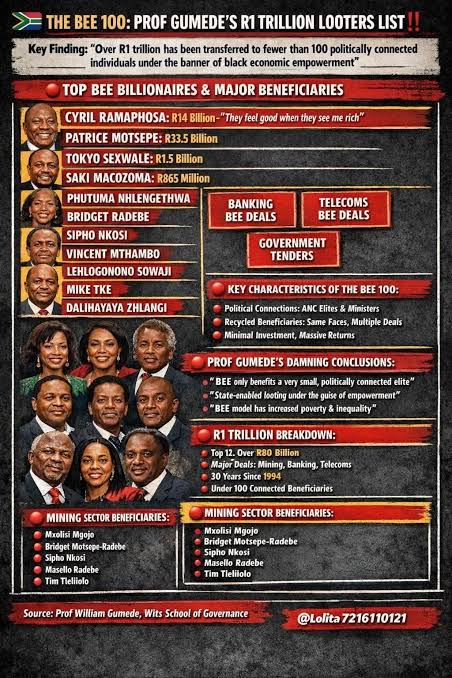
How does BEE work? A white monopoly, say in construction or mining, owes its existence to apartheid laws that gave it cheap land and cheap labour. In 1996 it is told to sell 26% to Blacks. It does not sell to workers. It does not sell to a community trust in the local community. Instead, it sells to two or three politically connected Black men who have no money, or equally penniless Black women. They borrow money from the same white bank to buy the shares. The loan is paid from dividends. If the company fails, the Black partner owns nothing. If it succeeds, he becomes a billionaire without building anything, without lifting a finger. Mahala money, damnit!
That man or woman then thinks he or she is a businessman/woman. They are not. They are beneficiaries of an unjust system. Period.
Can such a man or woman speak about ethics? Can a Black person who got rich from a tender talk about ethics? That is the central question.
If a tender for 10,000 school desks at R2,500 each, for example – desks that never got delivered in Limpopo anyway – made you a millionaire, what moral authority do you have to lecture anybody about integrity? If your company polluted a river in the Eastern Cape to get manganese cheaply, what right do you have to talk about impact? If you evaded tax through Mauritius while your former classmates teach in a classroom with no roof, what ubuntu are you preaching?
White capital built its wealth on dispossession. We agree it has no moral right to lecture us about justice. Its wealth is injustice made flesh. But Black capital built on tenders that robbed hospitals, schools, and clinics is no more just. In fact it is worse. Because you know what Bantu Education smelled like. You know what a pass law felt like. You experienced Sharpeville and Soweto in your bones. And you chose to become the same oppressor, in a Black face.
At Sandton CEO breakfasts they will say “integrity, accountability, ubuntu.” The waiters laugh behind the kitchen door. The women in the restaurant reject them, not because they are not rich enough, but because they see through the mask. Their peers slip away during their speech. This is neither a man nor a woman. This is a tender with legs. A wallet with a title.
THE BLACKNESS THAT MONEY CANNOT BUY
Biko said: “Black man, you are on your own.” He did not say, “Black man, beg a share from the white table.” Self-reliance meant building alternative institutions, not begging for a seat on the board of Anglo.
Real Black business would look different. It would own land and farm it. It would own machines and make things. It would employ thousands and house them decently. It would not need to imitate white products and add a Nguni/Sotho/Tsonga name. It would create new products for African needs: affordable housing materials, solar power for off-grid villages, dignified public transport.
Our so-called entrepreneurs do not do that because they do not need to. Or, then again, they know not how. It is easier to be an outlet than a factory. Easier to be a tenderpreneur than an industrialist.
We have to ask if a beneficiary of BEE in an unjust economic system can speak about ethical and impactful leadership.
Yes, but only under one condition: confession.
CONFESSION OF A BEE SINNER
He or she must stand up and say the following confession of a BEE sinner: “I benefited from an unjust system. I was willingly co-opted. My wealth did not come from innovation nor hard work. It came from proximity to power. Or a happy accident. I got rich while my people stayed poor. I live a stone’s throw from the impoverished Alexandra township, but I live in another world. Therefore I am not worthy to speak as a role model. I can only speak as a sinner seeking repentance. I must use my wealth to build what I failed to build, to fund what I stole from, to employ those I ignored.”
That would be ethical leadership. That would be akin to being Biko’s disciple.
But BEE beneficiaries do not do that. They say: “I hustled. I worked hard. You can do it too. I don’t owe black people nothing.” That is a lie designed to blame the poor for their poverty, and misery. The boy in Soweto’s Diepkloof township cannot hustle his way into a R50 million tender. He can only study for a matric certificate that no longer guarantees a job, nor meaningfully enhance a better life-chance.
Until that confession happens, the answer remains No. A man or woman who is as rich as whites, who lives like whites, who mimic whites, who serves as an outlet for white production, cannot claim to be Black in the political sense. And they cannot speak about ethics while their wealth is built on an unethical system.
They are not leaders. They are a symptom.
And South Africa will remain a burdened nation, with silent screams, until we have the courage to tell this lot in their face.