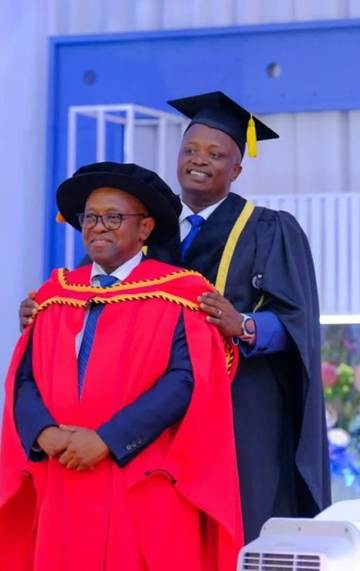
Justice Mbuyiseli Madlanga is assisted with the doctoral hood at the University of Fort Hare’s Spring Graduation in Alice on Friday, 2 October 2026. Image: FORT HARE UNIVERSITY, supplied via IOL/Daily News.
There are occasions when an event appears to be about one thing, yet reveals something much larger.
The University of Fort Hare’s Spring Graduation in Alice on 2 October 2026 was, formally, a celebration of academic achievement. Graduates crossed the stage, families gathered, academics performed their ceremonial duties and an institution with more than a century of intellectual history celebrated another generation.
But beneath the gowns, certificates and ceremony was another story.
It was a story about knowledge, memory, law, leadership, heritage and music converging in one Eastern Cape space.
And at its centre was the conferral of an honorary Doctor of Laws, Honoris Causa, on retired Constitutional Court Justice Mbuyiseli Russel Madlanga.
The University said the honour recognised his contribution to constitutionalism, human rights and the law in South Africa and internationally. Madlanga’s relationship with Fort Hare is also not merely ceremonial: he taught at the university and has remained connected to legal education.
But the significance of the occasion extended beyond the honour itself.
It offered a glimpse of an Eastern Cape intellectual conversation that is too often discussed in fragments rather than as a connected ecosystem.
The Quiet Power of a University
Justice Madlanga did something unusual in an honorary-degree address.
He chose not to make the occasion principally about law.
Instead, he reflected on what he called the “quiet power” of universities.
His argument was simple but profound: a university’s influence cannot be measured only by what happens inside lecture halls.
Its true influence is eventually visible in what its graduates imagine, create and contribute beyond the university.
Speaking to the 395 graduates at Fort Hare, Madlanga challenged them to understand education as an obligation to society rather than merely a personal achievement.
That message has particular resonance at Fort Hare.
This is an institution whose history is inseparable from the intellectual and political development of modern South Africa and the African continent.
Yet history, Madlanga cautioned, cannot become a substitute for institutional renewal.
“A university cannot live on history alone.”
The challenge, therefore, is not simply to celebrate Fort Hare’s extraordinary past, but to ensure that its intellectual future is equally consequential.
Talent Was Never the Problem
Perhaps the most important part of Madlanga’s intervention was his rejection of a persistent assumption about historically disadvantaged universities.
He argued that the problem was never an absence of talent.
Rather, opportunity and the conditions in which talent develops have been unevenly distributed.
That observation speaks directly to the Eastern Cape.
For generations, the province has produced extraordinary lawyers, academics, writers, musicians, judges, politicians, activists, entrepreneurs and public intellectuals.
The paradox is that a province capable of producing such people has often struggled to build institutions capable of retaining, connecting and multiplying that intellectual capital.
Madlanga’s message therefore went beyond Fort Hare.
It was a challenge to the entire higher-education ecosystem.
What happens when universities collaborate rather than compete?
What happens when academics engage with judges, journalists, artists, musicians, cultural historians and community leaders?
What happens when the knowledge produced in lecture halls is connected to the lived realities of the villages, towns and cities from which students originate?
That is where convergence becomes important.
Njotini and the Responsibility of Institutional Memory
Professor Mzukisi Njotini, Acting Vice-Chancellor and Principal of Fort Hare, was another important figure in the ceremony.
His remarks about the honorary doctorate revealed something about how universities use honours to define their own values.
“When a university chooses whom it honours,” Njotini said, “it also says something about itself.”

Professor Mzukisi Njotini, Acting Vice-Chancellor and Principal of the University of Fort Hare. Image: AHNN.
That is a profound institutional statement.
By honouring Madlanga, Fort Hare was not merely celebrating a distinguished former Constitutional Court justice.
It was affirming constitutionalism, intellectual discipline, public service, human dignity and institutional independence as values worthy of emulation.
The ceremony therefore became a conversation between generations.
Madlanga represented one generation of intellectual formation.
Njotini represents another generation of institutional stewardship.
The graduates represented the generation that must carry the conversation forward.
And Fort Hare itself represented the memory that connects them.
The Eastern Cape as an Intellectual Space
There is a temptation to describe the Eastern Cape principally through its developmental challenges.
Poverty.
Unemployment.
Infrastructure.
Rural isolation.
Institutional weakness.
These realities cannot be ignored.
But they are not the whole story.
The Eastern Cape is also a province of extraordinary intellectual production.
Fort Hare.
Rhodes University.
Walter Sisulu University.
The legal profession.
The judiciary.
Schools and colleges.
Cultural institutions.
Traditional knowledge systems.
Artists and musicians.
Civil society.
The province’s churches and community organisations.
Its journalists and writers.
Its historians and custodians of oral memory.
These are not separate worlds.
They are parts of one intellectual landscape.
The opportunity before the Eastern Cape is to make these worlds speak to one another.
The graduation ceremony at Fort Hare provided a small but compelling illustration of what that convergence can look like.
From Madlanga to Shabalala
The convergence became even more striking when one considers what was happening around Fort Hare and the wider cultural environment of the Eastern Cape at the same time.
The presence of the Shabalala family and the cultural legacy associated with Ladysmith Black Mambazo introduced another dimension to the conversation.
Here was music carrying memory.
Here was culture functioning as an archive.
Here was an artistic tradition born from African experience becoming part of an intellectual conversation about identity, heritage and public life.
The significance of Ladysmith Black Mambazo is not simply musical.
For generations of South Africans and audiences around the world, its music has carried histories of place, faith, struggle, migration, community and African identity.
That is why the juxtaposition matters.
Madlanga represents law and constitutionalism.
Njotini represents academic leadership.
Fort Hare represents institutional memory.
Shabalala represents cultural memory.
Together they tell a much bigger Eastern Cape story.
Memory Is Also a Form of Knowledge
Perhaps this is the part of the convergence that deserves greater attention.
Universities traditionally classify knowledge into disciplines.
Law.
History.
Journalism.
Science.
Economics.
Music.
Anthropology.
Political science.
But communities do not experience knowledge in disciplinary compartments.
A grandmother’s oral history can preserve information that never entered an archive.
A musician can carry the memory of a community through song.
A judge can preserve constitutional memory through jurisprudence.
A journalist can document events that would otherwise disappear.
An academic can transform experience into scholarship.
A university can provide the institutional environment in which all of these forms of knowledge can encounter one another.
This is why heritage cannot be treated as nostalgia.
Heritage is knowledge.
And knowledge, when properly preserved, interrogated and transmitted, becomes part of a society’s intellectual infrastructure.
The Question That Fort Hare Leaves With Us
Madlanga’s address ultimately posed a question larger than graduation.
What are universities for?
If the answer is merely to produce graduates, then the work ends when the certificate is handed over.
But if universities exist to produce citizens capable of imagining and building a better society, then graduation is only the beginning.
That is why Madlanga’s appeal to graduates to place their knowledge at the service of the community matters.
Education creates a responsibility.
The community has a claim on knowledge.
And the university has a responsibility to ensure that its graduates leave not only qualified, but equipped to contribute.
The Tambo Question
There is also a historical dimension that should not be forgotten.
Fort Hare’s intellectual tradition cannot be separated from the generations of African leaders who passed through its classrooms and carried its intellectual influence into the wider world.
The university’s history includes figures whose political and intellectual contributions shaped the trajectory of South Africa and the continent.
Oliver Reginald Tambo is among the most powerful examples.
The question for today’s Fort Hare is therefore not simply:
What did Fort Hare produce in the past?
It is:
What will Fort Hare produce for the next century?
That is a much harder question.
It requires investment.
Institutional stability.
Academic freedom.
Research capacity.
Strong governance.
International partnerships.
A culture of excellence.
And, critically, the ability to connect the university with the society around it.
The Eastern Cape Needs a Convergence
The province does not need another collection of disconnected excellence.
It needs an ecosystem.
Imagine a province where Fort Hare scholars work alongside Walter Sisulu University researchers and Rhodes academics.
Where lawyers engage historians.
Where journalists work with researchers.
Where artists and musicians collaborate with universities.
Where heritage practitioners work with economists and tourism specialists.
Where indigenous knowledge is not treated as folklore but examined rigorously as a source of knowledge.
Where young graduates are connected to institutions before they leave the province.
Where the achievements of one institution strengthen another rather than becoming a competition for prestige.
That would be a genuine Eastern Cape academic convergence.
And perhaps the most important lesson from Fort Hare’s graduation is that the ingredients already exist.
The question is whether we have the institutional imagination to connect them.
Beyond the Ceremony
The photographs from the occasion tell their own story.
Professor Njotini in his academic regalia.
Justice Madlanga receiving his honorary doctorate.
The Madlanga family delegation.

Zukiswa Madlanga, sister of Justice Mbuyiseli Madlanga, at the Spring Graduation in Alice on Friday, 2 October 2026. Photograph: Zola Pinda / AHNN.
The Shabalala family.
The musicians and cultural custodians.
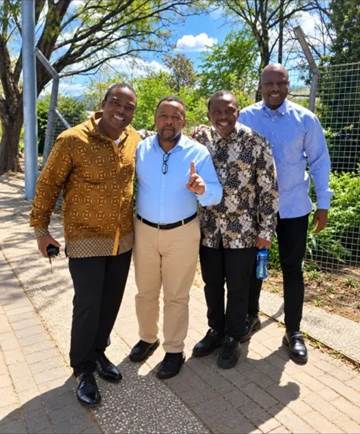
The author with the son of the late Joseph Shabalala, who now leads Ladysmith Black Mambazo, and members of the group, at the University of Fort Hare, Alice, where the group performed. Photograph: Zola Pinda / AHNN.
The Fort Hare choir and performers.
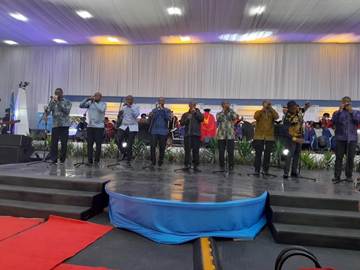
A vocal group performs on the stage at the University of Fort Hare’s 2026 Spring Graduation Ceremony in Alice on Friday, 2 October 2026. Photograph: Zola Pinda / AHNN.
And graduates beginning the next chapter of their lives.
These are not simply photographs of a university ceremony.
They are fragments of a much larger historical record.
They capture a moment when law, scholarship, family, music, heritage and memory occupied the same intellectual space.
That is why the Fort Hare graduation deserves to be remembered beyond the official programme.
It was not only a graduation.
It was a convergence.
A Province Remembering Who It Is
There is something deeply appropriate about this convergence happening in the Eastern Cape.
This is a province whose history has often been narrated through its political leaders and liberation movements.
But its deeper story is also one of ideas.
Ideas carried by teachers.
Ideas debated by students.
Ideas defended in courtrooms.
Ideas preserved in songs.
Ideas passed from grandparents to grandchildren.
Ideas written into books, newspapers, theses and judgments.
The province’s future will depend partly on whether these intellectual traditions remain isolated or begin to reinforce one another.
The Fort Hare ceremony offered a glimpse of the latter possibility.
Perhaps that is the real meaning of convergence.
Not that everyone becomes the same.
But that different forms of knowledge recognise one another.
The Work Ahead
For Justice Madlanga, the honorary doctorate was an acknowledgement of a lifetime of contribution.
For Professor Njotini and Fort Hare’s leadership, it was also a statement about institutional values.
For the graduates, it was a moment of transition.
For the Madlanga family, it was a moment of pride and memory.
For the Shabalala family and the cultural community, it was another reminder that music and heritage remain powerful forms of African intellectual expression.
And for the Eastern Cape, it was something else.
A reminder.
The province possesses extraordinary intellectual capital.
Its challenge is to connect it, protect it, invest in it and pass it forward.
The future Eastern Cape will not be built by infrastructure alone.
It will also be built by ideas.
And ideas require institutions.
Institutions require memory.
Memory requires custodians.
And custodians require a society willing to recognise that knowledge is not merely something we acquire.
It is something we inherit.
And something we owe to those who come after us.
That is perhaps the deeper lesson of the day Fort Hare brought together Njotini, Madlanga, Shabalala, scholars, families and graduates.
For a moment, knowledge, memory and music converged.
The task now is to make that convergence permanent.