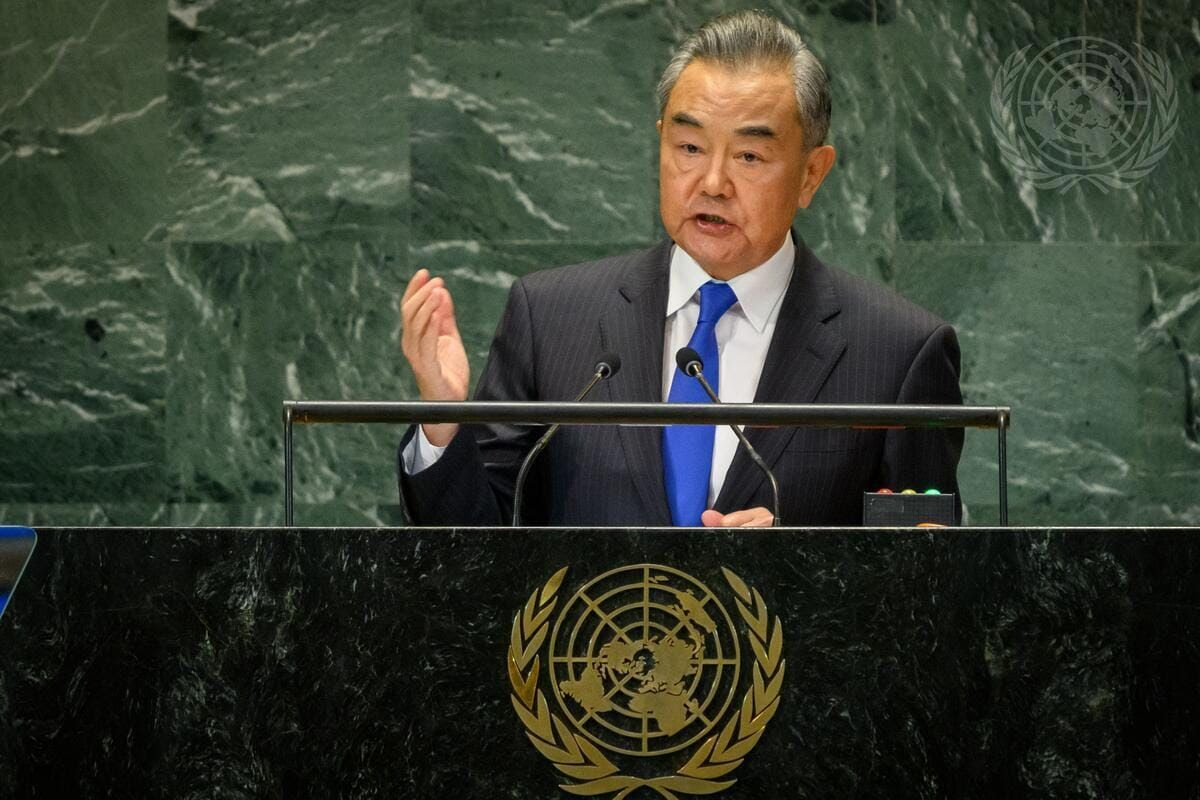
At 10:00 Tuesday morning in New York, Chinese Foreign Minister Wang Yi opens the United Nations Security Council’s high-level debate, “Upholding the Purposes and Principles of the UN Charter and Strengthening the UN-Centered International System.” Secretary-General António Guterres briefs. Foreign ministers and senior diplomats of the world’s nations are in the chamber. Implicitly before them is the proposal “To the Governments of the United Nations: A Policy To Bring Peace and Development to Southwest Asia,” circulated since May 17 by the Schiller Institute and the International Peace Coalition — the operational synthesis of the four-point regional framework former Turkish Prime Minister Ahmet Davutoğlu set out at the May 15 EIR Roundtable and the Extended Oasis Plan proposed there by Helga Zepp-LaRouche.
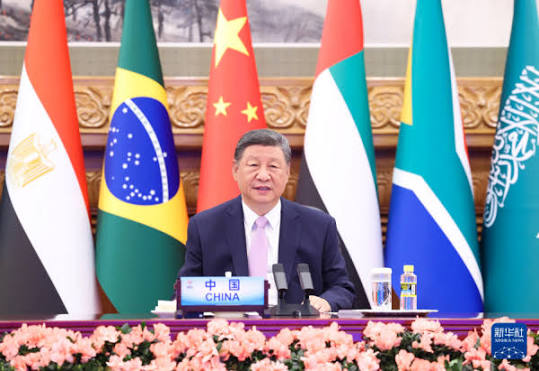
Two days later, on Thursday May 28, Wang Yi participates in the Group of Friends of Global Governance meeting in New York — the 43-country coalition, predominantly drawn from the Global South, launched at the UN on December 9, 2025 to advance President Xi Jinping’s Global Governance Initiative. Across the same window, the Russian Federation opens its First International Security Conference in the Moscow region with 140 delegations from 120 nations. And the foreign ministers of the United States, India, Japan, and Australia convene the Quad in New Delhi the same day as the UNSC debate. Multiple diplomatic architectures, on parallel display in a single week.
The present moment will not wait. Russia’s Foreign Ministry today announced a sustained campaign of strikes against the Ukrainian defense-industrial complex in Kiev, with explicit warnings to foreign diplomatic personnel to leave the city — and Foreign Minister Sergei Lavrov phoned U.S. Secretary of State Marco Rubio to inform him personally. The May 23–24 retaliation that triggered the announcement used an Oreshnik intermediate-range ballistic missile — nuclear-capable, with no NATO defense against it. But to read this only as retaliation for Starobelsk is to miss the longer shape of what is happening. Across the Russian expert and political spectrum — from Karaganov and Trenin to Medvedev, Ryabkov, and Polyanskiy, with senior military analysts naming twelve European drone-production sites as legitimate targets — the question being asked aloud in Moscow is no longer whether to escalate, but how, and against whom. Helga Zepp-LaRouche warned on Monday: “I am really extremely concerned that this thing can go out of control very, very quickly.” Whether the human race survives this passage is not an idle question.
The Iran picture is mixed, and possibly more hopeful — but against a coordinated effort to render it moot. Iranian Parliament Speaker Mohammad Bagher Ghalibaf (re-elected today), Foreign Minister Abbas Araghchi, and Central Bank Governor Abdolnaser Hemmati arrived in Doha for talks on the terms — frozen-assets release, Strait of Hormuz, uranium enrichment — that Pakistani and Chinese mediation have brought close to closure. The same day, Israel launched its largest wave of attacks on southern Lebanon in months, and the U.S. military carried out what CENTCOM called “self-defense” strikes on Iranian missile launch sites, small boats, and two empty Iranian-flagged tankers near the Strait. A last shot before a peace agreement, or a deliberate effort to scuttle it. The deal as currently structured — sanctions relief in exchange for nuclear concession — remains, as Trita Parsi argued on May 23, hostage to whoever next chooses to break it. The structure that would actually hold is the one Davutoğlu and Zepp-LaRouche have set out: a regional security architecture combined with the Extended Oasis Plan, a layered diplomatic and developmental order that makes war impossible among countries whose economies and cultures have come to depend on each other’s success.
Pope Leo XIV released his first encyclical, Magnifica Humanitas, on Monday. It had been signed on May 15, the 135th anniversary of his namesake Leo XIII’s Rerum Novarum and the same day as the EIR Roundtable. Leo XIV’s central arguments — that the pursuit of profit cannot justify the systematic destruction of jobs, that autonomous weapons cannot be allowed to make use-of-force decisions, that the moral fitness of civilization is what is finally at stake — echo, in another voice, the framework EIR and the Schiller Institute have placed before the world.
That the proposal now in the UN’s hands has been carried by the Moscow-based journal New Eastern Outlook — written by an IPC contributor, Tamer Mansour, who reconstructs Lyndon LaRouche’s 1990 dictum that “without a policy of economic development, the Arabs and Israelis have no common basis for political agreement: no common interest” — is a concrete measure of how far the Davutoğlu-LaRouche framework has traveled in just ten days.
The question Davutoğlu answered at the May 15 Roundtable is the question put to the foreign ministers this week: “The best way to peace is economic interdependency. There is no other way. Whenever you have economic interdependency, nobody will be starting a war.” It is also the question Lyndon LaRouche pressed on Western policymakers from 1990 onward. Writing from his prison cell in February 1991 to mark the centenary of Rerum Novarum, LaRouche warned that “any society which defies those considerations is threatening its own continued existence … a society which is not only losing the moral fitness to survive, but which, by God’s clock, will not long survive in its present form.”
Zepp-LaRouche made the case again today in the same idiom: “Unless we succeed in getting a debate on the need to have a new security and development architecture, which must take into account the interest of every single country, it will not work.” Whether tomorrow’s UNSC debate gets us that conversation, or whether the diplomatic moment is allowed to pass, is genuinely uncertain. What is not uncertain is what must be done.