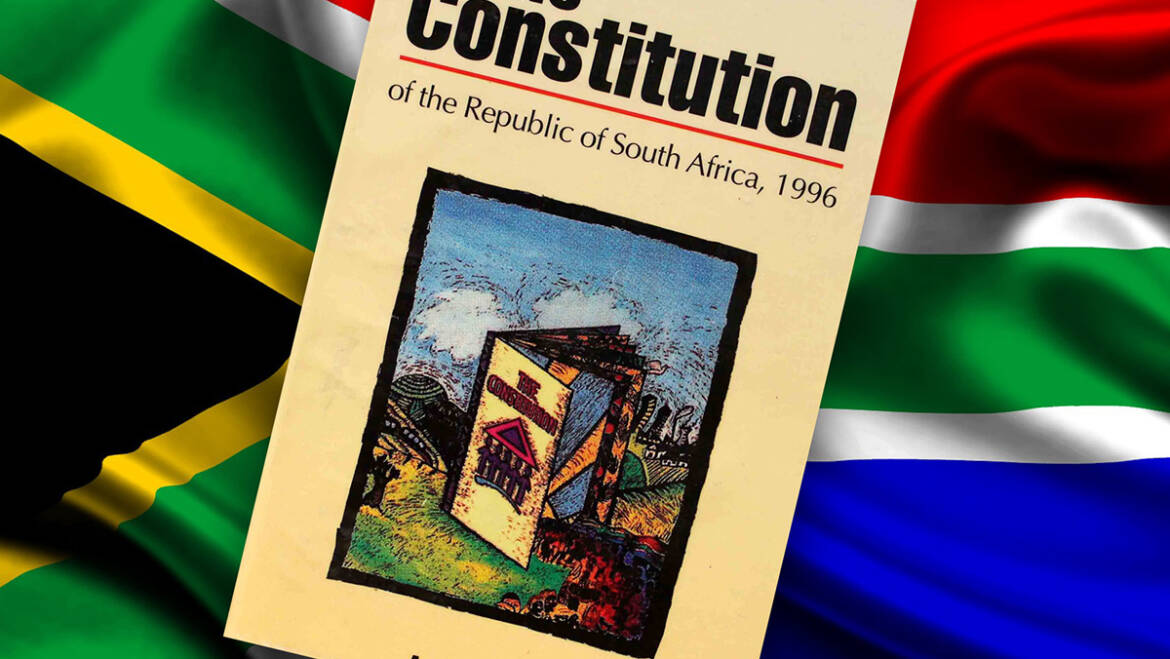
The 8th May marked 30 years since South Africa adopted a new constitutional dispensation in 1996 under a democratic order. The constitution is not just a symbolic document. It is the supreme law and the foundation upon which our constitutional democracy rests. Its importance cannot be over emphasised given the country’s history of divisions stemming from colonial domination and Apartheid segregation. However, the foundations of the constitution are structurally flawed as they are built on shaky ground; the constitution lacks the legitimacy that should serve as the reinforce and mortar that hold the foundations of our democracy together.
The 1996 constitution has largely been hailed as one of the most progressive in the world. Whilst there is no denying the strides made in the dismantling of the dehumanising aspects of Apartheid, the structural aspects of the legacy of colonialism and Apartheid remain unchanged; the promises of a democratic order have not been translated into a transformed and equal society the constitutional dispensation was meant to deliver.
One of the major failures of the constitutional democracy – as evidenced by the last thirty years – is its failure to deliver a truly democratic state founded on the values of “human dignity, the achievement of equality and the advancement of human rights” as contemplated in the founding provisions of the first chapter of the constitution.
The reasons for these failures stem from the ghost of coloniality lurking between the poetics of its flowery preamble and the prose of its founding provisions. Instead of being an enabler for the transitioning and transformation of South Africa from its colonial, racial and unequal past, the constitution is ironically fettered by its inherent hobbles of coloniality which its architects – under the umbrella of the constituent assembly – lacked the boldness and moral courage, first to unchain themselves from, and the wisdom and foresight to unchain the letter and spirit of the constitution itself, in order to unleash a truly new, free, democratic and equal society so many have sacrificed their lives for.
The constitution of 1996 is the second major constitutional dispensation in the history of South Africa following the 1910 Union of South Africa dispensation which, in essence, was a peace treaty between the Afrikaners and the British settlers following the two Anglo-Boer Wars, hence its failure to address the national question. The 1910 dispensation did not only exclude the black majority and other minority racial groups, but effectively stripped Africans and Coloureds of the Cape Colony of the enfranchisement rights which they had enjoyed under the Cape Colony dispensation. Whilst the Afrikaners have always been chastised for enacting and enforcing the racist laws of Apartheid, the seeds of racial segregation were planted by the British Parliament which sanctioned the racially exclusivist 1910 Union of South Africa dispensation.
In the eyes of many, the constitution is the last bulwark in defence of our democracy. However, Instead of being a progressive cover that protects the interests of the majority, the constitution has often been invoked by the privileged and the powerful minority as a blunt instrument that those who are against transformation first defer to in order to stifle and frustrate the transformation agenda. The recent legal challenge against the BBBEE legal sector codes by the country’s four biggest (white) law firms is a case in point. Also, we still have racial enclaves such as Orania, hiding and enjoying constitutional protection under private property rights and the right to cultural self-determination. This directly contradicts the constitutional principles of healing ‘divisions of the past’ and ‘unity in diversity’ and instead perpetuates the status quo of inequality, racial discrimination and the pain and suffering by the black majority under the Group Areas Act.
It is my contention that in as much as the failures of the South African post-colonial polity, first point to the failures of leadership and poor governance, their origins are traceable to the very foundations of the highly acclaimed 1996 constitutional dispensation. The fetters of a colonial legacy are embedded in the colonial architecture of the constitution. The ‘ghost in the machine’ of the constitution is the letter and spirit of colonialism that continues to haunt the transformation agenda. It Is the ghost of colonialism that renders the constitution illegitimate, and I dare argue, ‘unconstitutional’. This I must emphasise is a political argument premised on a critique of the constitution and not on legalities.
The 1996 constitution, in comparison to the 1910 Union of South Africa dispensation, was groundbreaking as it was put together by a Constituent Assembly made up members of the National Assembly as well as senate members from the various legislatures following the 1994 general election. Thus, the Constituent Assembly represented diverse political interests across the colour line as per the vote outcome. The 1996 Constituent Assembly borrowed heavily from the United States Constitutional Convention of 1787, but there are fundamental differences and inherent flaws. The first major difference lies in the process of adoption which was critical to giving the constitution its legitimacy.
The first challenge with the 1996 dispensation is the challenge of process. In the case of the United States in 1787, the nominees to the Constitutional Convention were nominees from the various legislatures, thus one could argue they did not directly represent the will of the people, despite being directly elected party representatives. However, the constitution was referred back to the various states for ratification, thus giving it a seal of legitimacy. In a marked departure with the US experience, the 1996 dispensation was never subjected to a process of ratification by the people. Notwithstanding what could have been a consultative process, It was only adopted by the Constituent Assembly, whilst the masses were still wallowing in the euphoria of democracy.
This was a huge omission in the process, which with hindsight – one could argue – was itself a subversion of the very democracy the constitution was meant to safeguard. I contend that this was deliberate on the part of the architects as they well were aware of the glaring gaps and contradictions of the letter and spirit of the document which was meant to lay the foundation to redress the injustices of the past and build a new just and equal society. Thus, the first challenge with the 1996 dispensation is its failure to enjoin the people to endorse it and thus, its lack of legitimacy despite it being wrapped in drapes of democratic processes such as the Constituent Assembly.
In form, the South African dispensation looks similar to the US system. Just as is the case in the US system, the 1996 constitution is a three-legged pot made up of parliament (an equivalent of the House of Representatives, the Executive (an equivalent of Congress) and the Judiciary. In the case of the arrangements of the National Assembly, in comparison to the House of Representatives, delegates of the National Assembly, unlike in the US system, are deployed by the party and not directly elected by the public. This is not a minor distinction.
In the US system, party representatives are directly elected by the public – not that the US system is perfect. This, however, gives a sense that they serve the will of the people even if reality may suggest otherwise. Nonetheless, It is an important consideration to give full meaning to voting beyond the exercise of balloting. The men and women who occupy the seats in the House of Representatives should reflect the will of the people. If they act at variance with the will of the voters, the voters have an opportunity to offload them in the next elect. This is what voter power is supposed to be. Something that is glaringly missing in the South African dispensation.
By design, our dispensation invites loyalty of party delegates, first and foremost, to the party and not to the electorate. We have seen how this loophole in our dispensation has repeatedly been abused. Whilst the principle of majoritarianism is embedded in the practice of democratic processes, this principle has often been abused against the popular will of the people and not for the benefit of the majority as the principle of majority rule was intended. This we have seen with the voting on the Nkandla scandal, and now recently with the Phala Phala saga, which have attracted criticism by the public, which criticism has elaborately been articulated by the Constitutional Court in both instances. The design of the constitution is not aligned to effectively deliver the will of the people, but the will of the parties, thus subverting and frustrating the will of the voters and rendering voters powerless.
This is another inherent flaw which has escaped scrutiny and interrogation by the public before final adoption.
The third challenge, and arguably the most controversial, is the challenge of the land question. The constitution, in its preamble, poetically pronounces, “South Africa belong to all who live in it, united in our diversity.” This clause in the preamble was part lifted from the Freedom Charter to give the new constitution a look of legitimacy and a feel that it truly represents the will of the people.
However, as I have argued in my book ‘The Blackness in Me’, we need to understand the context of the terrain of struggle and the power dynamics at the time of the drafting of the Freedom Charter, back in 1955. The Black majority and other minority racial groups had been excluded from the 1910 Union of South Africa dispensation – even then the Black representatives were pleading and petitioning for inclusion.
Whilst the Freedom Charter was a document that was crafted as a declaration of a vision of a future South Africa, reflective of the will of the people, it could not escape the political terrain and the power dynamics that gave rise to its political consciousness, which in the main was pleading for inclusivity and not a call for war.
By declaring that “South Africa belongs to all who live in it”, the constitution has failed to distinguish between the colonisers and the colonised, and “has defacto legitimised land dispossession and land theft by the colonisers and Apartheid segregationists”. Notably, the constitution has also failed to declare Colonialism and Apartheid as crimes against the indigenous people of South Africa. The 1996 constitution also seeks to mediate land restitution and redistribution through s 25, however, its provisions are inherently flawed and a limitation. S 25(7) of the constitution restricts restitution to acts of dispossession resulting from past racially discriminatory laws or practices committed after 19 June 1913.
Land theft is the ‘original sin’ and this started in 1652 and not in 1913 when the Natives Land Act was promulgated. This restriction suggests that land theft and dispossession that occurred before 19 June 1913 is fair game. The architects of the constitution, in all probability, realised this colonial conundrum and opted to limit restitution to acts of dispossession post 19 June 1913. Instead of doing the honourable thing, to redress the structural challenges posed by a colonial legacy, the Constituent Assembly opted for political expediency. This is an unforgivable betrayal by the constituent assembly, and no amount of rationalisation can sugar coat it.
Until we recognise and declare Colonialism and Apartheid crimes against the indigenous peoples of South Africa, we shall not properly address the problem of South Africa for what it truly is. The original sin of colonialism is land theft and land dispossession and until the 1996 constitution recognises and pronounces itself on that, it cannot claim that it truly ‘recognises the injustices of the past’.
Until the 1996 constitution remains with the inherent flaws where power vests in political parties, and not devolved to the voting masses, it cannot boldly lay claim that it has succeeded in giving true meaning and effect to the call of the Freedom Charter, that ‘the people shall govern’.
Until the 1996 constitution has been subjected to a referendum for ratification, it shall continue to lack legitimacy and cannot unilaterally coopt the victims of a colonial legacy through its poetic preamble by stating “We the people of South Africa ……”.
For these three challenges, or rather these three cardinal sins, the constitutional has failed the test of its own founding principles, and thus my verdict is to declare the 1996 constitution unconstitutional. That being said, it does not suggest we should throw the baby with the bath water. We need an overhaul of the constitution.