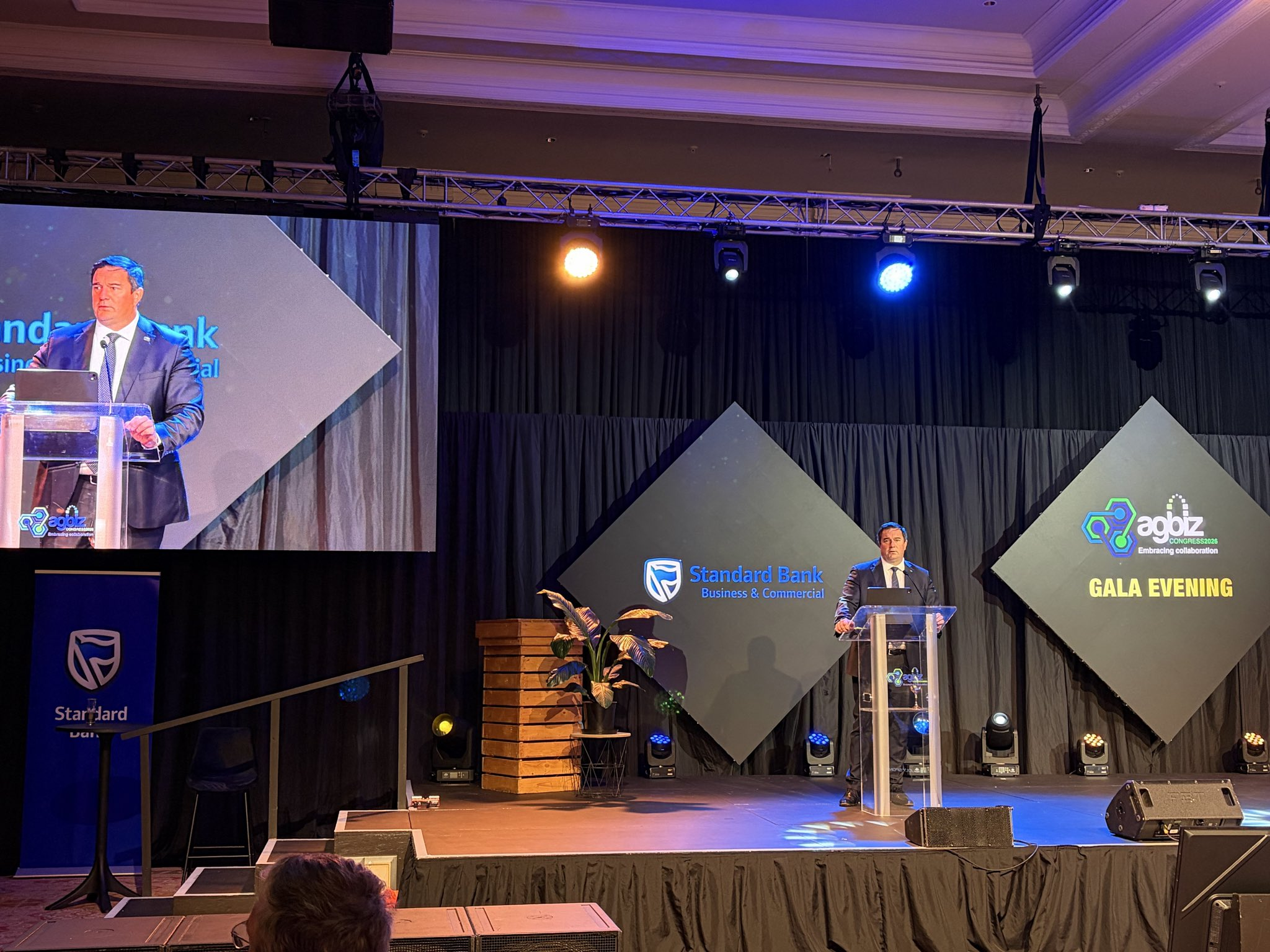
“It is always a pleasure to engage with the Agbiz family, but perhaps even more so at a gathering like this where we can speak a little more openly, a little more honestly, and perhaps a little less formally than we normally do in boardrooms and conference rooms.
I think it is fair to say that agriculture has become one of the few sectors in South Africa where people still believe that practical problem-solving matters more than ideology. That is one of the reasons why this sector continues to outperform expectations despite the many obstacles placed in its path.
Agriculture has learned something that much of the world is still struggling to grasp: uncertainty is no longer the exception. It is the operating environment.
Over the past year alone, we have had to navigate global conflict, rising protectionism, disrupted shipping routes, volatile exchange rates, logistical bottlenecks, climate shocks and ongoing biosecurity threats. We have seen how quickly tariffs can alter global trade flows and how fragile supply chains remain in an increasingly fractured world. Yet despite all of this, South African agriculture continues to grow.
That says something important about this sector. It says that our farmers, agribusinesses, exporters, processors and commodity organisations are resilient, innovative and globally competitive. But it also says something else: agriculture succeeds in South Africa not because conditions are easy, but because this sector has learned how to adapt faster than the obstacles confronting it.
Minister, I spend a great deal of time thinking about what government’s role should actually be in helping agriculture succeed. Over the past two years, I have become increasingly convinced that government often tries to do too much, too slowly, and in too many areas where it frankly has no business trying to dominate.
I believe government’s primary role is actually much simpler than we sometimes pretend. Our job is to create an enabling environment. Our job is to remove blockages, open markets, protect the production base through strong biosecurity systems, and ensure predictable rules and functioning institutions. Once we have done that, we must have the confidence to get out of the way and allow farmers, exporters, agribusinesses and investors to do what they do best.
The reality is that government does not create prosperity on its own. Productive sectors create prosperity when government stops making growth unnecessarily difficult.
That does not mean the state has no role. Quite the opposite. There are some things only government can do. Only government can negotiate market access agreements with trading partners. Only government can maintain sovereign biosecurity systems. Only government can establish the legislative and regulatory framework within which markets operate. Only government can coordinate certain forms of strategic infrastructure and international diplomacy.
But government cannot replace the energy, innovation and investment capacity of the private sector, nor should it try to.
That is why I believe the theme of this Congress, “Embracing Collaboration”, is not simply a slogan. It is increasingly becoming an economic necessity. The next phase of agricultural growth in South Africa will not be delivered by government alone, nor by the private sector alone. It will be built through practical partnerships focused on execution rather than endless process.
I believe we are now entering a new phase in South African agriculture, a phase where the conversation is shifting from survival towards expansion and value creation. There are several areas where I believe government and agribusiness can work together far more aggressively than we currently are.
The first is biosecurity. The recent Foot and Mouth Disease outbreak has been a brutal reminder that biosecurity is no longer a technical issue sitting quietly in the background of agriculture. It is now central to trade, investment confidence and food security itself. This is why we have adopted a far more aggressive and risk-based approach to disease management. It is why we are pursuing our goal of achieving FMD-free with vaccination status. It is why we have expanded vaccine procurement and strengthened partnerships around traceability, surveillance and vaccine production capacity.
But government cannot do this alone. That is why my focus has been, and continues to be, industry partnerships, coordinated movement control systems, integrated traceability platforms, and stronger collaboration around vaccination and disease management systems if we are going to build a modern animal health architecture capable of protecting our export markets.
The second area is infrastructure and logistics. Every person in this room knows that South African agriculture has effectively been paying a tax called inefficiency for years. Our producers have remained globally competitive despite logistics systems that too often work against them rather than for them.
While progress is slowly being made, particularly around ports and rail reform, we all know the pace needs to accelerate. Recent developments around private sector participation in the Port of Durban point to a growing recognition that government and industry must work together more pragmatically to restore efficiency and competitiveness within our logistics system. I believe agriculture should be at the forefront of shaping these public-private partnerships because agriculture understands better than most sectors what delays, congestion and uncertainty actually cost in real economic terms. For an export-driven sector such as ours, efficient ports, rail and freight systems are not a luxury, they are foundational to growth, market access and competitiveness.
The third area is access to finance. If we are serious about expanding production and integrating more small-scale and emerging farmers into commercial value chains, then we need to build on and strengthen the blended finance and support mechanisms that already exist. There is significant appetite within the private sector to support commercially viable emerging producers, but too often we still operate in fragmented silos where government financing, commercial financing and development financing are not sufficiently coordinated or aligned with the realities of agricultural production cycles and commodity markets.
We therefore need closer collaboration between government, banks, agribusinesses and commodity organisations to further de-risk agricultural lending and develop more innovative financing mechanisms tailored to the agricultural sector. This includes expanding the use of commodity-backed lending, warehouse receipt systems, off-take agreements, blended finance guarantees and inventory-backed facilities that allow farmers to leverage verified commodity stock and productive cashflows alongside traditional forms of collateral.
Importantly, we must stop thinking about inclusiveness as separate from growth. The future competitiveness of South African agriculture depends on broadening participation in a way that is commercially sustainable, investment-friendly and rooted in real economic opportunity.
The fourth area is extension services and technology. One of the realities we must confront honestly is that the traditional extension model is no longer sufficient on its own. The scale of agriculture, the pace of technological change and the complexity of modern farming require a very different approach.
This is why we are increasingly looking at hybrid digital extension platforms, remote advisory systems and partnerships that can connect farmers directly to information, markets, finance and technical support. I believe there is enormous room here for agribusiness participation.
Imagine the possibilities if government, commodity organisations, input suppliers, financial institutions and technology companies worked together on integrated digital extension systems capable of reaching farmers at scale. That is where the future is heading.
Then there are biofuels. I genuinely believe biofuels could become one of the next major growth frontiers for South African agriculture if we approach it correctly, not as a narrow energy debate, but as an agricultural industrialisation opportunity.
Biofuels create opportunities for grain producers, sugar producers, oilseed producers, logistics companies, processors and rural economies. But again, this will require collaboration. It will require policy certainty, investment, and urgency rather than allowing the process to disappear into another decade of reports and policy consultations. That is why we have already initiated interdepartmental engagements to establish a coordinated pathway forward involving agriculture, energy, trade and industrial policy stakeholders.
Ladies and gentlemen, One of the risks facing South Africa is that we sometimes create institutions, councils, forums and platforms that start with good intentions but gradually lose their effectiveness. When that happens, we must have the courage to acknowledge it honestly.
Collaboration only works if institutions are functional, trusted and outcomes driven. Agriculture cannot afford paralysis. It cannot afford endless process without delivery. It cannot afford fragmentation while global competitors move faster.
This includes areas such as transformation where trust, credibility and practical outcomes matter enormously. We need institutions that bring stakeholders together around growth, investment and inclusion, not structures that become disconnected from the realities facing producers and agribusinesses on the ground.
The agricultural sector has always succeeded when it focused on practical outcomes rather than ideological positioning, and that pragmatism remains one of this sector’s greatest strengths.
Despite all the challenges we face, I remain deeply optimistic about the future of South African agriculture. In fact, I would go further and say that agriculture is one of the most underestimated growth sectors in the South African economy today.
Few sectors have our export potential. Few sectors have our innovation capability. Few sectors have our ability to create jobs across rural economies. Few sectors have our resilience. Few sectors have the strategic importance that agriculture now carries in a world increasingly concerned about food security, supply chains and geopolitical instability.
The opportunity in front of us is enormous but realising that opportunity will require courage from both government and business. Government must be willing to reform, modernise and let go of outdated ways of operating. Business must continue investing, innovating and partnering. Both sides must resist the temptation to retreat into distrust or ideological comfort zones.
Ultimately, agriculture works best when we stop asking whether government or business should lead and instead ask how we can build systems that allow both to succeed together.
That is the real meaning of embracing collaboration. Not endless meetings. Not declarations. Not slogans. But practical partnerships that solve problems, unlock growth and build confidence in South Africa’s future.
I want to thank Agbiz for the important role it continues to play in shaping strategic thinking within the sector and for remaining a constructive and solutions-oriented partner to government.
Finally, I want to thank every person in this room for what you continue to contribute to South African agriculture. At a time when many sectors are losing confidence, agriculture continues to build. And that matters.
Thank you.”