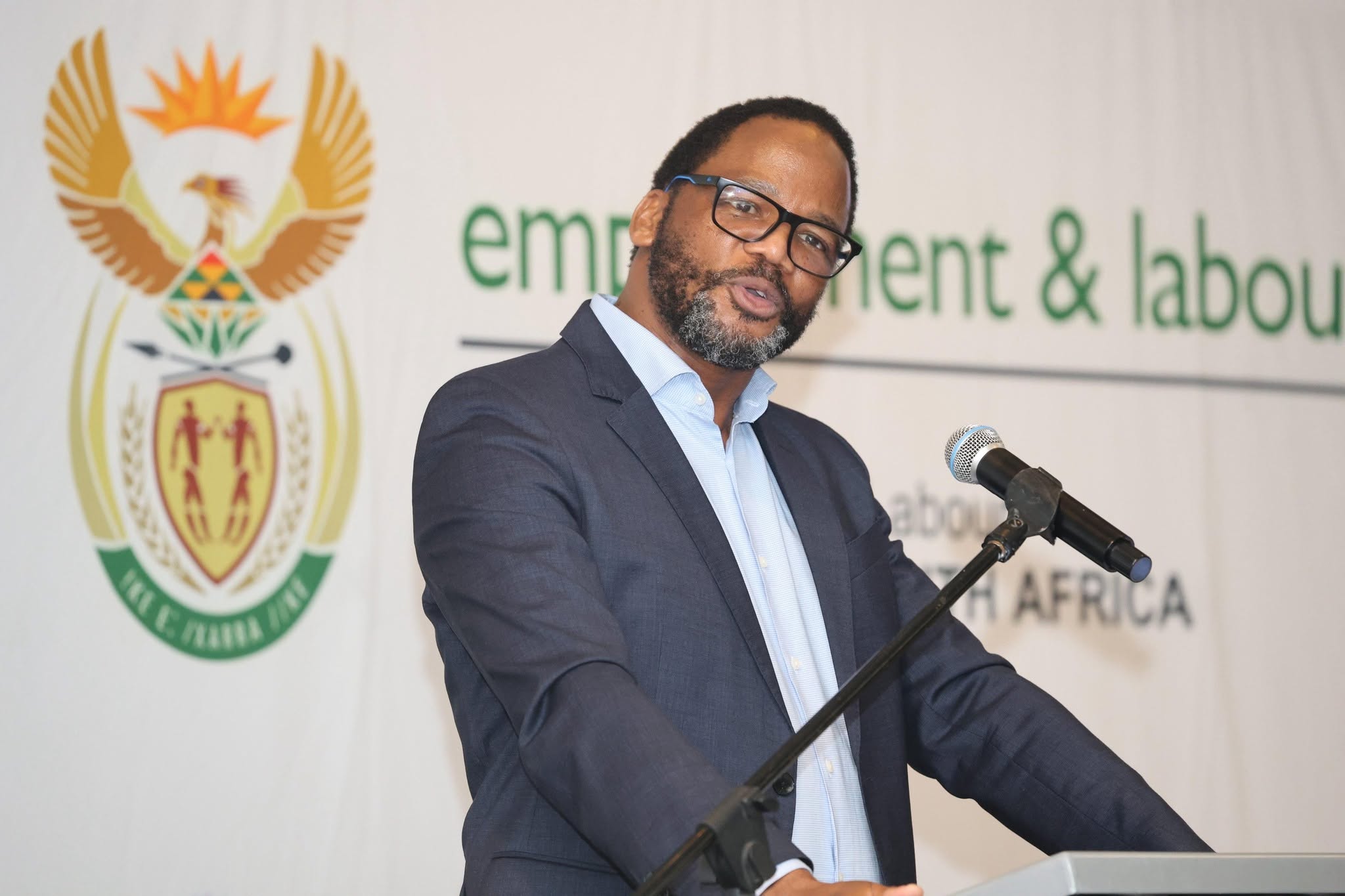
The Deputy Minister of Employment and Labour, Mr Jomo Sibiya, has called on employers in the petroleum industry to strengthen compliance with South Africa’s labour legislation and place the health, safety and wellbeing of workers at the centre of their business operations.
The Deputy Minister delivered the keynote address during the Department of Employment and Labour’s Employer Breakfast Session, hosted by the Inspection and Enforcement Services (IES) branch in partnership with Rand Mutual Assurance (RMA) at the Birchwood Hotel and Conference Centre in Boksburg.
The engagement brought together representatives from organised business, organised labour, bargaining councils, occupational health and safety practitioners, professional bodies, government institutions and employers operating within the petroleum industry to discuss compliance with labour legislation and the promotion of safer, healthier and more productive workplaces.
The Employer Breakfast Session followed an extensive inspection campaign conducted by the Department across fuel filling stations in Gauteng after concerns were raised regarding non-compliance with labour legislation within the sector.
The inspection project, which commenced in April 2026, was undertaken to assess employers’ compliance with the Occupational Health and Safety Act (OHSA), Compensation for Occupational Injuries and Diseases Act (COIDA), Basic Conditions of Employment Act (BCEA) and the Unemployment Insurance Act (UIA), while also identifying employers that had not transferred to the Rand Mutual Assurance in accordance with the relevant Government Gazette.
Addressing delegates, Deputy Minister Sibiya emphasised the strategic importance of the petroleum industry to South Africa’s economy, noting that the sector supports more than 140 000 jobs and plays a critical role in sustaining transport, agriculture and industrial activity.
He further highlighted the occupational hazards associated with petroleum products and stressed that employers have a legal and moral responsibility to protect workers from preventable workplace injuries, illnesses and fatalities through effective risk assessment and management, engineering controls, appropriate personal protective equipment and safe work practices.
Deputy Minister Sibiya said “The protection of workers cannot be negotiated. In addition, compliance with labour legislation is fundamental to ensuring that every worker returns home safely at the end of each working day. Employers must not regard compliance as a regulatory burden, but as an investment in their employees, their businesses and the sustainability of the industry.”
Presenting the outcomes of the inspection campaign, the Acting Provincial Chief Inspector, Mr Mbongeni Tshabalala, said the Department had conducted 682 Occupational Health and Safety inspections at filling stations operated by major petroleum companies and independent operators. Of these, 308 employers (45%) were found to be compliant , while 374 employers (55%) failed to comply with the Occupational Health and Safety Act. Inspectors issued 361 contravention notices, 92 improvement notices and 17 prohibition notices to employers who failed to meet the required safety standards.
Under the Compensation for Occupational Injuries and Diseases Act, inspectors conducted 402 inspections , with 255 employers (63%) found compliant and 147 employers (37%) non-compliant . Notably, 50 employers were found not to be registered with either the Compensation Fund or Rand Mutual Assurance, contrary to legislative requirements.
The inspections further revealed encouraging levels of compliance with the Basic Conditions of Employment Act, where 442 out of 457 employers (96.7%) complied with the legislation. However, labour inspectors identified shortcomings relating to employment contracts, record keeping and remuneration information, resulting in 15 compliance orders being issued. During the inspections, 623 foreign nationals were identified on site. Their immigration status could not be verified as the inspection exercise focused solely on labour legislation administered by the Department of Employment and Labour.
The Department also expressed concern over persistent non-compliance with the Unemployment Insurance Act. Of the 108 employers inspected , only 20 (19%) complied , while 88 employers (81%) were found to be non-compliant , with the most common contravention involving employers’ failure to submit monthly employee declarations to the Unemployment Insurance Fund.
Deputy Minister Sibiya further encouraged employers and organised labour to continue strengthening social dialogue through the country’s bargaining council structures, while investing in employee development to prepare the workforce for technological advances within the industry.
He also commended the partnership between the Department, Rand Mutual Assurance, organised business, organised labour and the bargaining councils, saying sustainable compliance can only be achieved through collaboration, information sharing and a shared commitment to decent work.
The Chief Director: Provincial Operations, Mr Tshepo Mokomatsidi, also emphasised that the Employer Breakfast Session formed part of the Department’s commitment to supporting employers through awareness and education. While the inspection campaign identified areas requiring urgent attention, the engagement provided an opportunity for employers to better understand their legal obligations and work collaboratively with the Department to improve compliance before enforcement action becomes necessary.
The Department of Employment and Labour remains committed to promoting a culture of compliance, strengthening workplace health and safety, protecting workers’ rights and working with social partners to build safer, fairer and more productive workplaces across all sectors of the economy.
For media inquiries, please contact: Teboho Thejane, Departmental Spokesperson: 082 697 0694/ teboho.thejane@labour.gov.za