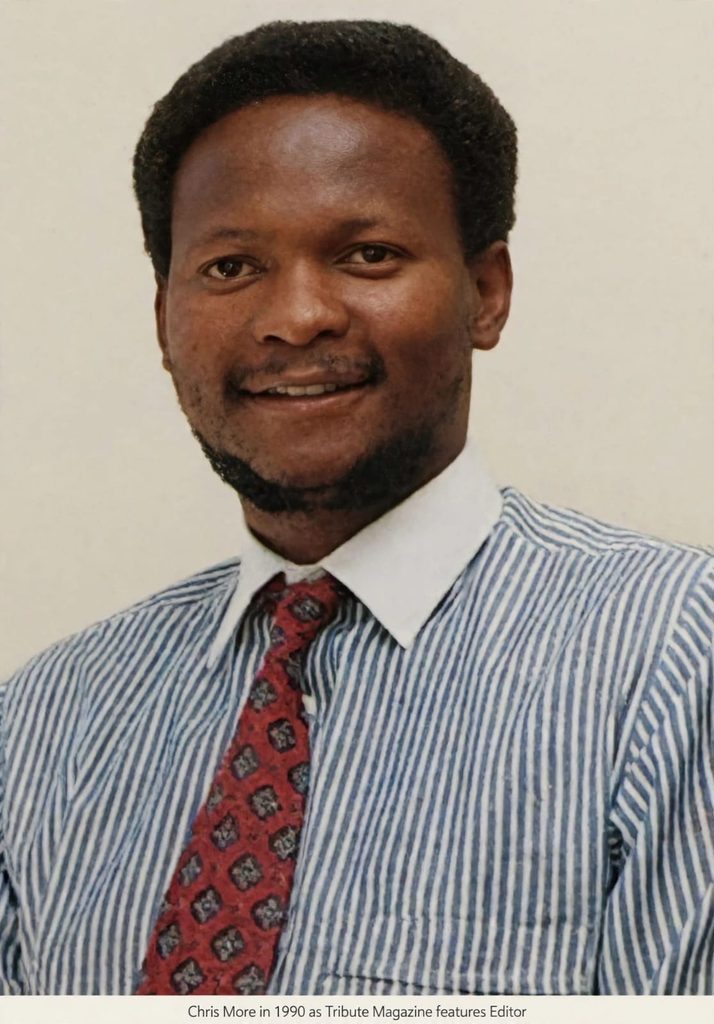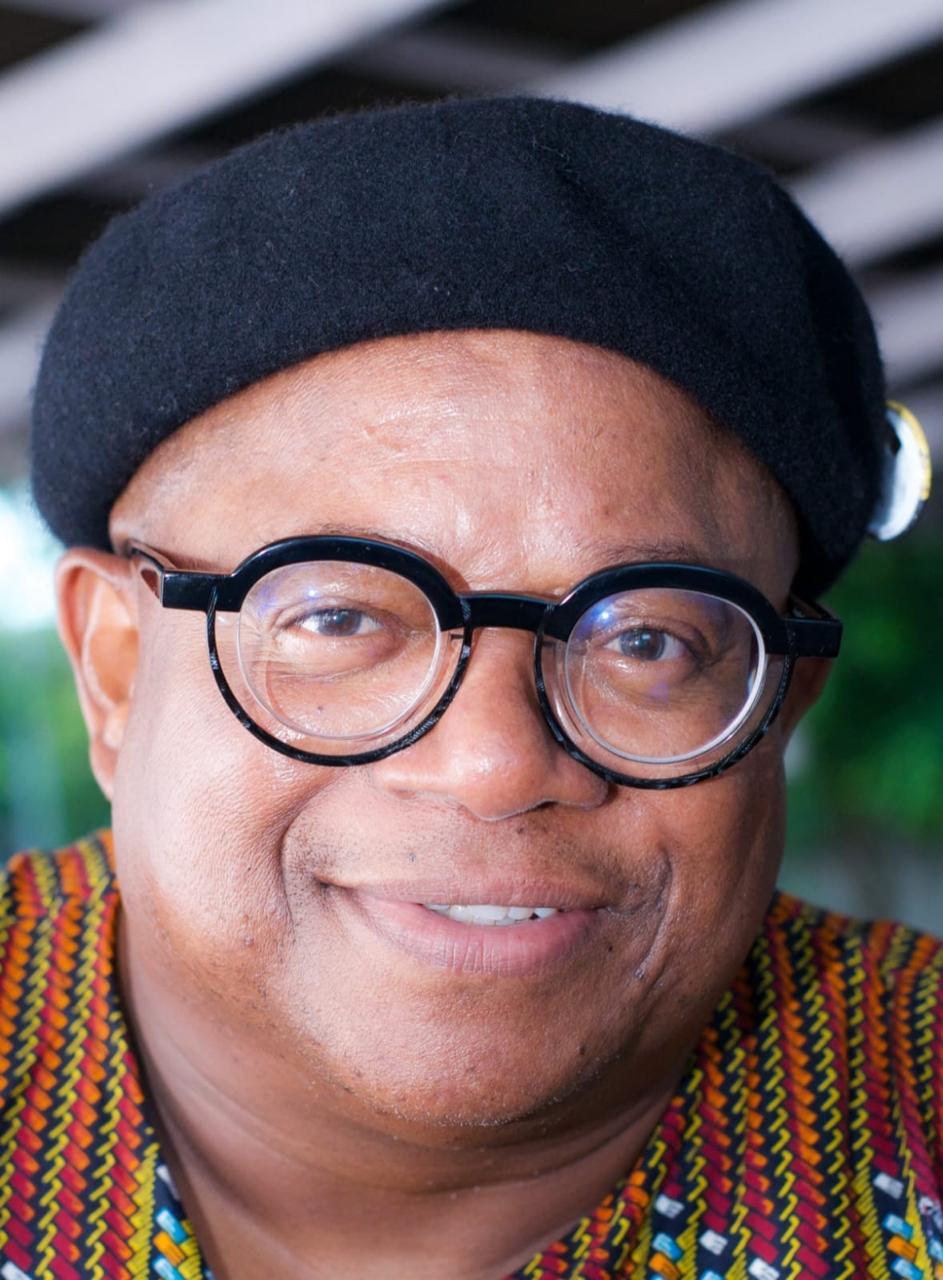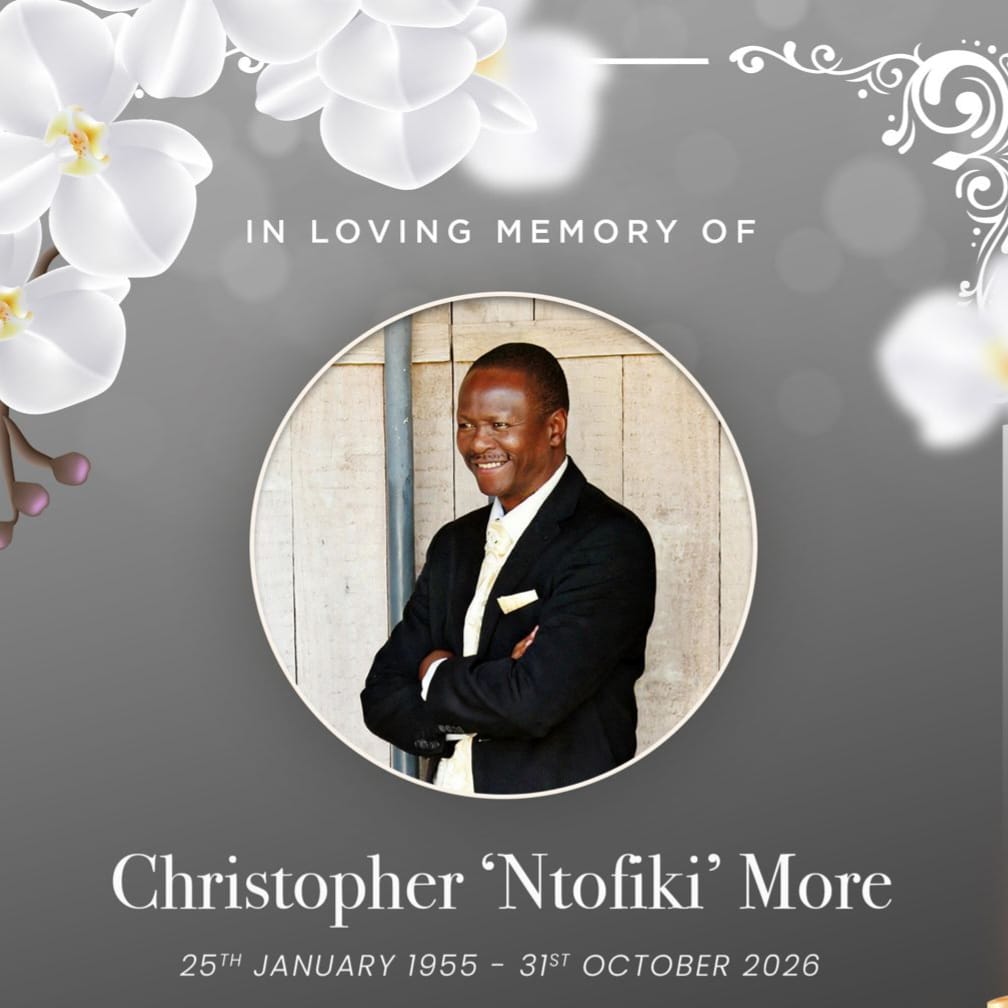
Chris “Ntofiki” More did not become a journalist because he wanted to be famous. He became a journalist because apartheid gave him no other choice.
To understand Chris, you must understand the context and conditions under which journalists worked in the turbulent 70s, 80s and 90s until the attainment of democracy.
This was not journalism as you know it today – laptops, Twitter, press conferences with bottled water. This was journalism under a state of emergency, under petrol bombs, under banning orders, under detention without trial.
The 1970s: From Classroom to Prison
He trained as a teacher at Hebron Teachers College but dropped out in his second year when June 16 upheavals began.
Hebron is in the Bophuthatswana bantustan, a college meant to produce obedient teachers for Bantu Education. But in June 1976, Soweto exploded. School children rose against Afrikaans. The country caught fire. You could not sit in a classroom in Hebron learning how to teach “Bantu” children to be good servants when children your own age were being shot in Vilakazi Street.
So Chris did what thousands of young black men did: He moved to Soweto and joined the political leadership team and those close to them. He hung out with the Soweto Students Representative Council, the underground structures that tried to keep the uprising alive after the leaders were killed or jailed.
This led to his incarceration for twenty-two months together with Dr Nthato Motlana and other leading activists.
Dr Nthato Motlana was Mandela’s doctor, Sisulu’s doctor, the soul of Soweto. To be locked up with him in those years was to be in a university of resistance. Twenty-two months in apartheid prison in the late 70s – no trial, no lawyers, just beatings, solitary, interrogation. Many came out broken. Chris came out politicised.
He understood then what journalism would mean: It was not a job. It was a continuation of the struggle by other means.
From Prison to Higher Education
He joined the South African Council for Higher Education (SACHED) which used to assist UNISA students with tuition.
SACHED was a front. Officially, it helped black students who could not go to white universities to study through UNISA. In reality, it was a haven for activists, for ex-political prisoners, for people banned from studying. It was run by liberal whites and radical blacks who believed education was resistance.
That is when he was given a scholarship to study journalism in England.
In apartheid South Africa, black people could not study journalism properly. White universities did not take you. The only place to learn was in exile, in London, at the London School of Journalism, at Cardiff, at Harare after Zimbabwe’s independence. Thousands of black journalists went this route – they left on SACHED or SA Catholic Bishops Conference scholarships, learned the craft in England, and came back.
Chris went to England. He learned inverted pyramid, feature writing, media law. But more importantly, he saw how a free press works. He saw newspapers that could criticize the Prime Minister without being banned.
He taught Julian Bahula to forge relatiins with the media as partner to promote his profile and projects.
He came back to practice that in a country where you could be banned for telling the truth.
The Sowetan and Aggrey Klaaste
He started his journalism at Sowetan with Bra Aggrey Klaaste.
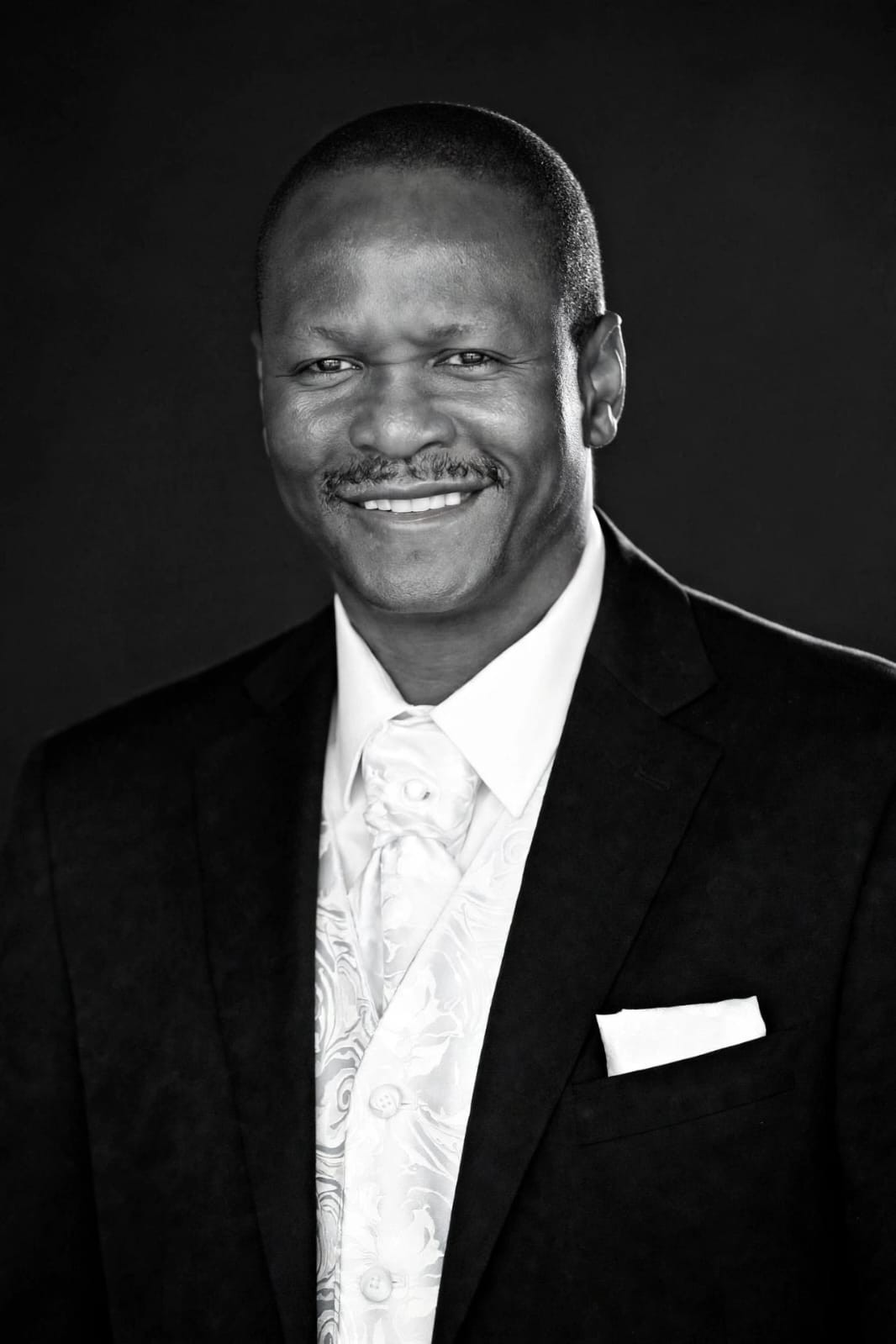
Aggrey Klaaste was the giant. The man who took The Sowetan from being a small township paper to being the biggest daily in South Africa. The man who created Nation Building.
For a young black journalist in the late 80s, The Sowetan under Klaaste was the only place to be. It was not just a newspaper. It was a school, a political home, a family.
Klaaste taught his boys: “Tell the story of your people, but tell it so that the white man cannot ignore it.” He taught them to write about soccer, about shebeens, about police killings, about housing, all in the same paper.
Chris learned there how to write for black people, not for white liberals.
He was in the thick of the fire during the upheavals, interrogating Arch Bishop Tutu who was saving spies and asking for their forgiveness.
The Liberal Press: The Star, Rand Daily Mail, Financial Mail
The latter was a training ground and feeder to The Star. In the 1980s when you worked for liberal newspapers like Rand Daily Mail and Financial Mail you were considered a hot journalist and taken seriously.
This is important context that young people don’t understand today.
In the 80s, there was a hierarchy of journalism. At the bottom was the black press – Sowetan, City Press. In the middle was the English liberal press – Rand Daily Mail, The Star, Sunday Express, Weekly Mail. At the top was the financial press – Financial Mail, Business Day.
If you were black and you crossed over from Sowetan to The Star, you had arrived. It meant white editors trusted you. It meant you could write for white readers. It meant you were “objective.” The Rand Daily Mail was the paper that exposed Muldergate, that exposed apartheid. To work there was to be taken seriously.
This was confirmation that Black Consciousness did not quite succeed to liberate the mind of journalists.
Steve Biko’s Black Consciousness taught black people to be proud of blackness, to not seek validation from white liberalism. But in journalism, the validation still came from white liberal papers. Many wanted to be accepted by The Star, by Rand Daily Mail, by Financial Mail. Because those papers had resources, had lawyers, had international attention that protected you slightly from the security police. And they gave you status.
Chris moved in that world. He was one of the hot black journalists who could write for both.
Tribute Magazine and the Co-option Era
He was to join Maud Motanyane as a feature writer, columnist and editor at Tribute magazine, to profile black professionals who had supposedly defeated apartheid by ‘making it’ to hold top jobs in white corporates.
This marked an covert corporate campaign to co-opt and integrate blacks into apartheid reform.
This is the most painful part of his story, and the most honest.
By the mid-80s, P.W. Botha realized apartheid could not survive as pure baasskap. He introduced reforms: tricameral parliament, black middle class, black managers in white corporates. Magazines like Tribute, Pace, Drum in its later years, were part of that.
Maud Motanyane was a brilliant editor. Tribute’s job was to say: Look, blacks are making it. Look at this black marketing manager at Anglo. Look at this black personnel director at BMW. Apartheid is reforming.
For a black journalist, this was a well-paying job. You got to wear suits, interview rich educated blacks, go to launches at the Carlton. Attend The Forum and mingle with movers and shakers. But politically, you were being used to show that apartheid could work if black people just worked hard.
Chris did it. He profiled those professionals. He knows today that it was co-option. He would tell you himself: We thought we were celebrating black excellence, but we were selling reform.
It is a lesson for today’s journalists who profile black CEOs and think they are doing radical journalism while they are actually doing PR for white capital.
The Bophuthatswana Detour
Ironically, when he disappeared from media he later joined Bophuthatswana in their Tourism Ministry and was stationed at Carlton Centre, promoting tourism in South Africa for Bob.
“Bob” is Lucas Mangope, President of Bophuthatswana, the bantustan. This is the part of Chris’s life that people whisper about.
After the 80s, many black journalists were tired. Detention, low pay, divorce, hard drinking, banning, seeing friends killed – it breaks you. Bophuthatswana offered good money. Mangope wanted educated blacks to run his “independent” homeland. He set up an office at the Carlton Centre – the tallest building in Africa – to promote Bop tourism: Sun City, Morula Sun, Pilansberg.
Chris went there. To promote tourism for a bantustan that was a creation of apartheid.
Was it betrayal? No. It was survival. It was also a common path. Many activists took Bop or Transkei or Ciskei jobs when the struggle became too hard. They told themselves: I will work from inside. Or, I need to feed my family.
Chris did that work. He learned marketing, tourism, government communications there – skills he would later use.
He continued this with North West Provincial Government under Premier Popo Molefe.
When Bophuthatswana collapsed in 1994 – when Mangope tried to resist reintegration and his army mutinied – Chris stayed. He joined the new North West government under Popo Molefe, the first democratic premier. From bantustan tourism officer to provincial communicator for an ANC premier. That is the continuity of many black careers: the homeland system trained them, the new government absorbed them.
The Last Return: Acting Editor of The Sowetan
His last employment contract was with The Sowetan as an acting Editor.
That is poetic justice. The boy who started at Sowetan with Klaaste as a junior in the 70s, came back in the 2000s as acting Editor of the same paper.
The Sowetan had changed. It was now owned by a big white company, Avusa. It was no longer the fiery township paper. It was trying to be respectable. Chris was brought in to steady it, to give it gravitas.
As acting Editor, he sat in Klaaste’s chair. He knew what that chair meant. He knew the ghosts in that newsroom.
The Miner in Lesotho
He was currently involved in mining in Lesotho.
Today, in his late 60s and early 70s, Chris was not in a newsroom. He was in the mountains of Lesotho, involved in mining.
Why? Because journalism does not pay pension. Because after 50 years of telling the truth, you too need a decent house. So you go to Lesotho, where there are diamonds, where there is quarrying, where a man who knows government and knows people can hustle.
It is not a fall. It is the reality of a frontline journalist who cut his teeth in the 1970s. The white journalists he worked with at Rand Daily Mail retired to houses in Parkhurst, or to beach houses in Cape Town, with pensions from Times Media. The black journalists retired to hustles.
Tribute
So we pay tribute to Chris Ntofiki More.
A man who dropped out of teacher’s college because Soweto burned.
A man who spent 22 months in prison with Dr Motlana and others
A man who went from SACHED to England to Sowetan to The Star to Tribute to Bophuthatswana to North West Government to Sowetan again to the mines of Lesotho.
His life is the map of black journalism in this country: From resistance to co-option to government to survival.
He never became a celebrity except in his own ranks. He never wrote a book about himself. He never chased awards.
He just kept working, telling stories, surviving.
And for those of us on the wrong side of 50, who remember what it meant to be a radical black journalist when being a black journalist meant the Security Branch opened your mail, we say:
Thank you, Bra Chris. You cut the path.
We walk it now, because you walked it first, with no shoes, in the fire.
You had no business to die.