FONDLY REMEMBERED, DESPERATELY MISSED: Reflections on the life and times of Eastern Cape student activist, Chule “KK” Papiyana
POLITICS OF FORMATION
Some people are remembered for the offices they held. Others are remembered by the people they helped to form. Chule “KK” Papiyana belongs to the second category.
I knew “KK” as a friend, a mentor and a comrade, at a time when student politics was not a rehearsal for public life but public life conducted under pressure and with real consequences. To write about him now is to examine a form of political education that shaped a generation of black students in the last years of apartheid and the dawn of democracy.
THE WORLD THAT FORMED US
The late 1980s and early 1990s were years of intense political ferment. Apartheid was weakening but had not conceded; liberation movements were approaching legality, yet the
future remained uncertain. On campuses, in townships and community halls, the question was not only whether apartheid would end but what would replace it and who would build what came after.
SANSCO was itself a product of that argument. Its emergence from AZASO in 1986 reflected a wider debate about the direction of black student politics, the relationship between Black Consciousness and the Congress tradition, and the kind of mass organisation a changing environment required. By the time SANSCO entered its final negotiations with NUSAS, years of resistance, repression and practical organising had accumulated. The 1991 merger was not an administrative event but an argument about the political future. KK came of age inside that argument.
KK did not arrive at Rhodes as a political beginner. Expelled from Fort Hare in 1985 for anti-apartheid activities, he had already learned organising under repression; by November 1987 he was president of the Black Students Movement at Rhodes and had been detained by the security police. His political education was formed under conditions in which ideas, organisation and personal risk were inseparable.
RHODES: THE IVORY TOWER AND THE TOWNSHIP
Rhodes University presented one of the sharpest contradictions of our youth: on the hill, an institution of old buildings, manicured lawns and the cultivated language of liberal scholarship; below and around it, townships where the material reality of apartheid was written into every corrugated-iron wall and overcrowded room.
That contrast sharpened our politics: it was impossible to debate the architecture of the university by day and pretend the architecture of the country did not matter.
THE UNIVERSITY AS A POLITICAL CLASSROOM
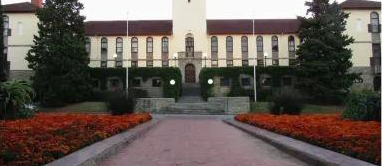
Rhodes University, where a generation of black student politics was sharpened and organised. Photograph: supplied
Rhodes University, where a generation of black student politics was sharpened and organised. Photograph: supplied
Rhodes was a complicated place for a black student: an elite institution with a strong liberal tradition, carrying the weight of its colonial name, while the surrounding Eastern Cape
experienced upheaval and state repression. My formation happened in more than one classroom. At Rhodes I studied politics and journalism under teachers such as Gavin Stewart, Terence Beard, Roger Southall and Don Pinnock. The university taught us to interrogate ideas, institutions and evidence; the movement required us to test those ideas in practice.
FOUNDERS HALL: THE POLITICAL CLASSROOM WITHIN THE UNIVERSITY
Much of the political education of our generation happened outside the formal curriculum. At Rhodes, Founders Hall was one such space — its rooms, corridors and late-night conversations an informal classroom where ideas were tested and arguments continued long after formal meetings ended. KK was at home there: his gift was turning an argument into a conversation, a conversation into understanding, and understanding into preparation.
In that circle of young people being formed by the circumstances around us were Thamsanqa Mchunu, Mxolisi Landu “Teach”, Simpiwe “Piya” Dzengwa, Nkabinde, Junior, Sivuyile Ntlabezo “Bagcine”, Mkhuseli Faku “Khusta”, Maxwell Boqwana “Maxhelwele”, Spookheuse and Mziwozuku Mgudlwa “Mzi”.
“KK” AND THE DISCIPLINE OF LEADERSHIP
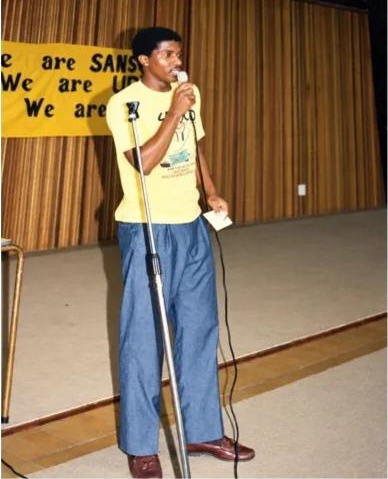
Chule “KK” Papiyana addresses students at a campus gathering, with a SANSCO banner behind him. Photograph: Tango Lamani.
KK was not the loudest person in the room; he did not need to be. He listened, weighed an argument, then spoke in a way that usually moved the discussion forward. What distinguished him was not theatrical authority but intellectual discipline — challenging sloppy reasoning and pushing younger comrades to read more seriously, argue more rigorously and understand the institutions they confronted. He understood that anger alone was not enough: it had to become thought, organisation and a programme people could carry.
I remember KK insisting that black activists at Rhodes could not afford academic mediocrity in the name of political commitment. The lesson I remember most clearly was that we had to “conquer the book and the street simultaneously.” That mattered because the university itself was an object of political struggle: to challenge institutional racism effectively, one had to understand statutes, committees, budgets, governance structures and the language through which institutions defended themselves.
THE FILE, THE FRIENDSHIP AND THE LESSON OF LEADERSHIP
An extract from Before the Leaders Came the Teachers: Chule “KK” Papiyana and the Politics of Formation
One episode captures the complexity of that relationship particularly well.
I remember KK arriving at my room with a file containing material relevant to a second-year Political Science test. He wanted me to help reproduce political material for circulation among students at other institutions. I resisted. I had a test on the Monday and wanted time to study.
KK’s priorities were characteristically political: the material had to be reproduced and distributed. But when I examined the file, I realised it also contained material relevant to the section we were to be tested on. My attitude changed. I told him I would get Mxolisi Landu, whom we knew as “Teach”, to help with the photocopying.
I went to Cory House and woke Teach. When I showed him the file, he understood why I was excited. We agreed not to discuss its origins with the other comrades, then went to the cafeteria to work through the photocopying.
When the results came out, Teach and I had both scored 90 per cent, while other comrades received marks around 50 per cent. The difference attracted attention, and questions followed. Someone had apparently seen KK carrying the file into my room, and students began asking whether he had given me material that offered me an advantage.
The episode placed our relationship with KK under a different scrutiny. What had occurred in private had acquired a public meaning: no longer a story about a file or two high marks, but a
question about trust, fairness and the responsibilities of someone who exercised political influence.
When I saw KK afterwards, he confronted me about the consequences — concerned that other students might conclude he was playing favourites, and reminding me that I was not part of the formal student leadership and that the perception of privileged access could generate resentment.
I remember the force of that lesson. KK wanted us to understand that closeness to a political leader did not confer status but imposed responsibility: the conduct of someone close to leadership could affect the leader’s credibility and the collective’s confidence.
His expectations were informed by the tradition he admired, particularly the example of Oliver Reginald Tambo. He wanted us to carry ourselves in a manner worthy of a larger political inheritance: activism was not an excuse for intellectual carelessness, and personal relationships could not undermine fairness.
That principle extended beyond the examination room. In the university cafeteria, we reproduced documents for teachers’ colleges, nursing colleges, agricultural colleges and other institutions across what were then the Ciskei and Transkei. Our political education travelled with those papers — between campuses, into meetings and along the roads connecting young activists who believed ideas had to circulate to become a force for change.
The file taught me that proximity to leadership could become a burden as readily as an advantage. The relationship left me with a lasting understanding of what KK expected: not entitlement or unquestioning loyalty, but discipline, responsibility and the capacity to think independently.
“KK” IN THE TOWNSHIP
KK’s political life did not stop at Rhodes. He moved between institution and township, between formal political language and the lived realities that gave it meaning. In the township, politics was not a seminar but about housing, food, transport, schooling, policing, unemployment, dignity and survival. KK understood that the political educator had to learn from people as well as teach. Rhodes was one classroom; the township another; the road between them part of the education.
TOWARDS A SINGLE NON-RACIAL STUDENT ORGANISATION
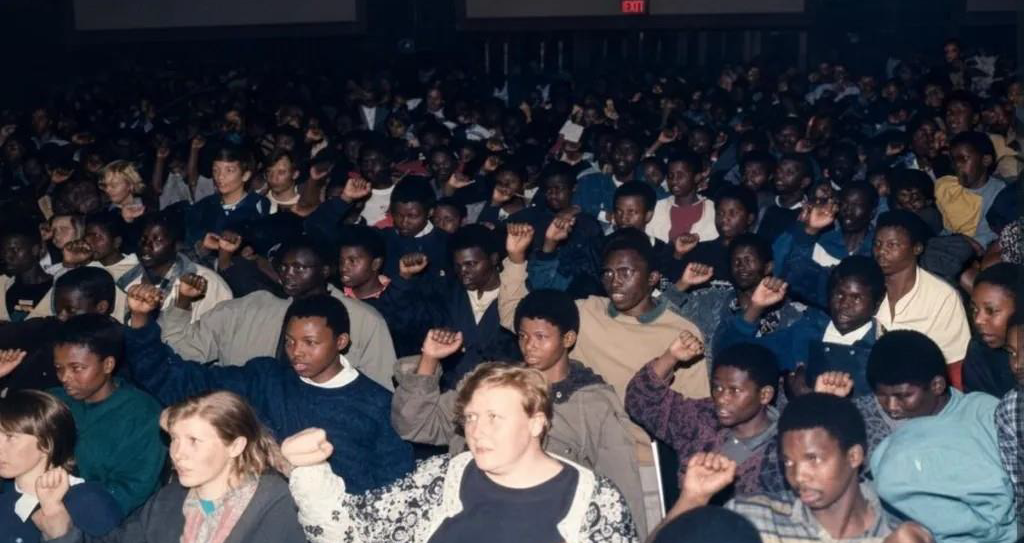
Students from NUSAS and SANSCO gathered at Rhodes University during the historic September 1991 congress that culminated in the formation of SASCO. Photograph: Tango Lamani.
Students from NUSAS and SANSCO gathered at Rhodes University during the historic September 1991 congress that culminated in the formation of SASCO. Photograph: Tango Lamani.
FROM CAMPUS POLITICS TO THE NATIONAL STRUGGLE
The Black Students Movement at Rhodes connected campus politics to the wider struggle. The SANSCO affiliate was proscribed under apartheid regulations in February 1988, and police raids on SANSCO and SRC offices showed the state did not treat student politics as harmless campus activity. KK understood the movement was not self-contained: SANSCO operated within the wider mass democratic movement and maintained an important relationship with the UDF.
POPO MOLEFE, VALLI MOOSA AND THE UDF TRADITION
The student movement existed within a larger political ecosystem. Popo Molefe was a founding figure in the UDF and became its National General Secretary, his trajectory having begun in the Black People’s Convention and the South African Students’ Movement. In the Transvaal, Molefe and Mohammed Valli Moosa were elected co-secretaries of the regional UDF; when Molefe was detained, Valli Moosa became acting National General Secretary, and was himself repeatedly detained, operating under extraordinary pressure during the State of Emergency. The lesson for our generation was that leadership was a chain: student leaders learned from civic leaders, civic leaders from workers and communities, and national leaders from organisers who could move through the most difficult spaces.
SANSCO, SATISCO AND THE CROSS-POLLINATION OF LEADERSHIP
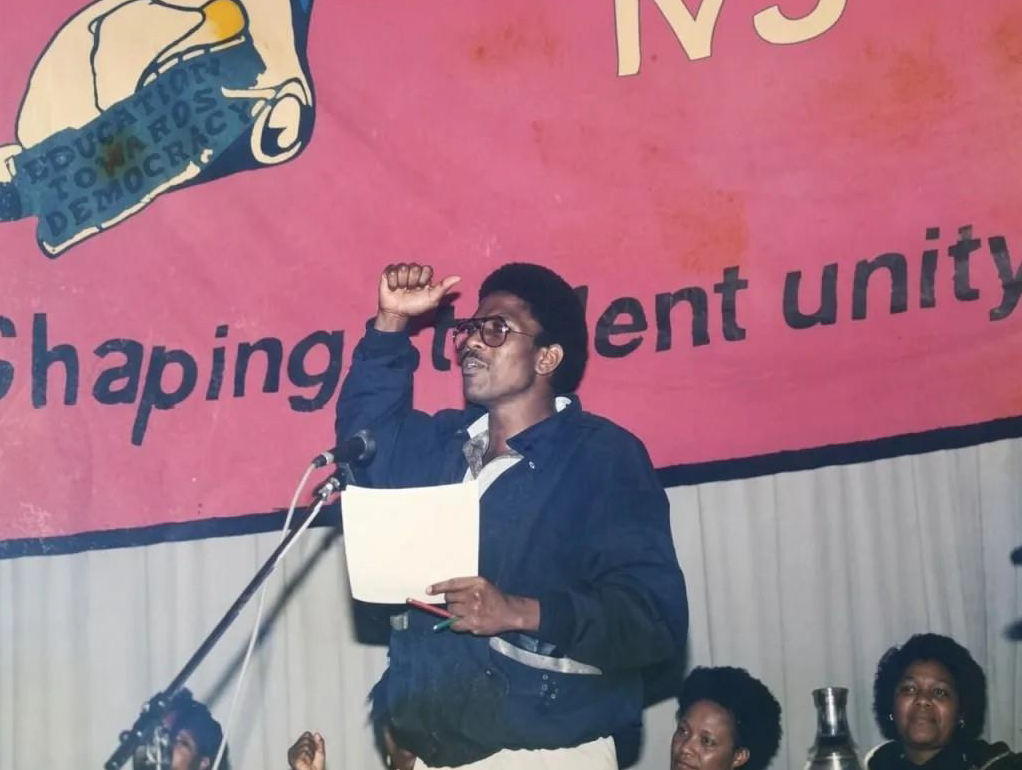
Mike Koyana addressing a gathering during the student movement era. The banner behind him carries the call for education, workers’ democracy and shaping student unity. Photograph: Tango Lamani.
The history of SANSCO cannot be separated from the struggle over sport. SATISCO — the South African Tertiary Institutions Sports Council — belonged to the wider tradition of non-racial sport, and leaders moved between student politics, student sport and broader democratic formations. The names associated with SANSCO, SASCO and the student-sport struggle — Mike Koyana, Robinson Ramaite, Kgomotso Masebelanga, David Makhura,
Mfundo Nkuhlu, Kovin Naidoo, Songezo Nayo, Mangaliso Mahlaba and Andrew “Druza” Dipela — belonged to a national political classroom larger than any single campus.
Mike Koyana addressing a gathering during the student movement era. The banner behind him carries the call for education, workers’ democracy and shaping student unity. Photograph: Tango Lamani.
At Rhodes, the same process could be seen in the relationships among Lincoln Mali, Bongani Gxilishe, Mvuzo Mbebe, Sindisile Maclean and Mzwandile “Tswai Radebe” Poswa.
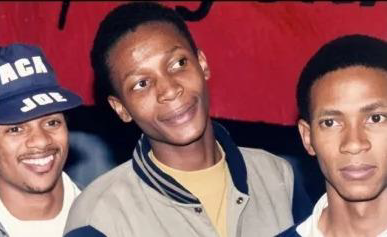
Lincoln Mali, Robinson Ramaite and Kgomotso Masebelanga, figures in SASCO’s founding national leadership in 1991. Photograph: Tango Lamani.
The founding of SASCO in 1991 was the visible moment when several streams of student politics, non-racialism and institutional struggle converged. KK’s role as political commissar belonged to that convergence: helping people argue, clarify and hold purpose together when choices were contested.
1991: THE POLITICS OF FORMATION IN PRACTICE
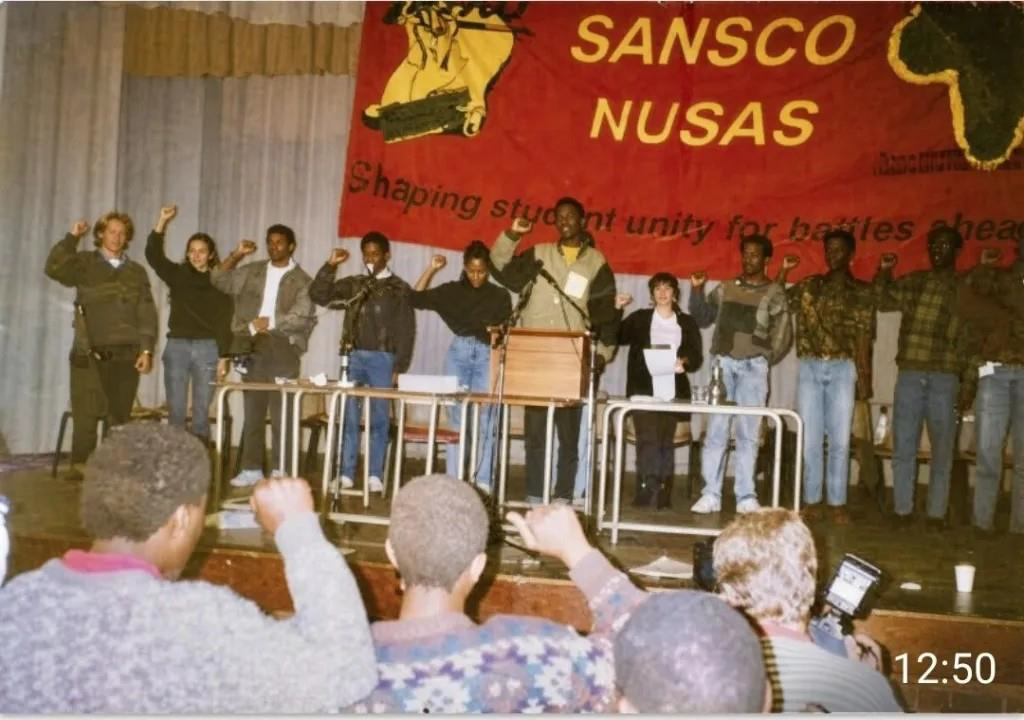
Leadership of SANSCO and NUSAS. Photograph: supplied
The culmination came at Rhodes in September 1991. About 600 students from 129 tertiary institutions gathered from 1 to 6 September under the banner “Towards a Single Non-Racial Student Organisation”. The discussions were substantive and at times heated: questions of organisational structure, African, working-class and women’s leadership, and the character of the new organisation went to the identity of the movement being created.
KK served as a political commissar during this process, helping summarise debates, clarify positions and keep political argument connected to organisational purpose. The title carried a particular responsibility in our tradition — political education, coherence and discipline. He could operate inside disagreement without treating it as disloyalty.
The names matter because they show the breadth of that formation. Mike Koyana stood at the centre of the SANSCO–NUSAS transition; Robinson Ramaite became the first SASCO president and Kgomotso Masebelanga its founding Secretary-General. Kovin Naidoo emerged from student politics at Durban-Westville and became a national vice-president of SANSCO. Simphiwe “Sim” Tshabalala belongs to the same Rhodes generation, though not to the SANSCO/SASCO leadership described here; his later path into law and the leadership of Standard Bank illustrates the range of directions that generation would take.
Lincoln Mali’s trajectory captures another dimension. He moved from student politics into the new democratic state and served as spokesman to Professor Sibusiso Bengu, the first democratic Minister of Education (1994–99). The movement’s political education produced not only future politicians but people who could enter government, law, journalism, business, sport, academia and public administration, carrying an understanding of how institutions worked.
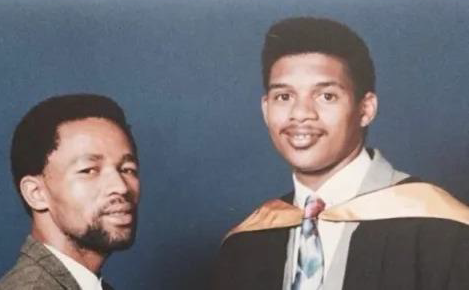
Zola and Lincoln, Rhodes University graduation ceremony. Photograph: supplied
MZI, THE GRAND HOTEL AND THE OTHER SIDE OF OUR POLITICAL LIVES

Mzi at Steyn City. Photograph: supplied
putting at Steyn City. Photograph: supplied
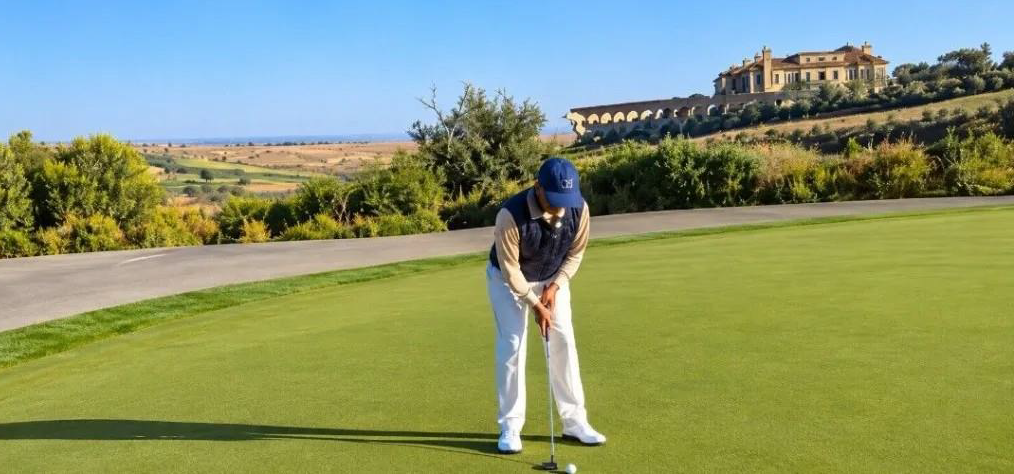
At Leopard Creek. Photograph: supplied
I remember the Grand Hotel, the journeys to different golf courses, and the companionship that grew between Mziwozuku “Mzi” Mgudlwa and me. We began playing with caddies, learning from men whose practical knowledge of the course often exceeded our own — a lesson politics should also teach. Our golfing memories run across South Africa’s distinctive courses: Leopard Creek near Malelane, Gary Player Country Club at Sun City, Blair Atholl near Lanseria, and the Eastern Cape courses of our world — Homewood, Olivewood, East London Golf Club at Bunkers Hill and West Bank Golf Club. The Club at Steyn City, where I was photographed putting on its Nicklaus-designed course, belongs to the same story. Golf became an observation post from which to weigh the distance between privilege and deprivation: whether people formed by a politics of equality could enter spaces of privilege without forgetting where they came from. My memories of Mzi are of the friend with whom I shared those journeys, not only the lawyer and business leader he later became.
THE RED GOLF: POLITICS ON THE ROAD
KK and I were political comrades, but our friendship went beyond politics. In our family understanding, the Papiyana lineage is associated with the Gxarha tradition and the wider Pondoland country around Ntabankulu. I came from the rural Peddie side of the Eastern Cape, where self-sustaining farming was part of lived experience; KK used to tease me about being the grandson of a peasant farmer.
Some of the most important political education of that period did not happen behind a podium but in a little red Golf Chico. In that car, KK and I, with the late Bongani Gxilishe, Lincoln Mali and the late Mzwandile “Tswai Radebe” Poswa, travelled the long roads of the Eastern Cape and beyond — to Johannesburg for national congresses, and to Alice, Mthatha and campuses where SANSCO and later SASCO branches needed support. The country was still under apartheid rule; activists were detained and organisations restricted. In the boot were books and documents: Fanon, Biko, the Freedom Charter, ANC and SACP discussion papers and SANSCO material. The road became another seminar, and KK’s intelligence was
most visible in those ordinary moments — the quality of his questions, the calmness of his reasoning and the seriousness with which he treated political work.
FROM RESISTANCE TO GOVERNMENT
Trevor Manuel embodied one part of the transition. He had served as a UDF Regional Secretary in the Western Cape and on its National Executive Committee, endured detention and house arrest during the State of Emergency, then moved into the new democratic government — first as Minister of Trade and Industry in 1994 and later as Minister of Finance. His trajectory illustrated the new demand on a generation formed in resistance: conviction now had to be translated into policy, institutions, budgets and administration.
The transition after 1994 introduced another classroom. Comrade Popo Molefe, by then Premier of the North West, opened an opportunity for younger activists from the student movement to spend time in the province learning the machinery of government. I was among those who benefited. Political liberation did not automatically produce administrative competence; we now had to understand departments, budgets, legislation and public administration — extending a lesson I had first encountered through KK: commitment had to be matched by preparation.
SPOOKHEUSE, KHUSTA, MAX AND THE HUMAN CIRCLE AROUND “KK”
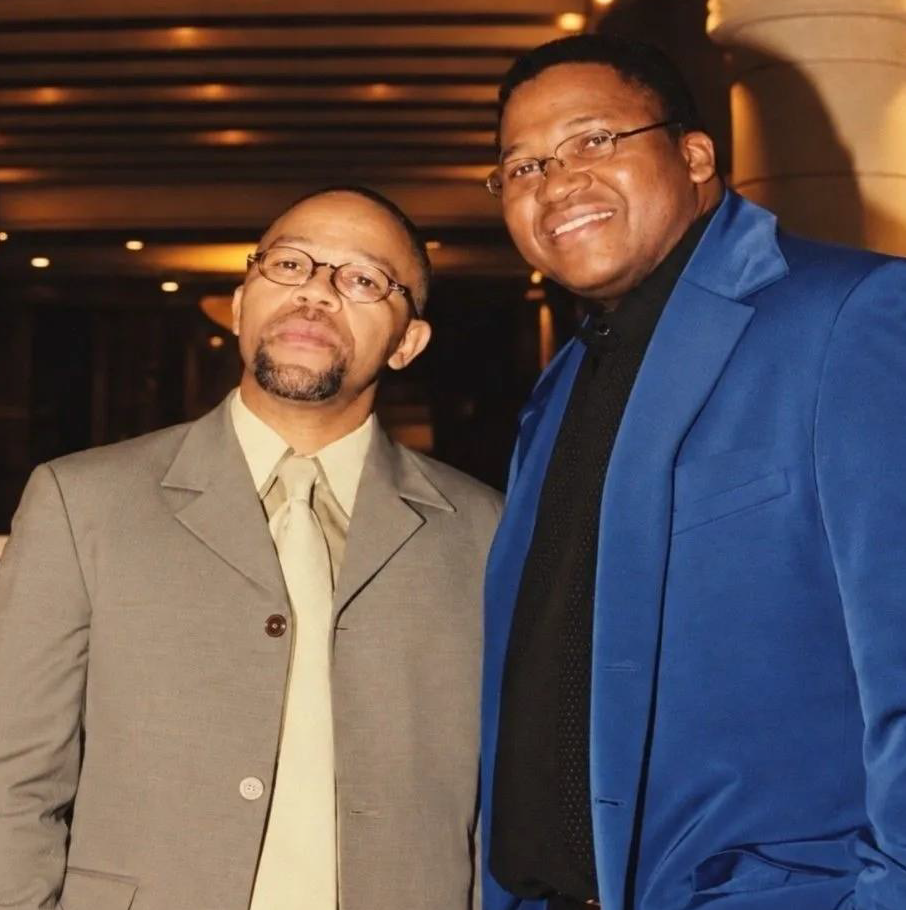
Pinda and Faku at the restaurant. Photograph: supplied
History remembers leaders by their positions; memory remembers people differently — the friends and quiet figures who made political life human. In my memory of the Founders Hall circle were Mkhuseli Faku “Khusta”, Maxwell Boqwana “Maxhelwele”, Spookheuse, Mxolisi
Landu “Teach”, Thamsanqa Mchunu, Simpiwe “Piya” Dzengwa, Nkabinde, Junior, Sivuyile Ntlabezo “Bagcine” and Mziwozuku “Mzi” Mgudlwa — people who disagreed sharply and continued living alongside one another. KK’s influence was strongest where relationships let him teach without lecturing, challenge without humiliating and insist on standards without losing comradeship’s warmth.
THE GENERATION BESIDE “KK”
One cannot remember that generation honestly without remembering those who are no longer here. Kgomotso Masebelanga, elected the first SASCO Secretary-General at the founding conference, was later murdered in 2003. Mike Koyana, central to SANSCO and the 1991 moment, is also gone; so are Mvuzo Mbebe and Sindisile Maclean. These losses remind us that movements are built by people whose later visibility varies but whose contribution at the moment of formation can be decisive.
THE DISCIPLINE OF POLITICAL EDUCATION
KK’s method was not confined to formal meetings. He encouraged reading because movements could not rely indefinitely on inherited slogans. Fanon, Biko, Freire and Marx were not names to cite but ways of thinking about power, consciousness, organisation and social change. The point was not that every activist had to reach the same conclusion but that they should explain why they believed what they believed. The philosophy he insisted on — to conquer the book and the street simultaneously — held that study and preparation, organisation and public responsibility, were each indispensable and neither sufficient alone.
THE POLITICS OF NON-RACIALISM
Non-racialism was not a slogan everyone read the same way: emerging from a history in which apartheid organised life through racial classification, the question was how to build a democratic organisation that rejected racial domination without pretending the consequences of racial power had vanished. Questions of African, working-class and women’s leadership reflected competing understandings of how historical inequalities should be addressed. KK’s role was not to make disagreement disappear but to help people work through it without losing the larger objective.
THE PEOPLE BESIDE “KK”
It is important not to turn KK into a solitary hero. Alongside Bongani Gxilishe, Lincoln Mali, Mzwandile “Tswai Radebe” Poswa and Mike Koyana were less visible figures — branch organisers, residence activists, students who drafted memoranda and carried national decisions back to their campuses. Political formation happens before a résumé records it; KK understood that. THE STANDARD OF POLITICAL FORMATION
The political generation that formed us did not invent the idea that leadership required intellectual preparation. An older tradition within the liberation movement, represented by Oliver Reginald Tambo and, later, Thabo Mbeki, held that political leadership demanded
engagement with history, political economy, institutions and strategy. Intellectual seriousness did not make these leaders infallible, but it established a principle: political responsibility required the capacity to think. KK is best remembered as a political educator — teaching that decisions should be thought through, disagreement handled politically, and much of leadership carried out as preparation when nobody is watching.
WHY “KK” STILL MATTERS
KK never lived to experience that transition. He died in 1991, before the first democratic election. Three decades give those of us who knew him a responsibility he cannot exercise: to ask whether the political education we received remains adequate to the country we inherited. South Africa’s present difficulties are not only institutional or economic but questions of political culture — how leaders are formed, how movements educate their members, and what happens when ambition detaches from preparation and ethics. KK’s example offers a standard: young activists should read, understand institutions, argue carefully, organise, and learn that leadership is a responsibility before it is a position.
I write this as a journalist who was also a participant in that student movement. The university gave us intellectual tools; the movement tested them; KK showed us what political discipline looked like when those ideas had to be put to work. He was my friend, my mentor and my comrade. What stayed with me was not a title but a habit of mind: read before speaking, understand the institution before challenging it, prepare people rather than merely impress them, and do the work whether or not a title follows. That is the politics of formation.
THE PEOPLE WHO SHAPED THE JOURNEY
My Brother, Molo
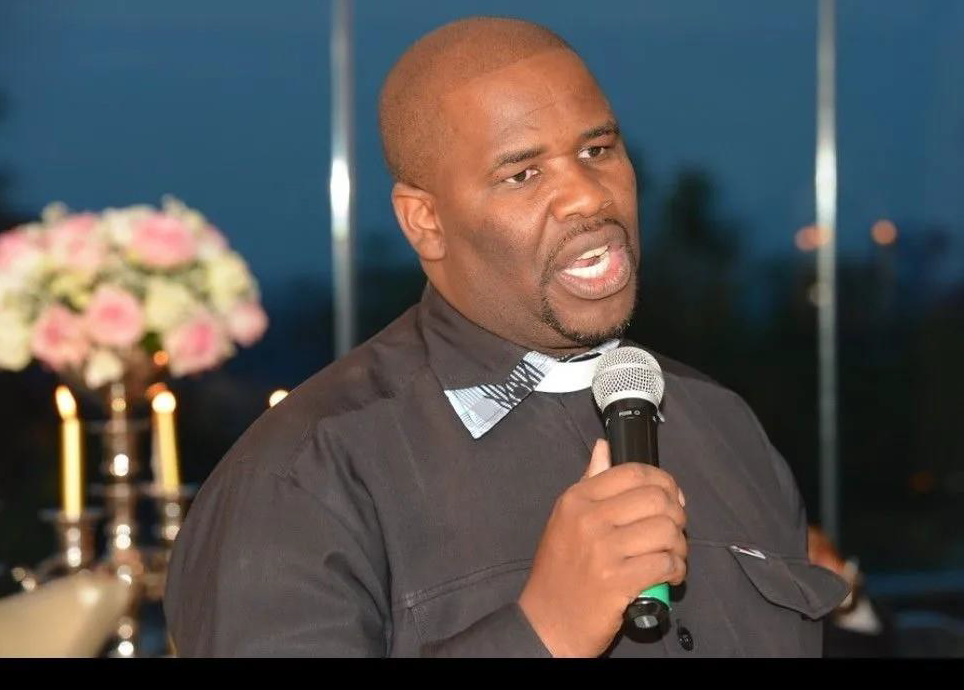
MOLO
No journey is walked alone. Mine is the sum of conversations, mentors, colleagues, family and friends who saw something in me before I saw it in myself. Molo has been part of my journey for as long as I can remember — through the triumphs and the trials, as brother, friend and confidant. His place in my story belongs to the lived history of the journey itself.
Molo
THE POLITICS OF MEMORY
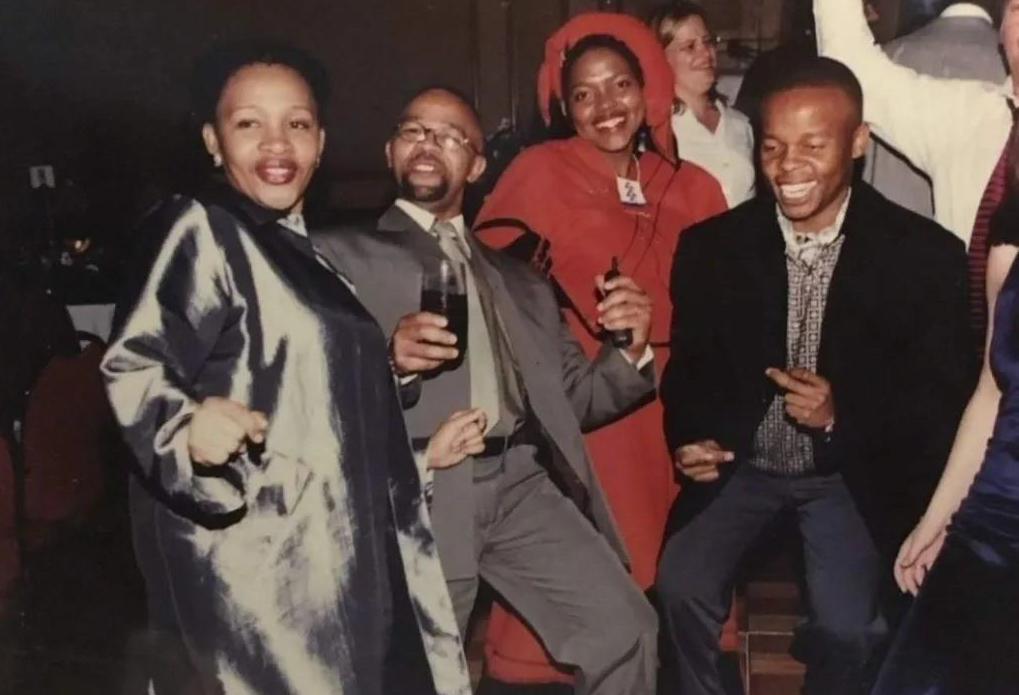
Mosima, Pinda, Koyana and Mofokeng. Photograph: supplied
The fuller this history becomes, the less convincing it is to tell as a story of one institution or one man. It was a story of movement between worlds: Rhodes and the township; the residence and the street; SANSCO and SATISCO; resistance and government; poverty and professional life; friendship and political discipline. KK stood at the centre of many of those crossings. The purpose is not nostalgia but to remember what political formation once demanded — reading, discipline, service, courage, institutional knowledge, and the humility to know that the people beyond the campus were not objects of politics but its reason.