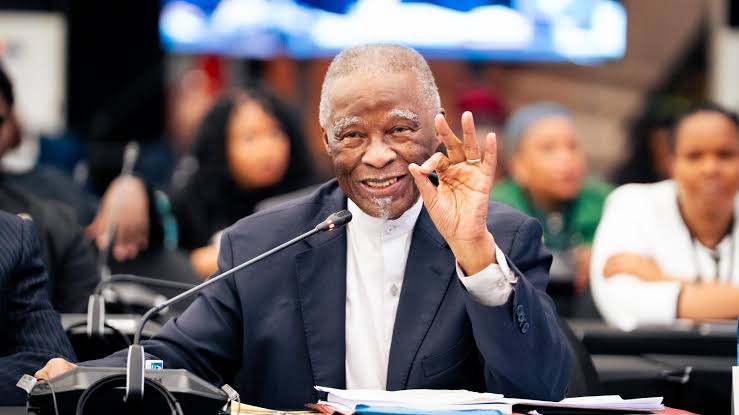
This week, an old video clip of former President Thabo Mbeki, speaking during the Seriti Commission of Inquiry, resurfaced out of the blue – coinciding with yet another appearance by Mbeki, this time at the ongoing Khampepe Commission of Inquiry into delayed Truth and Reconciliation Commission (TRC) prosecutions.
The video, in which Mbeki scolds Adv Paul Hoffman in a dramatic dressing down, made rounds as if though it was fresh from the Khampepe Commission, which wasn’t the case.
I was among the many people misled by its origin. However, my standpoint about the essence of Mbeki’s address remains at least unchanged. The racism issue the former President raised then remains an important matter in our socially incohesive society.
In the video clip, which a source very close Mbeki later told me they were taken aback by its sudden reappearance, Mbeki vehemently challenges the apparent racial prejudice aimed at him, with his supportive wife Zanele Mbeki right behind him. However, disappointedly, I take umbrage with the former President in that he held back from tackling democratic SA’s enduring spate of racism. No wonder, perhaps, the video resurfaced. The lingering scourge of racial prejudice is a lived experience for way too many people, nay, victims.
Mbeki’s performance at the Seriti Commission was thus a painful watch for more reasons than one. Painful, because, the former president did what SA’s political elites oftentimes do best – they shy away from telling the hard truths, all in pursuit of an endeavour to “build a new society” where racism will be a malady of our past.
Addressing the Commission Chair, Mbeki bitterly reflected on what many Black South Africans speak about at social gatherings such as braai vleis, family dinner, friends’ night out, radio talk-shows and so forth. In taxis and busses, lift clubs, at villages and townships, and the suburbs – the issue of white supremacy in the so-called new South Africa is topical. It is made particularly legitimate by the autoethnographic – or lived experience – of too many Black victims of racism.
Mbeki’s pointed complaint against Adv Hoffman, who had earlier quizzed him aggressively about his role in the past, in my book served as a microcosm to SA’s imperfect race relations that linger on more than 30 years into our nascent democracy.
Mbeki said Adv Hoffman’s line of questioning was conducted in an utterly “condescending manner”. He said the white lawyer resembled characteristics of what I can call white supremacy. The following are Mbeki’s words, referring to Adv Hoffman: “He’s very superior…I’m raising this, Chairperson, I don’t know what can be done about it,” he said, before continuing: “Perhaps there’s no way to change Mr Hoffman. He’s got a particular attitude, very superior, very condescending, and says all of these insulting things. I do hope that we should all of us understand that we are trying to do something about building a new society. And maybe we’ll have to make a special effort to take out of our bloodstream things that have become ingrained,” he said.
Mbeki’s exasperated tone and irritated posture were unmistakable in his attempted admonition of Adv Hoffman. I say “attempted”, because the former President did not go full steam nor all the way to address the singular most factor that continues to hold back SA’s progress into an ideal future of social cohesion and harmonious coexistence of all races. Where I umbrage with the former President, whom I must confess I hold in high esteem, was when he told the Commission Chair: “I don’t know what can be done about it.”
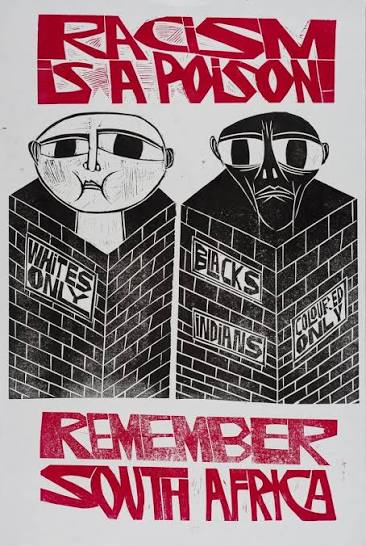
Well, surely of all the people, Mbeki should know that racism, outlawed with the demise of apartheid at the turn of the 1990’s, is punishable by law. Mbeki and the multitude of comrades from across the liberation movement spent decades in exile and on Robben Island fighting to establish a racism-free SA. In April 1994, we all thought they had succeeded when Mandela became the first democratically elected president. Mbeki succeeded Mandela in 1999, and under his stewardship for nearly two-terms of office the economy of the country flourished.
Despite the economic good times, something about SA’s structural issues and complex challenges continued to rear its ugly head: The rich became richer and the poor, poorer.
This was Mbeki’s economic conundrum, how does a Black majority government pull the previously disadvantaged majority out of the morass of abject poverty and create better life-chances for them, the poorest of the poor in particular.
Until the end of his incumbency, Mbeki was consistent in his complaint about a South Africa that appeared to have two different economies – one white and affluent, the other black and sluggish.
Mbeki should have judged Adv Hoffman against this backdrop, which he knows and understands too well. He needed not to play the man, but the ball. He should have reminded Adv Hoffman to know better. Whereas Mbeki was born and bred under apartheid, Adv Hoffman is fully aware about the white privileges he enjoyed during apartheid, which a form of political governance based on the oppression of one race by the other because of one’s colour of skin. There can be no worse form of hatred. And this is why Mbeki ought to have reminded Adv Hoffman to know better. The pain of oppression never goes away completely. It simply lies low and too quick to jump at the slightest provocation.
In addressing Adv Mbeki, Mbeki should never have said “I don’t know what can be done”. As former President, he knows all the spheres of government and should have recommended what needs to be done. This penchant by our leaders to beat around the bush instead of calling a spade, a spade, is what inadvertently perpetuates the attitude of racial prejudice by some of the previously, and still, advantaged members of our “most unequal society in the world”.
At a humane level, Mbeki deserves great praise for showing genuine compassion toward a teary Adv Hoffman following his revelation that he had lost his 34-year-old daughter to suicide. Mbeki displayed Ubuntu-Botho, a core characteristic of what makes us a special nation. Mbeki displayed features of what we all need as we continue to strive for a new society premised upon equality not only on paper, but in practice. I don’t know Adv Hoffman, nor ever met him. However, I offer him and his family my deepest sympathy over his tragic loss. As a practising Christian, I pray for strength unto the entire Hoffman family. No amount of setback, though, should bring the worst out of us. The truth shall set us all free.