
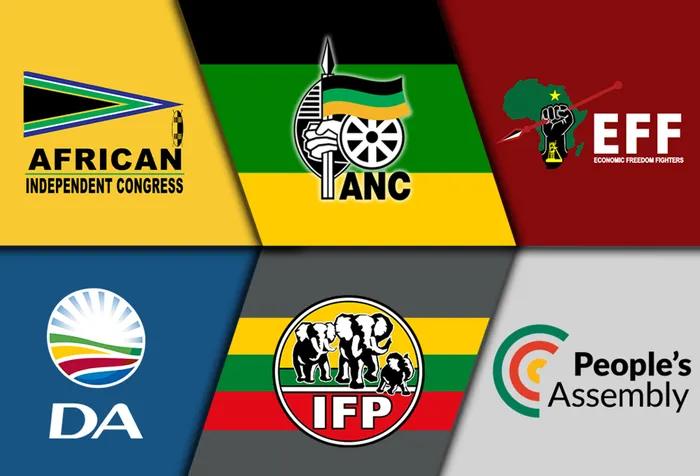
In just a few days, South Africans will be going to cast their vote in the local government elections (LGE 2026). Just like the National Elections, local government elections in South Africa take place every five years, just two years after the National Elections. The assumption is that National Elections set the tone for local government elections, and sometimes vice versa. With the nuances and intricacies around service delivery, optics and sentiments, and the ever-escalating rate of unemployment, things can shift very fast. As is the norm with every election, various survey institutions conduct polls to indicate the direction of the shifting sands on the political landscape.
Most surveys have focused on the key metros of Tshwane, Johannesburg and Ekurhuleni in Gauteng, Nelson Mandela Bay in the Eastern Cape, eThekwini in Kwazulu-Natal and Cape Town in the Western Cape. What is emerging from the surveys is the indication that coalition politics will be the order of the day. As politics at local and provincial level are more nuanced, it is unlikely that local government level trends will necessarily replicate prevailing arrangements at national level as per the last national elections of 2024 as we have seen in the Gauteng province which defied the national sentiment.
Polls are a useful instrument in scanning the voter temperature across different demographics, but they do not tell the full story on why black voters choose to vote the way they do. Also, as opposed to entrenching democracy, coalition politics may effectively serve to subvert the power of the black voter.
The temperature of voting patterns in the major Metros
A report by Thompson Reuters indicates that all three of Gauteng’s Metros are likely to fall under coalition arrangements as has been the case since 2016. In Tshwane, the administrative capital, the ANC and the DA who form the backbone of the GNU at national level, have both had their fair share of problems. In 2016, the DA led coalition took over from the ANC, only to lose to a paper-thin arrangement between the ANC, the EFF and Action SA, with Action SA – the new kid on the block – assuming the mayorship in 2024.
As the seat of the Union Buildings, Tshwane is the executive capital of the country. It is also the largest Metropolitan Municipality in the country by land area, but the 5th most populous. A Mark Data survey commissioned by eNCA for the local government elections, places the DA ahead of the ANC at 33,9 % (up from 24,7 % in 2021) with the ANC at 24,9 % (down from 34,31 % in 2021). The EFF is expected to build on its 10,62 % vote registered in 2021 up to 12,3 %.
If, as expected, service delivery is to be the dealbreaker for the Tshwane voters, despite the latest debacle with water challenges, Action SA should improve its fortunes on the 8,9 % in the last election and break into double digits following Nasiphi Moya’s impressive run as Mayor of the ANC, EFF and Action SA aligned coalition. The Metro polled an overall negative sentiment of 18 %, which is the lowest of all major Metropolitan Municipalities, but that being said, water challenges and the cholera outbreaks in Hamanskraal and Bronkhorstspruit may just muddy the waters for various parties at the polls for the Metro come next Wednesday.
It is a given that Johannesburg, the financial capital of South Africa, will be highly contested. Most of the parties have put their best candidates forward to improve their chances of winning the Metro that is undoubtedly the jewel in the crown. It is evident that the DA has raised the stakes by putting the name and the face of their most seasoned and, undisputedly, their most feisty senior party horse in Helen Zille, as their Mayoral candidate on their campaign posters. The move is meant to send a clear signal to big business and to the residents of Johannesburg that the DA is serious. Gogo Zille has not wasted time; she was quick off her campaign blocks, skidding in drag race cars to connect with youthful voters and to show she is not too old for the job.
With the highest population density of all the Metros, Johannesburg commands such importance that even businessman and leader of Action SA, and former Mayor of Johannesburg, Herman Mashaba has put up his hand to vie again for the Mayoral hat. The EFF has roped in renown health rights advocate, Dr Tlaleng Mofokeng, to bolster their fortunes. The ANC had touted the respectable name of Rev Frank Chikane for the Johannesburg Mayorship but internal political wranglings have put paid to that, and the ANC has had to forego putting faces of individual candidates on their campaign posters and rely on Ramaphosa’s face. It is no longer 1994, and voters are no longer prepared to hand parties a blank cheque, and this may prove costly for the ANC come the 4th of November.
The Reuters report places the DA at 30 % (up from 26,47 % in 2021) ahead of the ANC which is predicted to decline to 20 % (down from 32,34 % in 2021). The Mark Data survey places the MKP at 12,5 %, followed by the EFF at 11,9 % and Action SA at 10,3 %. In Nelson Mandela Bay, the polls show DA neck and neck with the ANC at 37,7 % and 37,4 % respectively. In the Western Cape, the DA is expected to emerge with an outright majority at 52,6 %, with the ANC posting a low 23,6 %, the EFF a distant 6,5 % and the PA at 4,9 %.
eThekwini has the 4th highest ranking of the population. According to the Mark Data survey the MKP is expected to continue where it left off in the National elections in 2024. It is expected to win 48% of the LGE vote, way ahead of the DA at 25,2 %, with the ANC predicted to only scrape a paltry 14,5 % of the vote and the IFP at 6%. Other punters expect the MKP to win an outright majority. Overall voters polled a negative sentiment of 22 % for the Metro.
The emergence of coalition politics on the South African political landscape
The phenomenon of coalition politics emerged on the South African political landscape in 2016. The momentum of the phenomenon continued to intensify and solidify in 2021. According to the MISTRA Coalitions Barometer 2021-2023, “The 2021 elections (LGE2021) were characterised by an unprecedented number of hung municipalities, which had risen from 27 in the preceding 2016 local elections (LGE 2016) to a record approximately 70 hung metropolitan and local municipalities across South Africa’s nine provinces.” The MISTRA Coalitions Barometer attributes the phenomenon of coalitions to general party-political transitions in SA politics.
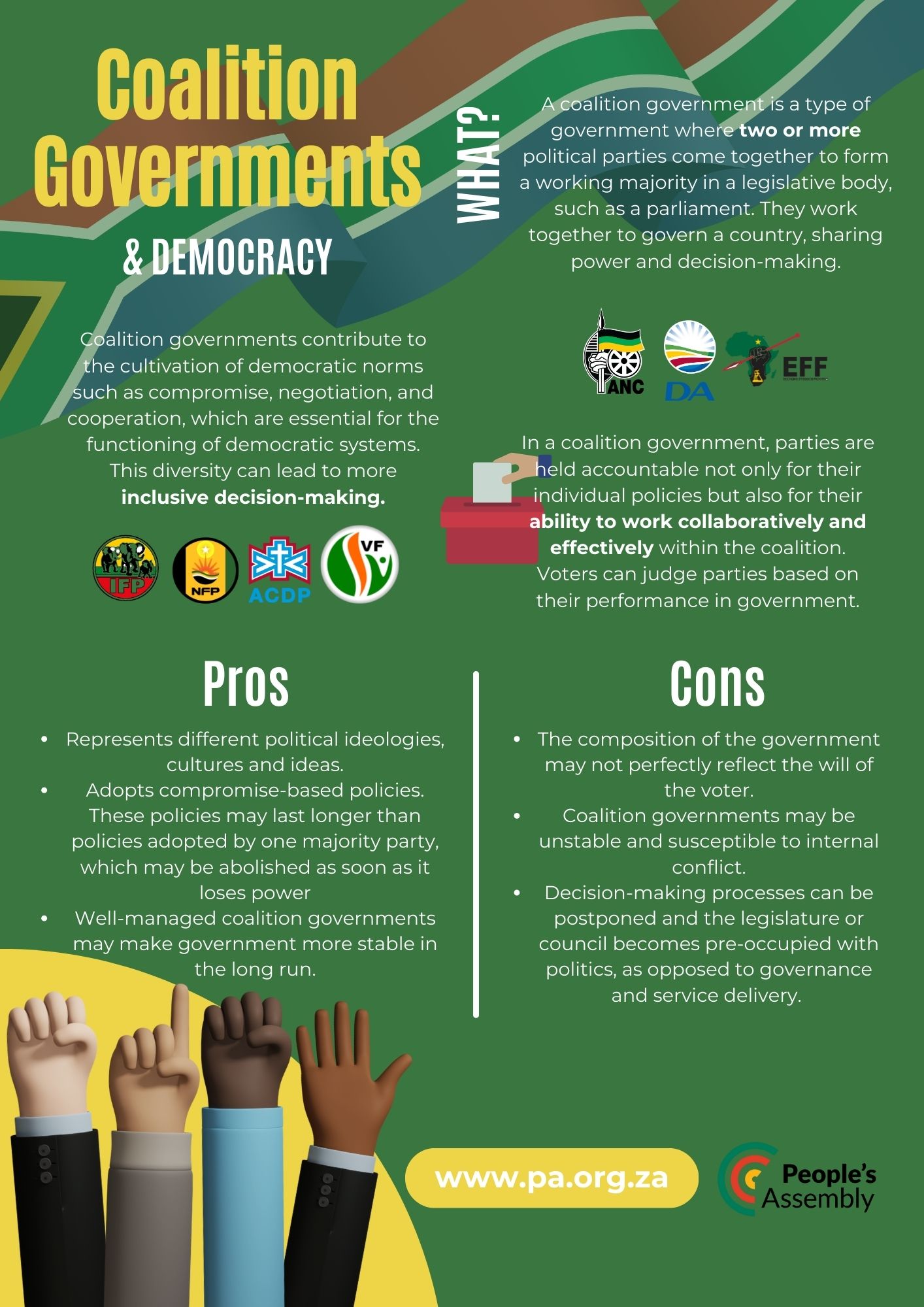
In the 2024 national elections, for the first time, the ANC lost its outright majority to govern and was forced to go into a coalition arrangement and chose the DA as its major coalition partner. To soften the shockwaves of the bizarre coalition arrangement, the PR machine of the behind-the-scenes suitors of the former liberation movement went on overdrive to reposition the optics of the alien coalition arrangements between a former liberation movement and a historically colonial party under the misnomer of the government of national unity (GNU). Mainstream media outlets went full blast to endorse the GNU as a reflection of the will of the South African voters. More tellingly, it was explained away as an arrangement that was responsive to market sentiments.
Taking the votes garnered by the ANC at 40,18 % of the national vote, together with the EFF (an ANC offshoot) at 9,5 % and the MKP (an ANC breakaway) at 14,58 % accounts for a total of 64,26 % which was more than enough to form a coalition government and just shy of a two-thirds majority. The three parties are not lumped together for the simple reason that they are black, they are lumped together as a block as they come from the same struggle tradition and on paper stand for the same things. At a provincial level, the ANC opted to form a coalition government with the DA, the IFP and the NFP to deny the MKP the KZN throne. It is as clear as day that more than 300 years of colonial dispossession and Apartheid segregation has nothing on the distrust and divisions between black parties.
With party politics at play, Coalition arrangements are very volatile and often compromise functionality. Also, the need to leverage power and resources makes Coalition arrangements often vulnerable to ‘coalition-crossing.’ Service delivery in Tshwane has largely been compromised by political horse trading by Coalition alliances. In the last ten years, Johannesburg has gone through eight mayors, six of which are directly attributable to Coalition instability in the Metro.
Continuation of the classic case of divide and rule
There are some who hold the view that the emergence of coalitions on the South African political landscape is a signal of the maturation of our democracy. If anything, the architects of coalition politics understand their impact on black politics more than even the black parties realise, unless they are in on the grand scheme. Far from entrenching democracy, they are meant to undermine the power of the black vote. Coalition politics are meant to dilute the power of majoritarianism. It is for this reason that by and large, white money has been used to fund the emergence of the likes of Action SA, Rise Mzansi and Build One South Africa.
In 2026, a total of 546 parties will be contesting in LGE 2026. This is a whopping 68 % increase from the 325 parties that contested the 2021 LGE. Whilst some may argue this is democracy in action; it is evident that this phenomenon is driven to spread the black vote thin and render it powerless. We do not see the phenomenon replicated with white parties. Whites have been in power since 1652 and understand the power of money, the power of politics, and the power of the vote. The searing divisions of the black parties do not primarily stem from differences in policies or principles, but rather from the agenda of their funders. It is a classic case of divide and rule.
Elected representatives, both at Parliament and the provincial legislatures are quick to remind everyone that they serve at the behest of the mandate of the electorate, yet their actions are more often at variance with the will of the people. The performance of the parties at the Parliament Adhoc Committee probing the allegations by lieutenant General Mkhwanazi leaves much to be desired with all parties pulling in different directions. In comparison to the proceedings at the Madlanga Commission, they have been exposed. One is left wondering whose interests do these many parties in parliament actually serve? But then again, in politics, funder’s money rules the roost, not the voters mandate or the clichéd people’s interest.
The electorate vote on optics and sentiments and not necessarily on principles
The electorate vote on optics and sentiments. The gen-z (those eligible to vote), attended multiracial or private schools, wherein white culture reigns supreme. Once they graduate, they enter a predominantly white corporate culture, wherein whites still decide whether they have a career or not. Whites control the economy and everything including politics turns on it. Are we to be surprised that the young ones who know very little about Biko or Sobukwe vote for the DA? It is their careers, and their personal well-being that will first influence their voting decisions and not so much political or struggle history.
On the other hand, those who choose to go the public sector route know better to toe the line as the Comrades wield the power. Human beings are naturally wired for survival; with the high rate of youth unemployment figures at 46,7 %, sentiments around which party is likely to unlock unemployment, even if its temporary youth services may just steal the youth vote before any grudge with service delivery stands in their way.
These are subtle yet powerful optics that play on the subconscious mind and seasoned campaigner, Gogo Zille, knows this all too well. With LGE 2026, on paper, service delivery should be a deal breaker, but other subtle factors and personal interest may very well be the reason voters choose to vote the way they do. In the end each voter will have to make value judgments; a clean neighbourhood street and drinkable water or healthy personal balance sheet? Ordinarily, in a healthy democracy, these are not mutually exclusive and there should not be any trade-offs. In the end, it is your vote that will influence who governs your metro beyond next week Wednesday.
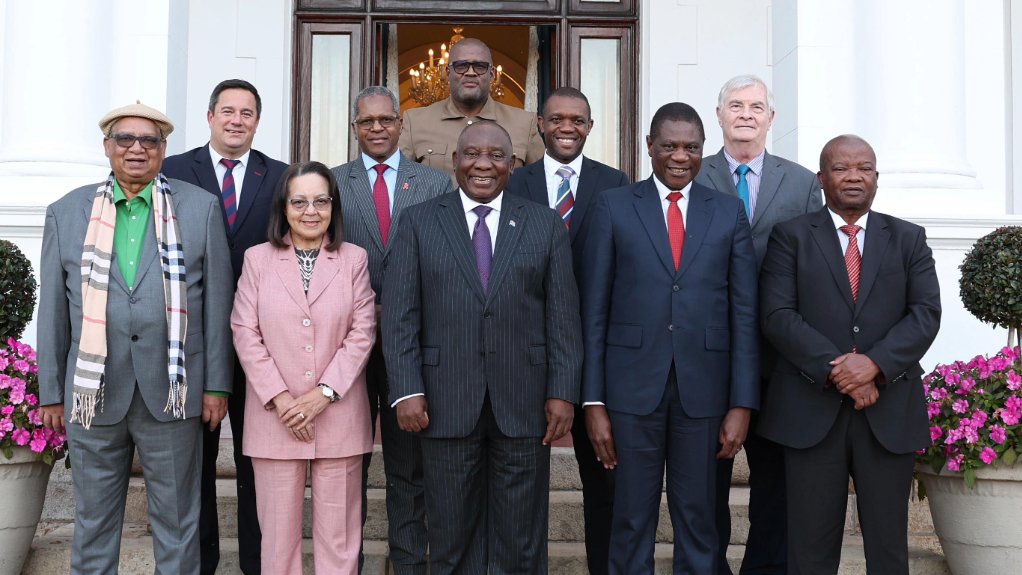
COALITION MIX: A picture of South Africa’s current coalition leadership that forms the Government of National Unity


One Response
Wow what a powerful message that needs to be shared with the voters definitely those close to me will know thanks Bro Sipho much appreciated long time hope to see you soon.